For a small veterinary laboratory, a Shaking Incubator purchase should proceed only after the supplier documents site requirements, staff handover, cleaning ownership, replacement parts, and service coverage. Unlike a static Laboratory Incubator, a shaking incubator combines controlled incubation conditions with programmed motion, so its staffing and support burden can matter as much as chamber capacity.
A shaking incubator is a Laboratory Incubator that maintains a controlled incubation environment while moving samples on an internal platform or tray. In veterinary settings, that capability may support laboratory workflows involving cultures or other sample-preparation processes, but the intended workflow should be confirmed before selecting chamber size, motion settings, or service coverage.
What documentation should a small lab request before buying a Shaking Incubator?
A Shaking Incubator quotation is not enough for a purchasing decision unless it identifies the exact model, included configuration, installation requirements, and post-sale responsibilities.
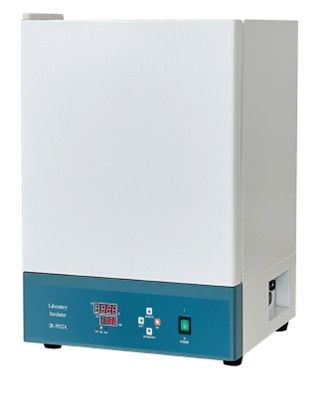
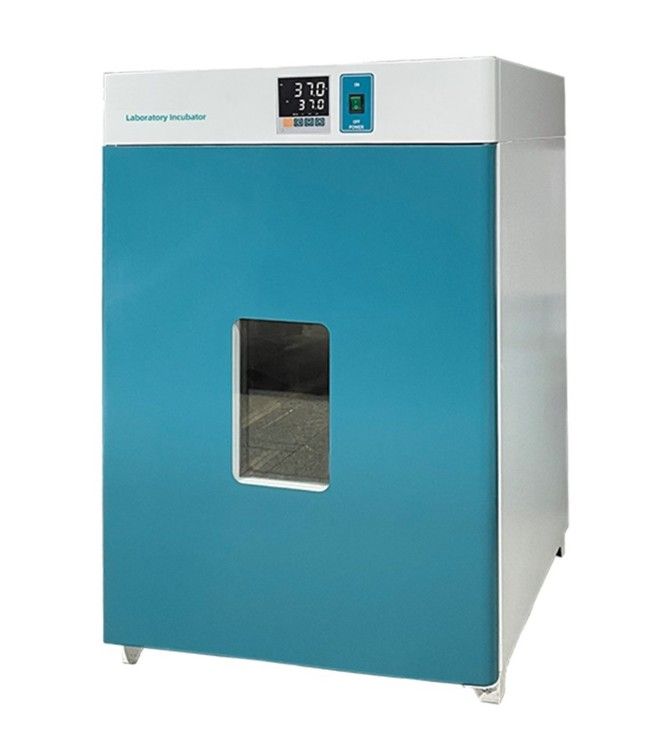
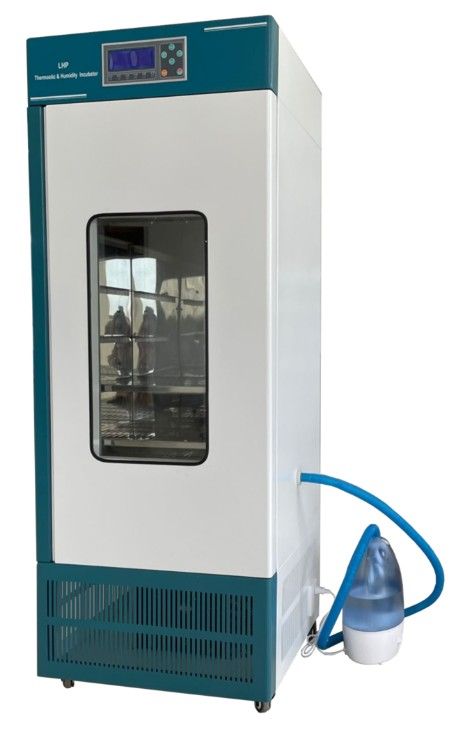
No Shaking Incubator model specification, user manual, certification file, price list, service agreement, or spare-parts schedule was supplied for this review. The available manufacturer-supplied materials cover static biochemical incubators and dry ovens, not incubators with documented shaking functions. Those materials can help a buyer compare basic chamber and electrical information, but they should not be treated as evidence that a listed incubator includes orbital, reciprocal, or other shaking motion.
- Request a model-specific data sheet that identifies chamber capacity, motion type, motion range, speed range, load limit, timer functions, and temperature range.
- Ask for the installation drawing, packed dimensions, net weight, electrical requirements, ventilation-clearance requirements, and any site conditions that could affect placement.
- Require a written list of included shelves, clamps, trays, platforms, adapters, power cords, software, and optional accessories.
- Ask whether commissioning, staff orientation, cleaning guidance, preventive-maintenance scheduling, and repair support are included or quoted separately.
- Request the documents relevant to the importing jurisdiction, including the manufacturer identity, model designation, electrical documentation, and available certifications.

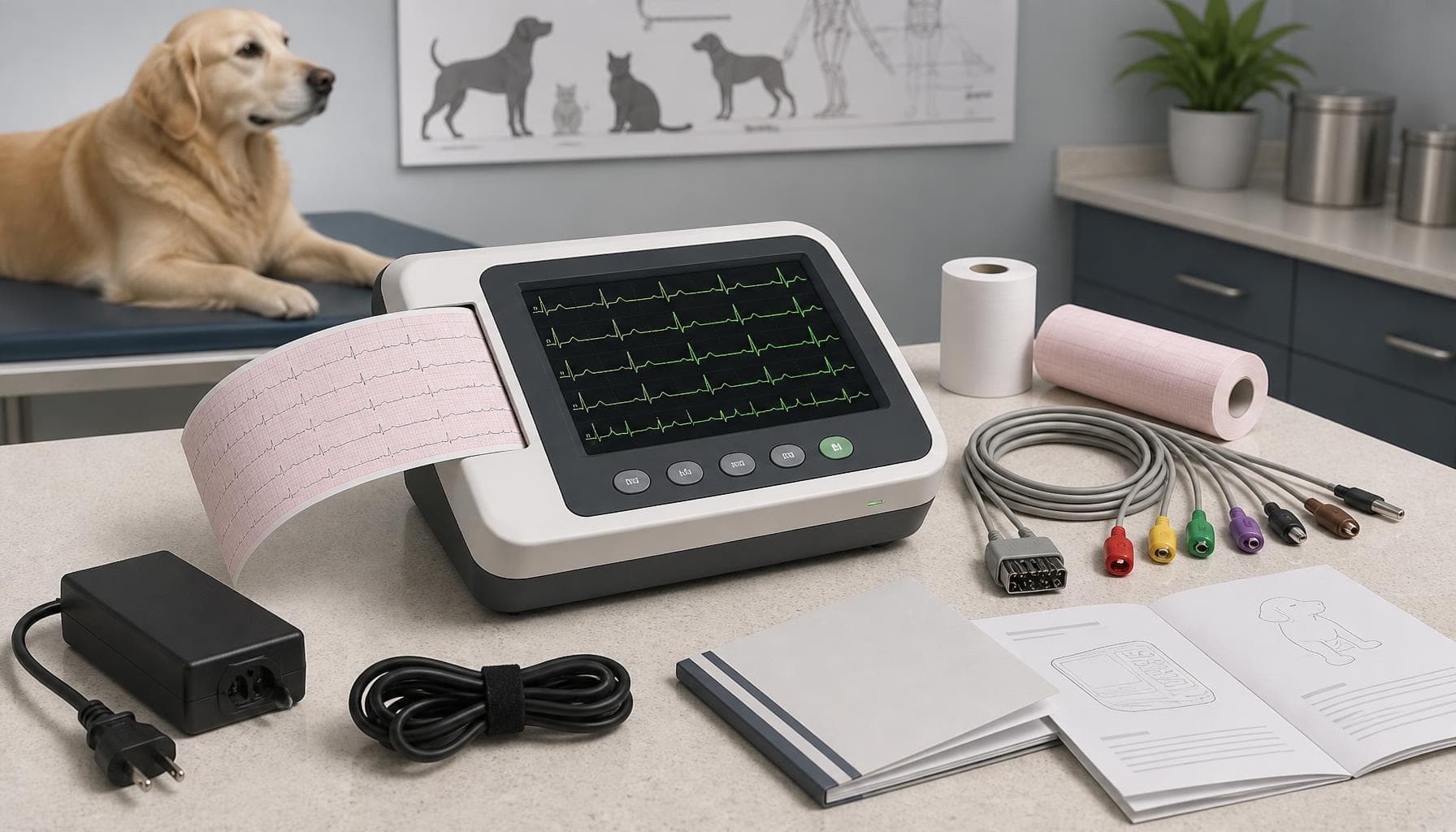
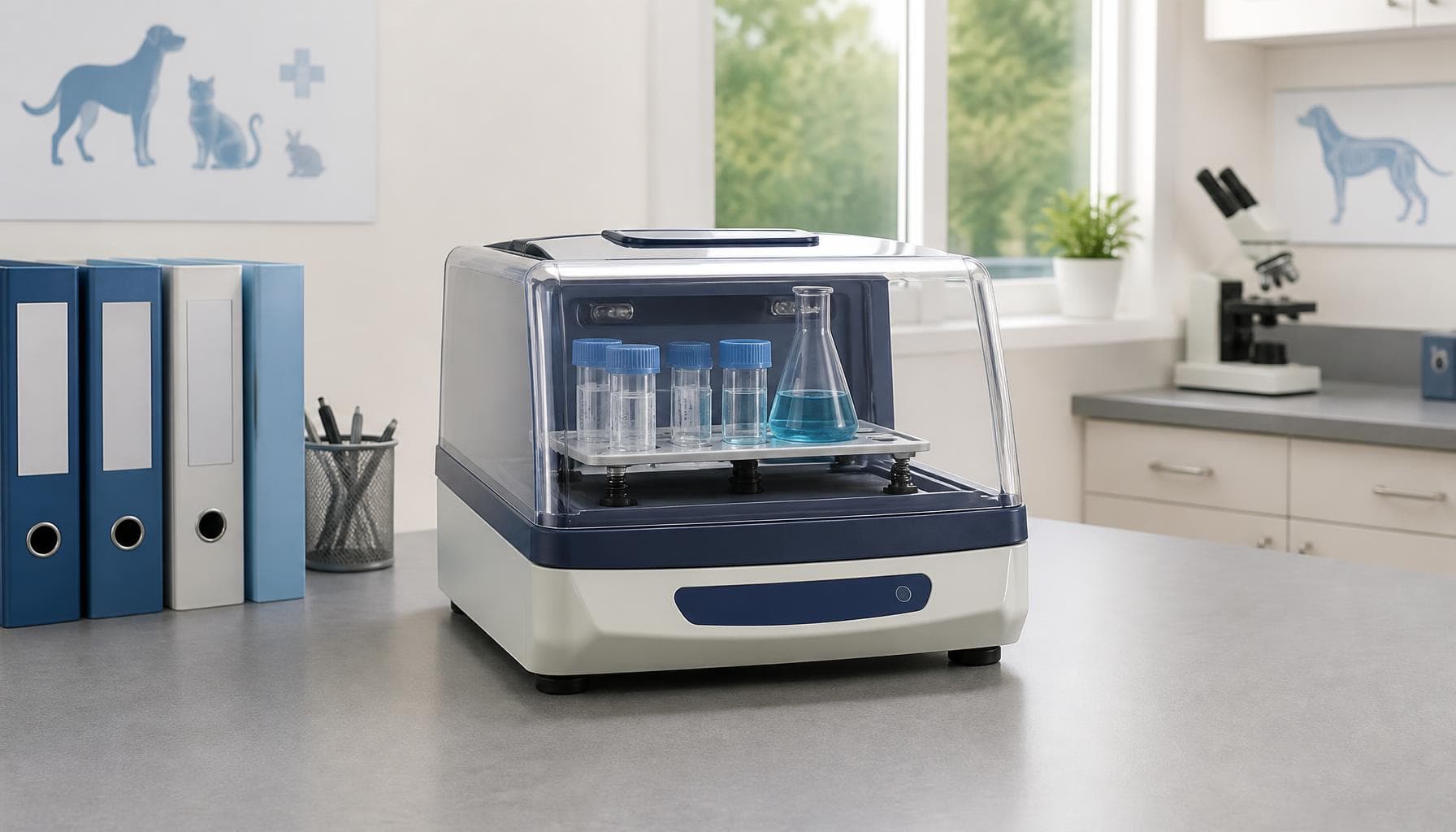
AI-generated illustration for procurement planning; it does not depict a specific model, installation, or verified performance result.
How should staffing affect a Shaking Incubator purchase for a veterinary lab?
A Shaking Incubator should fit the staff structure that will receive deliveries, manage routine cleaning, document service, and coordinate repairs—not only the laboratory’s expected sample volume.
In a small companion-animal practice with a limited in-house laboratory, one person may handle receiving, documentation, cleaning coordination, and contact with the distributor. In that setting, a simpler configuration with clear ownership of training and service may be more practical than a feature-heavy unit with unclear support terms.
A referral hospital, equine hospital, or mixed-animal facility may have more laboratory staff, but it may also have more users across shifts and more complex responsibility boundaries. For those sites, purchasing teams should establish who can authorize service visits, who keeps maintenance records, who orders replacement accessories, and who receives training when staff change.
Supplier training should be defined as a deliverable rather than assumed to be part of installation. The purchase order can specify the training format, the number of attendees, whether training covers the supplied accessories, and whether updated documentation is available for future hires. Without a model-specific manual, a buyer should not assume that cleaning procedures, alarms, calibration responsibilities, or replacement intervals are the same across models.
What Shaking Incubator site and installation questions belong in the purchase order?
A Shaking Incubator installation review should confirm physical access, electrical compatibility, bench or floor support, and service clearance before the equipment is shipped.
Motion adds a procurement question that does not apply in the same way to a static incubator: the supplier should state the approved installation surface, maximum operating load, and any restrictions on placement. A chamber that fits on a bench may still be unsuitable if the bench, nearby equipment, or room layout does not meet the manufacturer’s requirements.
- Confirm the exact voltage, frequency, plug type, power consumption, and whether the unit requires a dedicated electrical circuit.
- Provide the supplier with the intended bench or floor location and ask for written confirmation of required clearances and permitted placement conditions.
- Verify delivery-route constraints, including door widths, elevators, corridors, unloading arrangements, and whether the unit ships assembled or requires on-site assembly.
- Ask whether installation includes unpacking, positioning, accessory fitting, initial inspection, and removal of packaging materials.
- Confirm who is responsible if the delivered unit cannot be placed at the planned location because site dimensions or utility requirements were not documented.
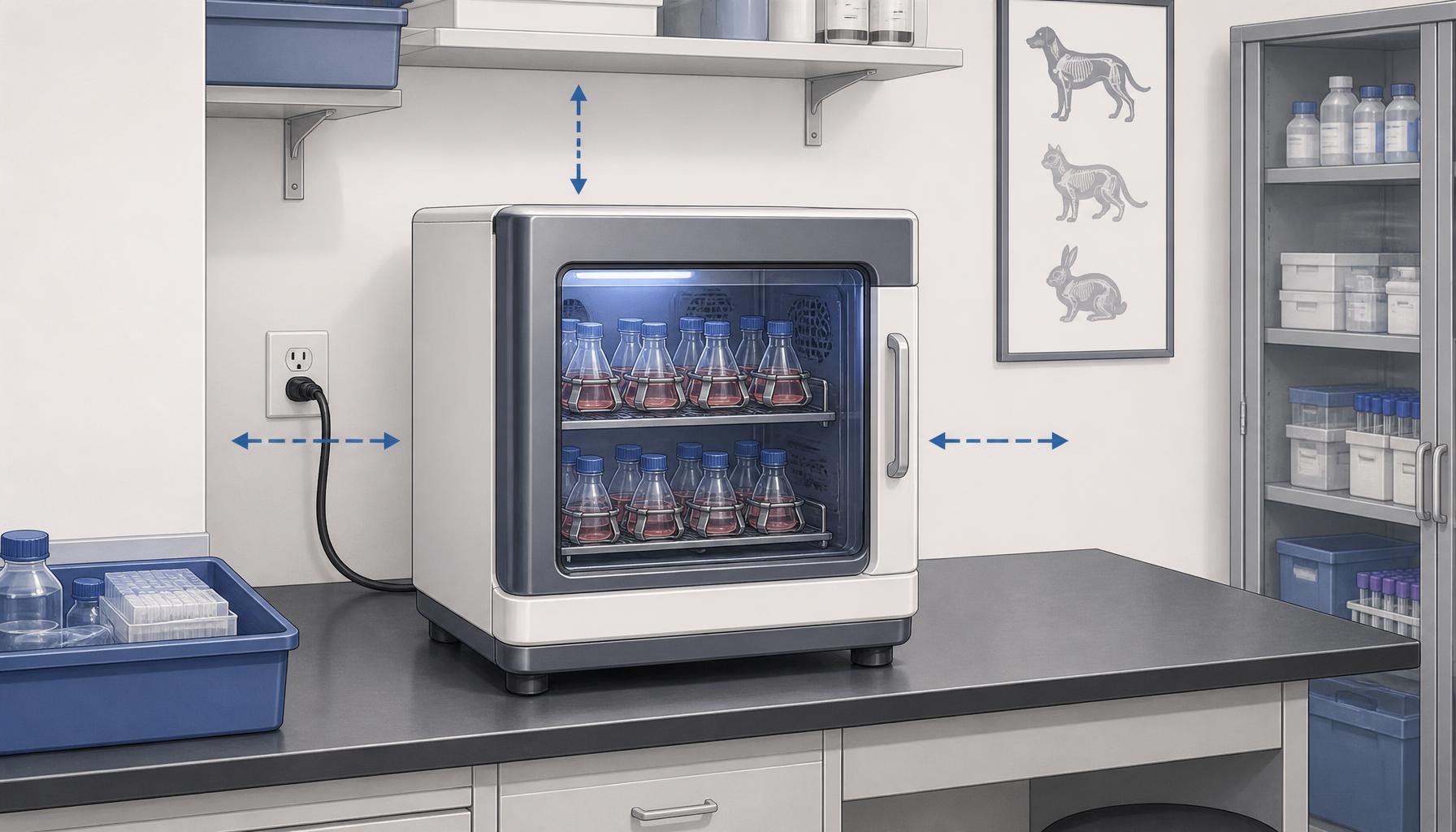
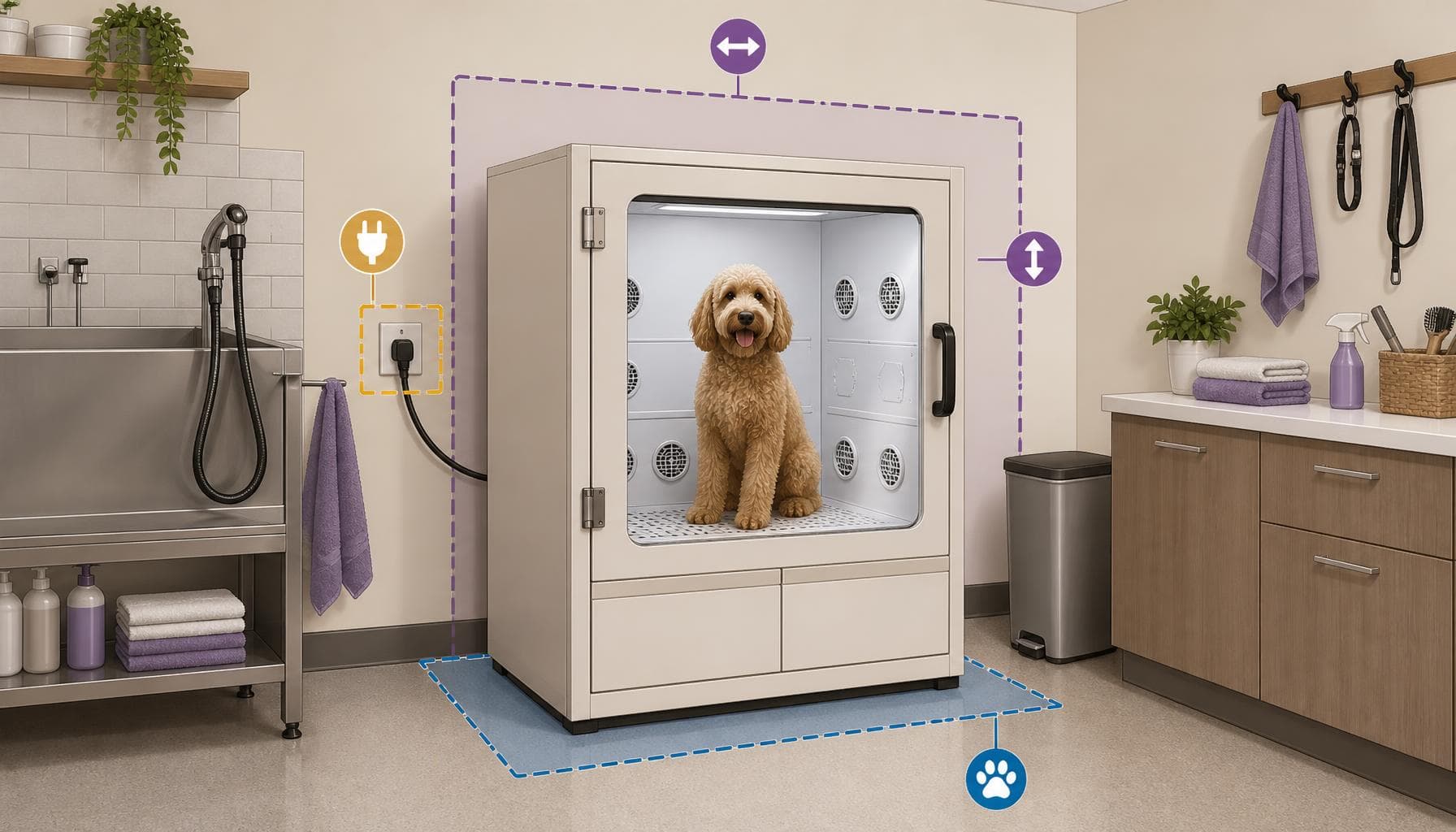
AI-generated illustration showing a planning concept only; final placement requirements must come from the selected model’s manufacturer documentation.
Can a biochemical incubator replace a Shaking Incubator?
A documented biochemical incubator should not be purchased as a Shaking Incubator unless the supplier provides model-specific evidence of an integrated shaking mechanism and its operating specifications.
The available manufacturer-supplied information describes the SPX biochemical incubator range as temperature-controlled equipment with stainless-steel interiors, door locks, glass doors, alarms, timers, and optional interior sockets for BOD culture. The supplied data does not describe shaking motion, platform type, speed range, motion range, or load capacity.
| Documented model | Capacity (L) | Temperature range (°C) | Electrical supply | Documented shaking function | Confirm with supplier |
| SPX-50B Biochemical Incubator | 50 | 5–60 | 220V, 50Hz | Not stated in supplied material | Whether any compatible shaking accessory exists; motion specifications; accessory pricing; service coverage |
| SPX-80B Biochemical Incubator | 80 | 5–60 | 220V, 50Hz | Not stated in supplied material | Whether any compatible shaking accessory exists; available internal socket configuration; service coverage |
| SPX-150B Biochemical Incubator | 186 | 5–60 | 220V, 50Hz | Not stated in supplied material | Whether any compatible shaking accessory exists; delivery access; installation responsibility |
| SPX-250B Biochemical Incubator | 250 | 5–60 | 220V, 50Hz | Not stated in supplied material | Whether any compatible shaking accessory exists; site requirements; maintenance and parts terms |
The SPX-50B and SPX-80B documentation lists an optional interior socket for BOD culture. That option should not be interpreted as evidence of shaking capability. Buyers evaluating a static incubation workflow can compare these units as biochemical incubators, while buyers requiring sample motion should obtain specifications for a dedicated shaking configuration.
Which Shaking Incubator maintenance, cleaning, and parts questions should be answered before purchase?
A Shaking Incubator purchase should identify who owns cleaning, preventive maintenance, warranty communication, and replacement-parts procurement before the unit arrives.
For a small laboratory, the cost of ownership may depend less on the cabinet itself than on whether the distributor can supply wear items, replacement platforms, clamps, trays, seals, fuses, motors, control components, and other model-specific parts. The purchaser should ask for a parts list and expected availability rather than relying on general statements about after-sales service.
- Ask which cleaning tasks are expected from laboratory staff and which require a service provider under the manufacturer’s instructions.
- Request the recommended preventive-maintenance schedule and identify whether visits are included during the warranty period.
- Confirm whether the supplier stocks critical replacement parts locally, ships them internationally, or requires factory approval before ordering.
- Ask for written warranty exclusions related to accessories, loading, cleaning agents, transport damage, electrical supply, and unauthorized service.
- Clarify the service-response process, including the contact route, remote-support availability, service territory, labor charges, travel charges, and loan-unit policy if offered.

AI-generated illustration for service-planning context; it does not represent an actual maintenance procedure or a supplier’s contractual terms.
What should a Shaking Incubator quotation include for import and service approval?
A Shaking Incubator quotation should be accepted only after commercial, technical, import, and support documents refer to the same exact model and configuration.
Import documentation requirements vary by destination, electrical system, distributor arrangement, and intended use. Procurement teams should ask the seller which documents are available for the quoted model and should have the importing party or local compliance adviser review whether those documents are sufficient before payment or shipment.
A useful quotation package should identify the model code, serial-number process, country of origin, delivery terms, warranty period, included accessories, excluded accessories, installation scope, training scope, available certifications, service contact, spare-parts ordering process, and documentation language. If the seller offers a substitute model after ordering, require written confirmation that the replacement has the same documented electrical, installation, and support terms.
For structured comparisons across several vendors, the equipment comparison worksheet can help keep site requirements, service terms, included accessories, and documentation requests attached to each quoted model. The product documentation resource is also useful when purchasing teams need to organize manuals, certificates, and supplier declarations before import approval.
When is a Shaking Incubator a reasonable purchase for a small veterinary laboratory?
A Shaking Incubator is a reasonable purchase when the laboratory has a defined workflow that requires controlled incubation with motion and the supplier can document installation, training, cleaning responsibilities, parts access, and service support for the exact configuration.
If the workflow only requires static temperature-controlled incubation, a biochemical incubator may be the more appropriate Laboratory Incubator category to evaluate. If motion is required, do not substitute a static model based on chamber capacity, glass-door design, timer functions, or optional internal sockets alone. The purchasing decision should remain conditional until the supplier provides the missing model-specific motion, installation, service, and import documentation.