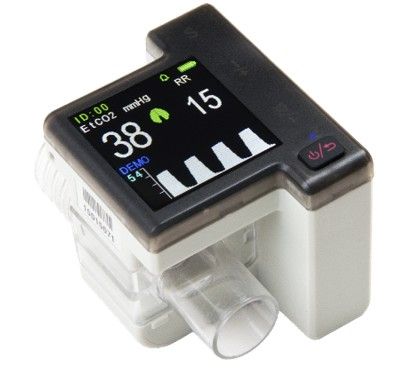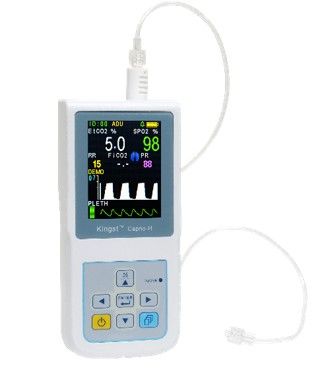
Portable capnographs are purchased to bring EtCO2, inspired CO2, and respiratory-rate information closer to the point of care. In veterinary practice, that can matter during anesthesia, recovery, transport, emergency stabilization, and procedures performed outside a fully equipped operating room. For buyers, however, the useful question is not simply whether a unit displays EtCO2. It is whether the quoted configuration can be imported, supported, cleaned, supplied with compatible consumables, and kept in service by the clinic.
This guide compares the two HQS handheld veterinary capnographs, Capno-H and Capno-T, and lists the questions to settle in the quotation. Operating, calibration, alarm-management, and repair procedures belong to each model’s instructions for use and service documentation, which should be requested with the quote.
Capno-H and Capno-T: HQS Portable Capnograph Models
HQS publishes specifications for the Capno-H handheld capnograph monitor and the Capno-T portable capnograph monitor. These product pages are useful for comparing published monitoring functions, power arrangements, environmental limits, and included or optional components.
Import documents, instructions for use, service manuals, and pricing are handled at quotation stage. Requirements differ by destination market, so ask HQS to confirm in writing which documents apply to the exact configuration offered.
For a clinic purchasing an EtCO2 Monitor as part of a broader monitoring plan, the related veterinary patient monitor category may also be relevant. The procurement decision should distinguish between a stand-alone portable capnograph and a multiparameter monitor with integrated CO2 capability, because the consumable chain, service contract, and responsibility for accessories may differ.

Capno-H and Capno-T Specifications: Monitoring, Display and Power
The published data support a narrow but useful conclusion: both listed models are intended for portable breath-by-breath CO2 monitoring and provide a documented CO2 measurement range of 0–150 mmHg, selectable mmHg, kPa, or percentage units, 24-hour trend storage, and audible and visual alarms.
The Capno-H documentation lists EtCO2/CO2 and respiration-rate monitoring as the base configuration. SpO2 and pulse monitoring are optional. That distinction matters at quotation stage: a purchaser should not assume that a displayed SpO2 feature is included unless the quotation identifies the sensor and extension cable.
The Capno-H product page also lists a 2.8-inch color TFT display, a rechargeable 3.6 V / 3800 mAh battery, AC input of 100–250 V at 50/60 Hz, IPX32 ingress protection, and an operating environment of 5–40 °C, 30–75% non-condensing relative humidity, and 55–115 kPa atmospheric pressure.
The Capno-T documentation lists a 1.5-inch color TFT display, rechargeable 3.7 V / 1.35 Ah battery, AC 220 V / 50 Hz power, IPX33 ingress protection, and an operating environment of 5–40 °C, 30–75% non-condensing relative humidity, and 86–106 kPa atmospheric pressure. HQS also states a battery working time of 6–8 hours after a full charge.
These differences have practical purchasing implications. A clinic using a standard 100–250 V power environment may find the Capno-H power specification easier to assess against local electrical supply. A buyer considering the Capno-T should request confirmation of the supplied charger, plug type, input compatibility, and local electrical suitability rather than treating “AC220V 50Hz” as a minor specification detail.
Capno-H vs Capno-T Comparison Table
| Decision point | Capno-H published data | Capno-T published data | What the buyer should confirm |
| Core monitoring | EtCO2/CO2 and respiration rate | EtCO2/CO2 and respiration rate | Whether the quoted unit includes every required monitoring parameter and accessory |
| CO2 measurement range | 0–150 mmHg | 0–150 mmHg | Whether this range and stated accuracy meet the clinic’s intended animal population and protocols |
| EtCO2 update | Every breath | Every breath | Whether display, trend, and alarm functions are supplied in the requested language and configuration |
| Trend storage | 24 hours | 24 hours | Whether data can be reviewed, exported, printed, or retained in the format required by the clinic |
| Optional parameters | SpO2 and pulse monitoring are optional | Not listed on the product page; confirm with HQS | Exact sensor type, extension cable, patient-size suitability, and replacement availability |
| Power input | AC 100–250 V, 50/60 Hz; consumption ≤5 VA | AC 220 V, 50 Hz; consumption ≤10 VA | Charger input, plug standard, spare charger availability, and local electrical compatibility |
| Battery information | Rechargeable 3.6 V / 3800 mAh lithium battery | Rechargeable 3.7 V / 1.35 Ah lithium battery; published working time 6–8 hours after full charge | Whether battery replacement is user-accessible, supplier-only, locally stocked, or subject to transport restrictions |
| Ingress protection | IPX32 | IPX33 | How the manufacturer’s stated protection aligns with the intended transport, recovery, and cleaning environment |
| Import documents | Confirm for the quoted configuration | Confirm for the quoted configuration | Model-specific conformity and import documentation required for the intended market |
The published specifications should not be used to declare one model universally better. They help identify the questions that can change the purchase decision. Display size, power input, optional parameter scope, battery arrangement, and protective rating are more actionable procurement distinctions than generic claims of portability.
What to Request in a Capno-H or Capno-T Quotation
A quotation should identify more than the monitor body. A portable capnograph is a system that may include patient-interface parts, power accessories, software or language configuration, and service arrangements. Request a written bill of materials tied to the model and serial-number range being offered.
Ask for import and conformity documents before placing the order
- Request the model-specific EU Declaration of Conformity and the applicable CE documentation for the exact device and accessory configuration offered for import.
- For the United States, ask the supplier to identify the FDA regulatory basis applicable to the exact model, including any relevant clearance, exemption, registration, listing, or import documentation.
- Request copies of the product label, instructions for use, manufacturer legal entity details, country of origin, and intended-use statement that will accompany the shipment.
- Confirm whether the supplied sampling accessories, SpO2 sensors, chargers, and replacement batteries are covered by the same documentation or require separate documentation.
Conformity paperwork should match the exact model, intended market, manufacturer identity, and shipped configuration. If a distributor is involved, clarify whether the distributor or HQS will provide the documents needed by the importer and local regulatory authority.
Define the consumable package
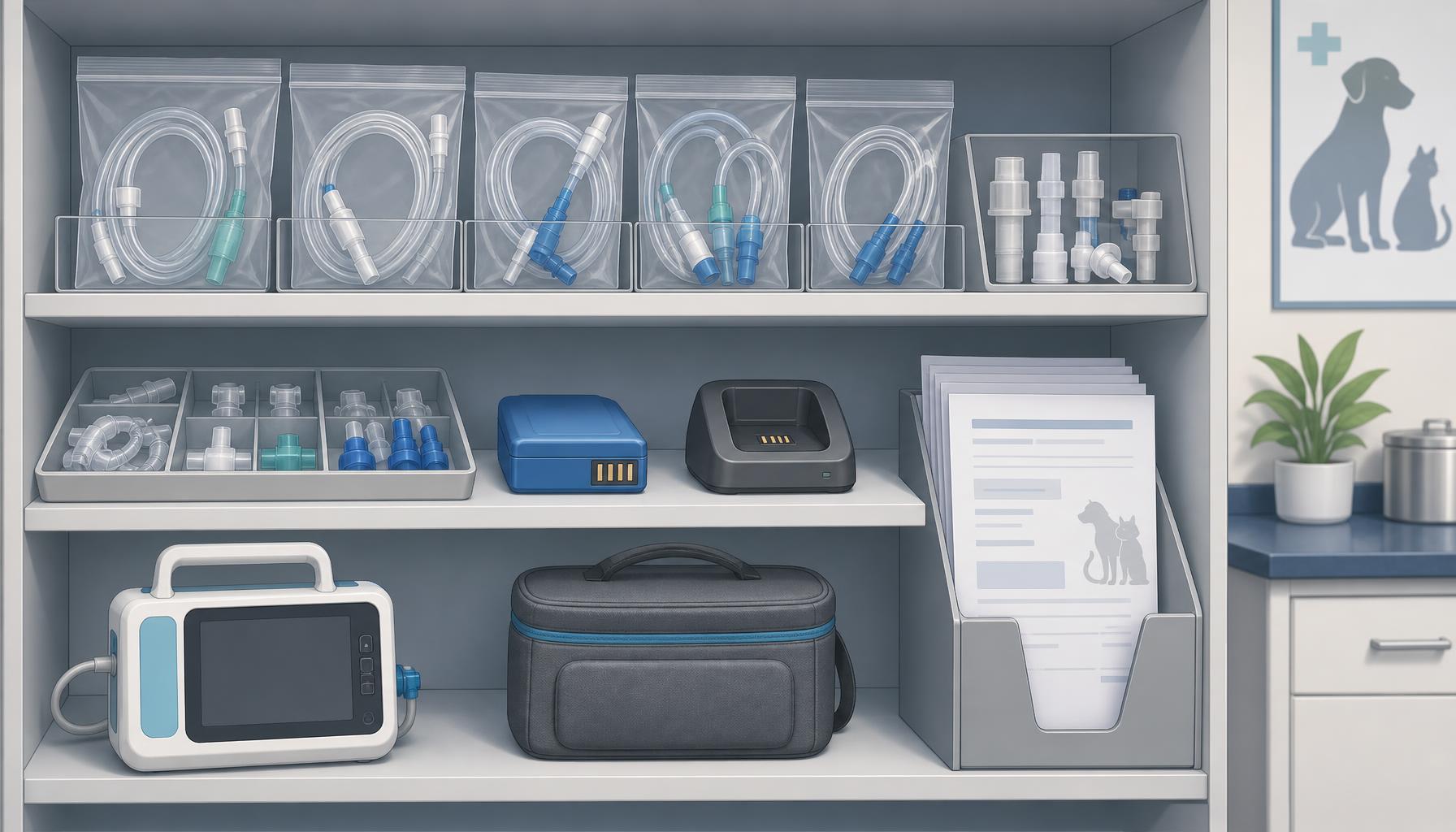
The Capno-H product page specifically advises buyers to confirm the supplied sampling adapter, sampling line, charger, battery, and replacement consumables. This should be expanded into a line-item schedule. Ask whether adult, pediatric, feline, equine, or other patient-interface options are available only where the supplier’s documentation supports those claims. Do not assume that an adult adapter included with the monitor makes the device ready for every species treated by the clinic.
- List every sampling line, adapter, water-management component, airway adapter, and sensor included in the initial shipment.
- Ask for manufacturer part numbers, minimum order quantities, shelf-life information where applicable, and the supplier’s process for identifying compatible replacements.
- Confirm whether consumables are single-patient, reusable, or subject to a stated cleaning process in the model-specific instructions for use.
- Ask which components are routinely stocked locally and which are supplied only by international shipment.
This is especially important when capnography is being purchased alongside an veterinary anesthesia machine. The anesthesia provider, monitor supplier, and purchasing team should agree on the airway-interface components required for the clinic’s intended circuits and patient groups before the purchase order is issued.
Assign cleaning, maintenance, and service responsibility
Cleaning schedules, preventive-maintenance intervals, calibration procedures, repair pathways, and spare-parts lists should come from HQS or its authorized supplier for the exact model, not be improvised by the purchaser.
- Request the current instructions for use and cleaning guidance for the monitor housing, sampling components, sensors, charging equipment, and any reusable accessories.
- Ask who is authorized to perform preventive maintenance, software updates, battery replacement, internal repair, and functional verification.
- Confirm warranty duration, exclusions for consumables and batteries, turnaround expectations, loan-unit availability, and the location of the service center.
- Request a priced spare-parts and consumables list separately from the instrument quotation, even if the clinic does not plan to purchase all items initially.
For a small general-practice surgical room, a portable unit may be selected primarily for one anesthesia station and occasional recovery use. In that setting, a clearly defined starter pack, compatible power arrangement, and practical replacement pathway may be more important than optional multiparameter capability.
For an emergency or mobile service that may move monitoring between treatment areas, transport vehicles, and temporary procedure spaces, procurement should place greater weight on battery support, charger availability, protective limits, accessory inventory, and service logistics. Those are purchasing priorities, not claims that either documented model has been validated for a particular workflow.
Capno-H or Capno-T: Which Portable Capnograph Fits Your Workflow
Both Capno-H and Capno-T are portable EtCO2 monitoring options with breath-by-breath updates, a published 0–150 mmHg CO2 range, 24-hour trends, and audible and visual alarms. Import documentation, local distributor support, cleaning requirements, and long-term service cost depend on the destination and configuration, and should be confirmed with HQS before ordering.
Capno-H warrants closer review where the clinic needs optional SpO2 and pulse monitoring, a larger listed display, or a published AC input range of 100–250 V at 50/60 Hz. Capno-T warrants closer review where its listed 6–8 hour battery working time, 80 g listed net weight, and IPX33 rating are relevant to the intended workflow. In both cases, confirm the shipped configuration in the quotation, since product-page specifications do not define what will be included in each shipment.
The most defensible procurement decision is conditional: proceed only after the supplier provides model-specific import documentation, a complete accessory and consumable schedule, applicable cleaning instructions, a defined warranty and service route, and a clear source for replacement parts. If those documents cannot be supplied before purchase, the apparent portability or feature set should not substitute for an auditable support plan.