A cabinet-style Pet Dryer can help a veterinary practice or pet-care facility manage drying after bathing, grooming, or selected noncritical care activities while reducing the need for continuous hand-held drying. Before purchase, however, the practical question is not simply which cabinet fits an animal. It is whether the unit can be placed, powered, cleaned, serviced, and documented appropriately within the facility.
HQS publishes cabinet dimensions, weight, declared power, fan or outlet counts for some models, and stated animal-size suitability for each VD-U model. Exhaust or moisture-management needs, drainage, cleaning schedules, consumable part numbers, service intervals, and import documents are confirmed per model and destination, so include them in the quotation request rather than assuming them.
HQS VD-U Pet Dryer Models and Listed Features
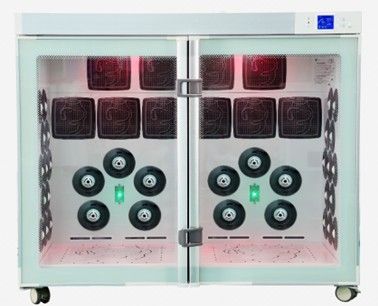
HQS lists five cabinet-style Pet Dryer models: the Pet Dryer VD-U2, VD-U4+, VD-U7, VD-U1D, and VD-U1S. All five are described as cabinet-type dry rooms intended to dry and air-shower pets. Several models are described as having infrared LED, ionizer, oxygen/aroma therapy, and hair-collecting features.
For procurement purposes, the infrared, ionizer, and oxygen/aroma functions should be treated as listed grooming-cabinet features, not as a defined therapeutic capability, and the drying cabinet should not be credited with a clinical oxygen-delivery role. A practice that needs patient oxygen support should evaluate dedicated oxygen concentrators separately.
VD-U Pet Dryer Dimensions, Power and Weight
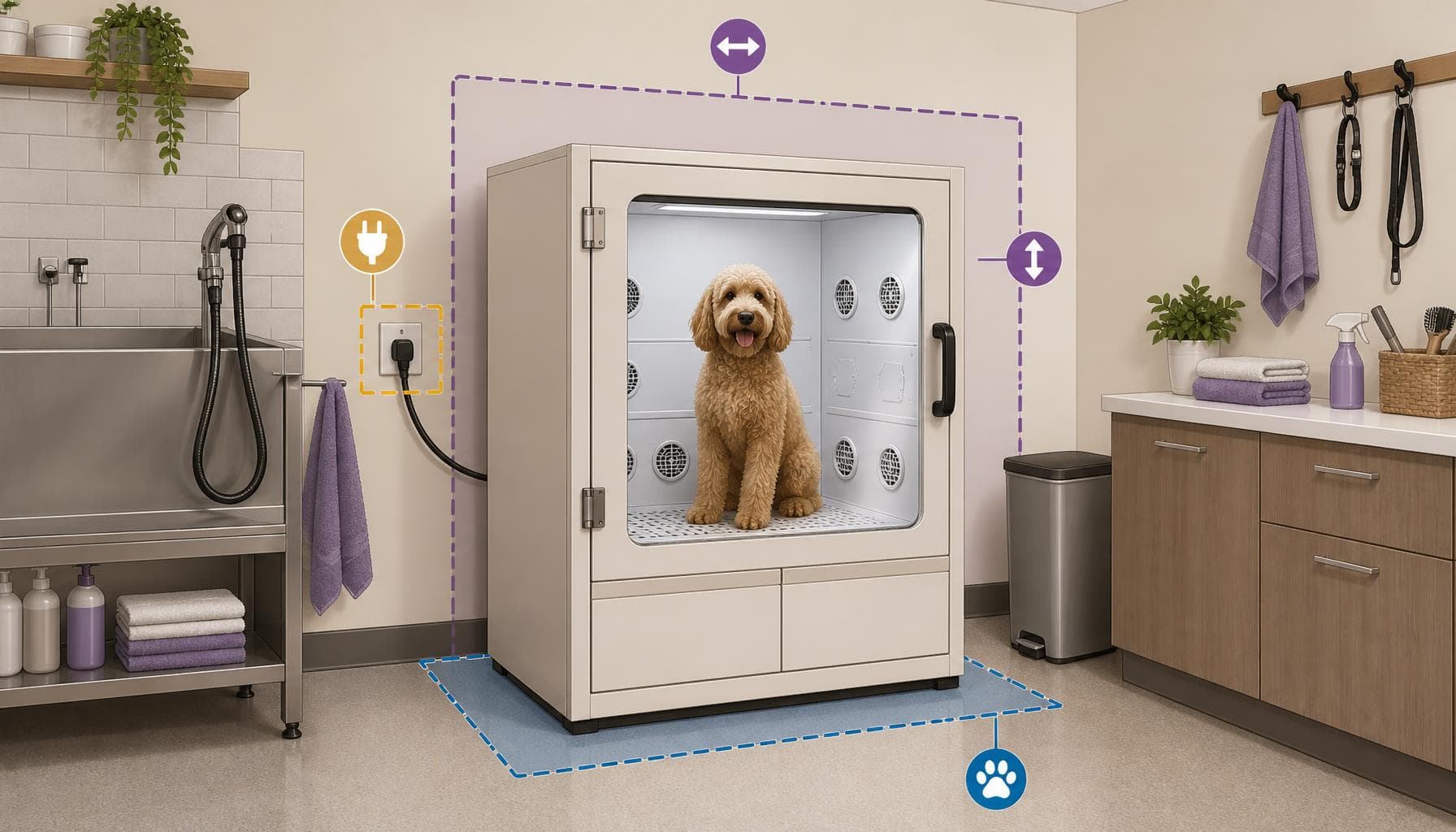
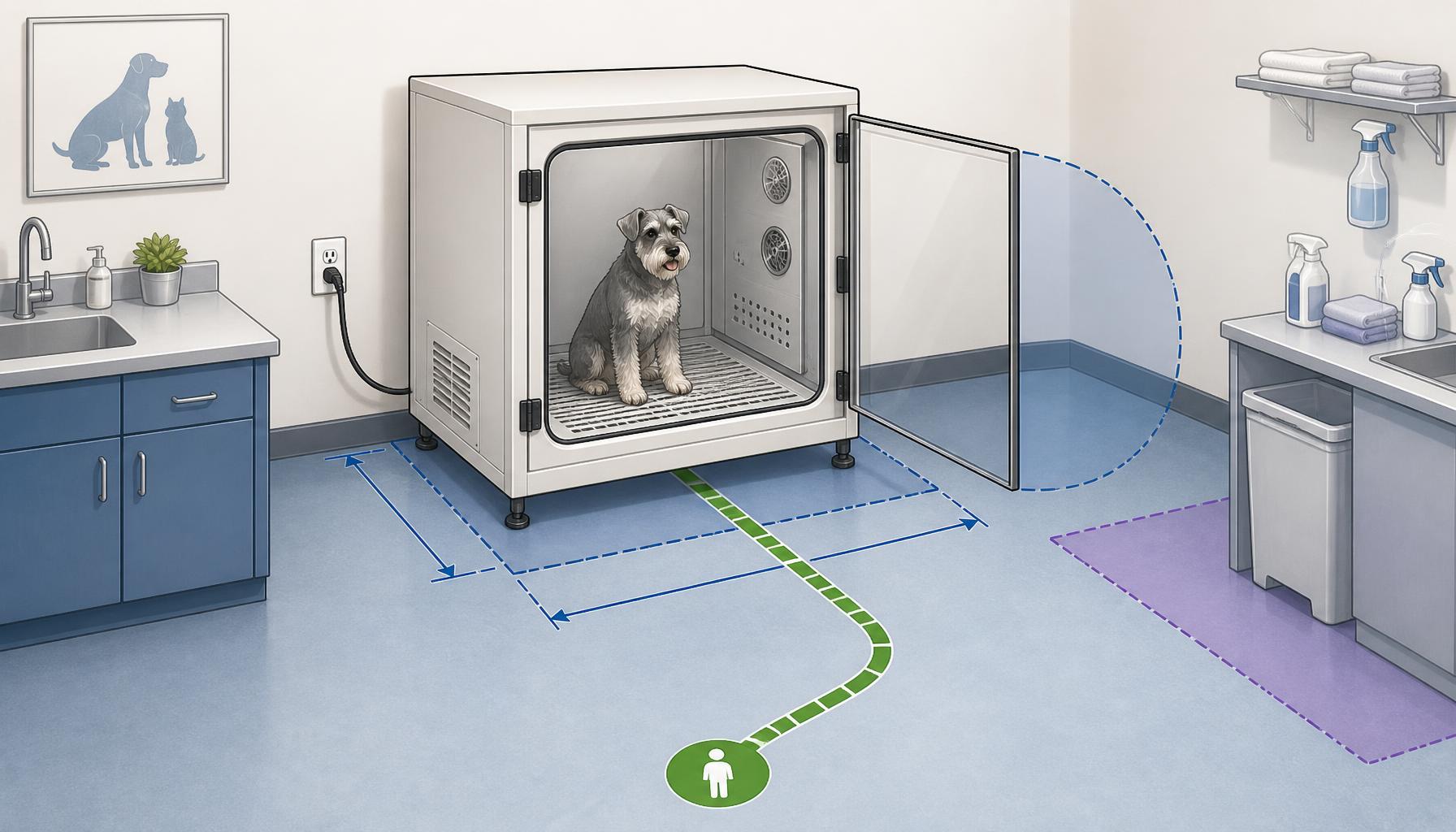
The published dimensions support early space planning, but they are not a complete installation drawing. External dimensions indicate the physical cabinet envelope; they do not establish the clearance needed for doors, cleaning access, power cords, wall spacing, transport through doorways, or maintenance work. A facilities lead should obtain those requirements in writing for the exact model under consideration.
The declared power requirements range from 1,200 W to 2,500 W across the five models, all listed at 220 V. Use these figures to start the electrical review with HQS and the facility electrician, and confirm plug type, circuit rating, cord length, grounding requirements, and whether the stated power is maximum, nominal, or configuration-dependent.
- The VD-U7 is listed at 1,200 W, with an external size of 53 × 53.5 × 65.4 cm and a net weight of 35 kg.
- The VD-U2 is listed at 1,300 W, with an external size of 58 × 79.5 × 81.7 cm and a net weight of 63 kg.
- The VD-U1S is listed at 2,500 W, with an external size of 99 × 71.5 × 93 cm and a net weight of 100 kg.
Before reserving wall penetrations, roof exhaust capacity, or floor drainage, ask HQS whether the specific model is self-contained, whether any exhaust or moisture-management provision is needed, and whether local installation guidance applies. Plan the room on that written answer rather than assuming either that the unit needs these connections or that no site condition applies.
The listed weights are useful for handling and floor-planning discussions, especially for the 81 kg VD-U1D and 100 kg VD-U1S. They do not by themselves establish floor loading or caster suitability. If the dryer will be moved between grooming and treatment areas, confirm whether mobility hardware is supplied, how the cabinet is secured when stationary, and whether moving it changes warranty coverage or installation requirements.
Compare VD-U7, VD-U4+, VD-U2, VD-U1D and VD-U1S Pet Dryers
Capacity claims should be compared against the facility’s actual animal mix rather than against a generic “large” or “small” label. A feline-focused practice may value separate small-animal capacity. A general small-animal hospital may instead need a cabinet that accommodates one medium or large patient without relying on an unverified fit assumption. Equine and most large-animal services should not infer suitability from these models, which HQS lists for dogs and cats only.
| Model | External size | Net weight | Declared power | Stated animal suitability | Documented air arrangement |
| VD-U7 | 53 × 53.5 × 65.4 cm | 35 kg | 1,200 W | One small dog or cat, about 8 kg | Two draught fans and two air outlets |
| VD-U4+ | 48 × 67 × 112.5 cm | 72 kg | 1,200 W | Two small dogs or cats, about 8 kg | Four draught fans; 16 outlets per single layer or 32 outlets for double layer |
| VD-U2 | 58 × 79.5 × 81.7 cm | 63 kg | 1,300 W | Medium-sized dog, 20 kg | Four draught fans and 32 air outlets |
| VD-U1D | 90 × 71.5 × 73 cm | 81 kg | 2,500 W | Two small dogs of 15 kg or one medium-sized dog | Four draught fans and 50 air outlets |
| VD-U1S | 99 × 71.5 × 93 cm | 100 kg | 2,500 W | Two medium-sized dogs of 20 kg or one large dog | Six draught fans and 58 air outlets |
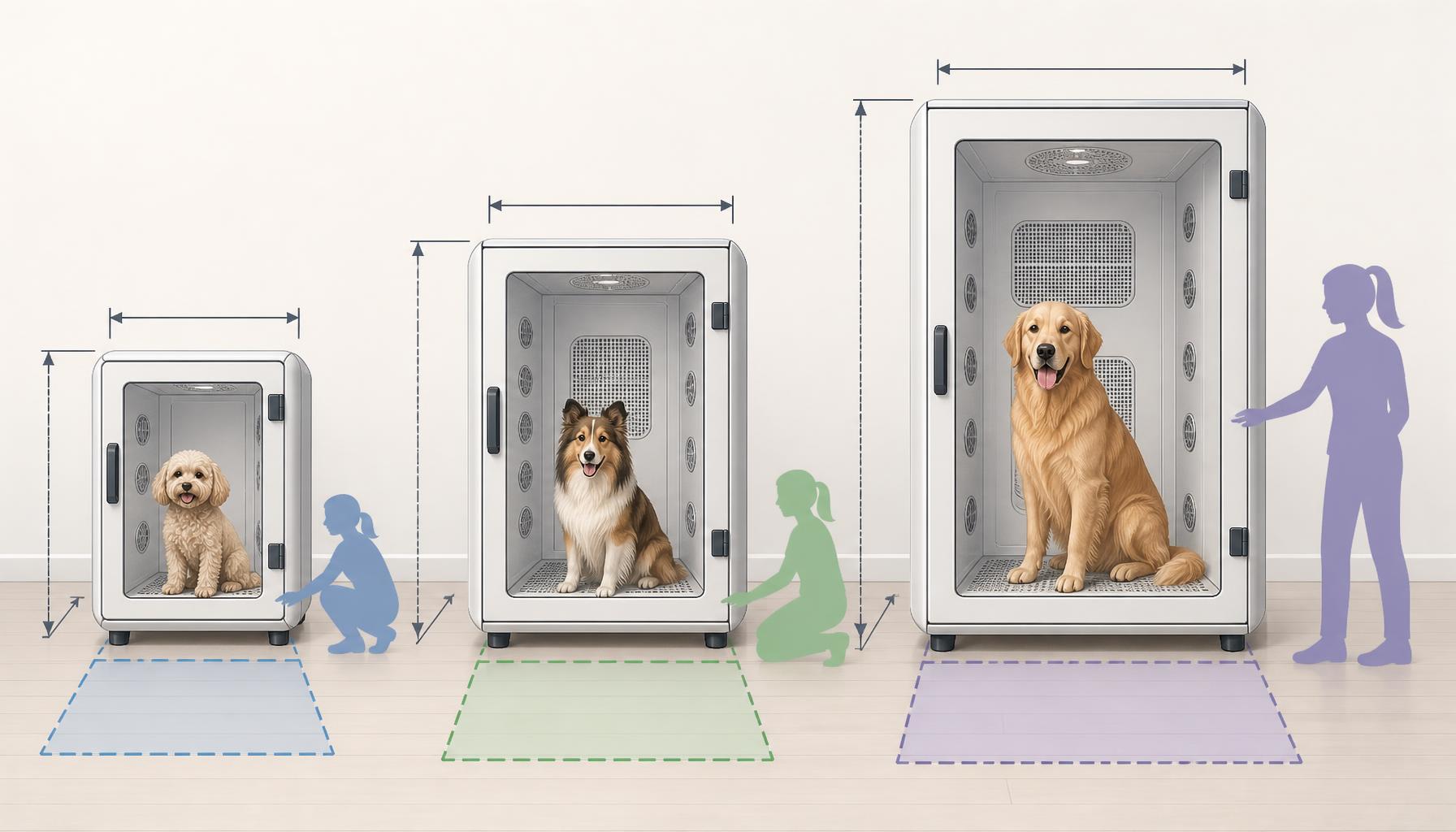
For a compact companion-animal practice with mainly cats and small dogs, the documented VD-U7 or VD-U4+ capacity statements may be relevant starting points. The choice between them should also account for the VD-U4+ height, multi-layer configuration, loading approach, and cleaning access; ask HQS for these details for the exact configuration offered.
For a grooming room within a general veterinary hospital that handles medium and larger dogs, the documented suitability claims for the VD-U2, VD-U1D, and VD-U1S may be more relevant. The larger cabinets also have higher listed weights and, for the VD-U1S, higher declared power. That may affect delivery planning, placement, electrical review, and the amount of floor area that remains usable around the unit.
What to Ask HQS Before Ordering a VD-U Pet Dryer
A productive quotation request should identify the exact model, destination country, intended room, and expected animal mix. It should also ask the supplier to distinguish supplied components from optional items. Product summaries are useful for initial comparison, but they are not sufficient for approving installation or forecasting lifecycle costs.
Installation and site questions
- Provide the current model-specific installation manual, including required side, rear, top, front, and door-opening clearances.
- Confirm whether the unit requires any venting, external exhaust, condensate collection, drainage connection, or room ventilation provision.
- Confirm plug type, cord length, grounding requirements, recommended circuit arrangement, and whether the quoted electrical specification applies to the exact configuration offered.
- State delivery dimensions, packaged weight, assembly requirements, and any doorway, lift, or threshold constraints for installation.
Cleaning, consumables, and responsibility questions
- Identify every user-serviceable hair-collection component, filter, screen, tray, or other consumable, with part numbers and recommended replacement criteria.
- Provide the approved cleaning agents, surfaces that must not be wetted, and cleaning responsibility expected under the warranty.
- Confirm whether infrared LED, ionizer, oxygen/aroma, fan, or control components have planned replacement intervals or separate warranty terms.
- Clarify whether training is included for the person responsible for routine cleaning, daily inspection, and escalation of service issues.
Service, documentation, and import questions
- Identify the local distributor or service contact, expected parts route, warranty duration, exclusions, and response arrangements for the destination market.
- Request a spare-parts list covering filters or hair-collection components, fans, controls, doors, seals, and other replaceable items supported by the supplier.
- Request certifications, declarations, electrical documentation, and import documents applicable to the destination country for the exact model and configuration quoted.
- Ask whether the supplier provides an acceptance checklist after installation and whether it distinguishes operator training from technical commissioning.
Choosing a VD-U Pet Dryer Size for Your Facility
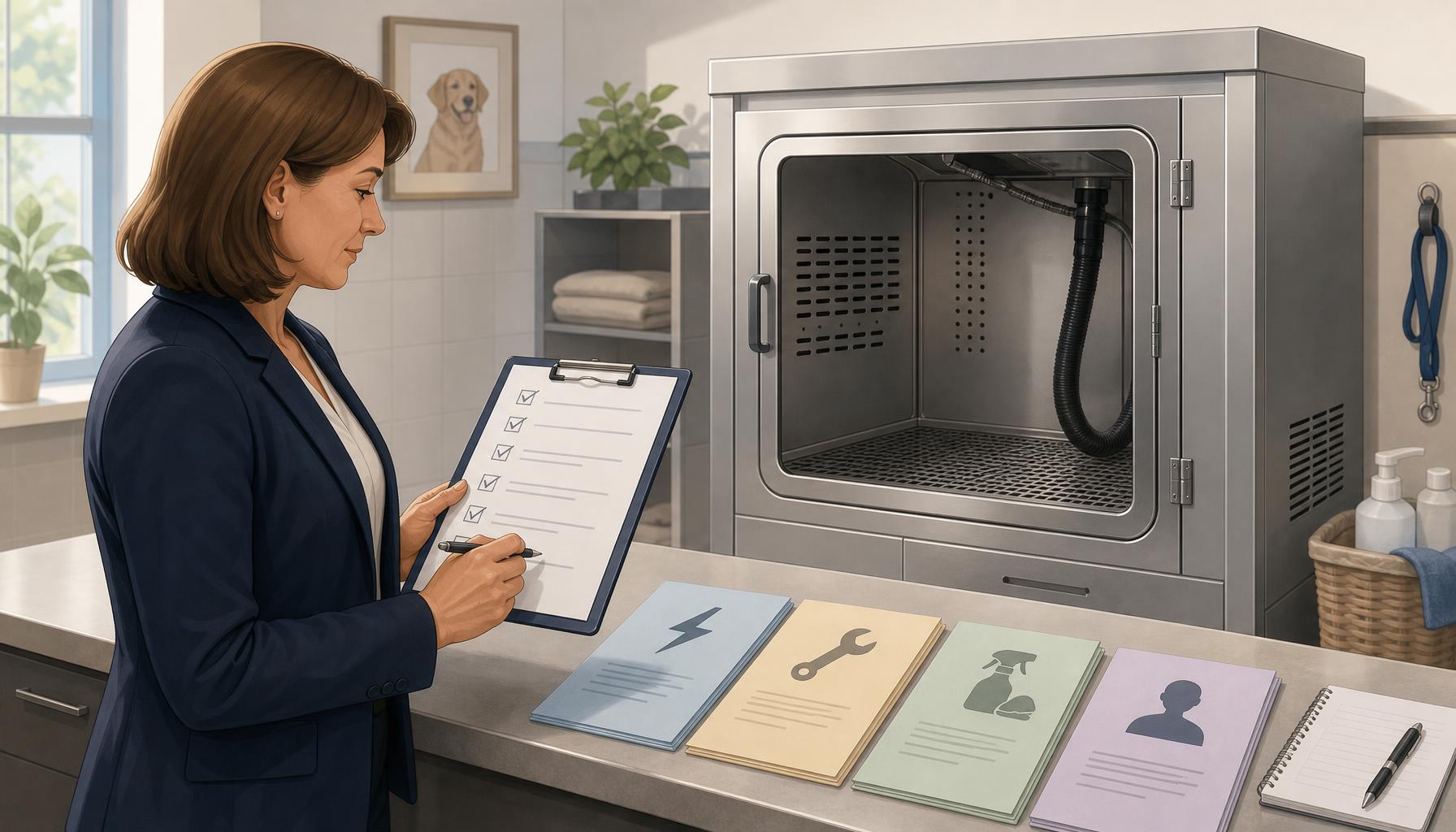
The documented range is differentiated primarily by cabinet size, stated animal capacity, weight, declared power, and air-outlet configuration. Those are useful selection inputs. Clearance, any venting or drainage needs, cleaning method, consumable availability, local service coverage, and import documentation should then be confirmed with HQS for the chosen model so they do not delay installation.
For a practice considering a Pet Dryer as part of a grooming or pet-care workflow, the safest purchasing sequence is to select the likely size class first, validate its physical route and room location second, and release the order only after the supplier confirms the model-specific utility, cleaning, training, service, and compliance details in writing.
The smaller documented configurations may suit facilities where compact placement and small-animal throughput are the main concerns. Larger models may better match a mixed canine workload, but their higher weight, larger cabinet envelope, and higher declared power can create additional site-review questions. In either case, feature claims such as hair collection, ionization, infrared LED, and oxygen/aroma therapy should be evaluated against written documentation, maintenance obligations, and the clinic’s intended use rather than treated as a substitute for installation or service information.