A veterinary ECG machine gives a clinic a documented electrical tracing for rhythm assessment, peri-anesthetic evaluation, cardiac workups, and referral records. For a buyer, the central question is not simply whether the unit prints an ECG. It is whether its recording format, consumables, patient cable, documentation, and local service arrangement fit the clinic’s actual caseload and workflow.
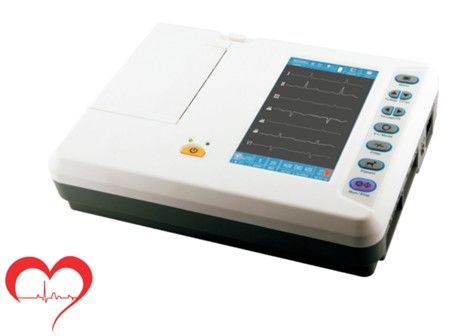
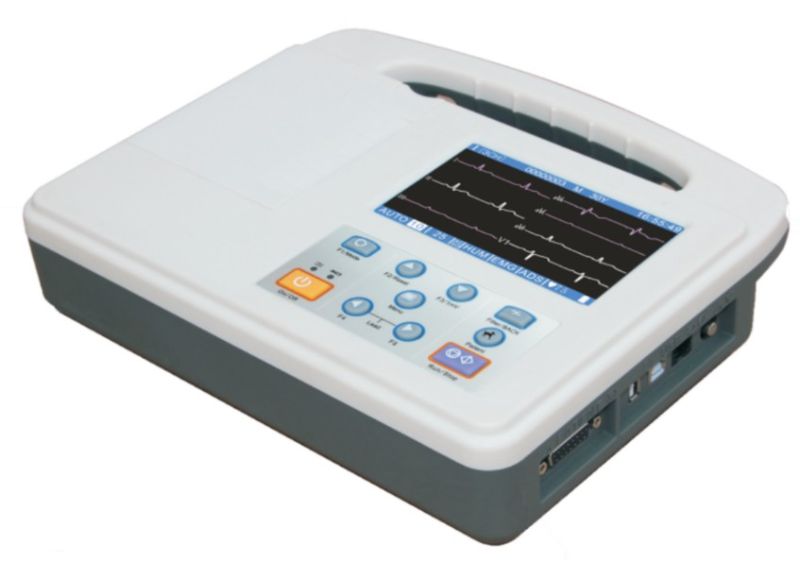
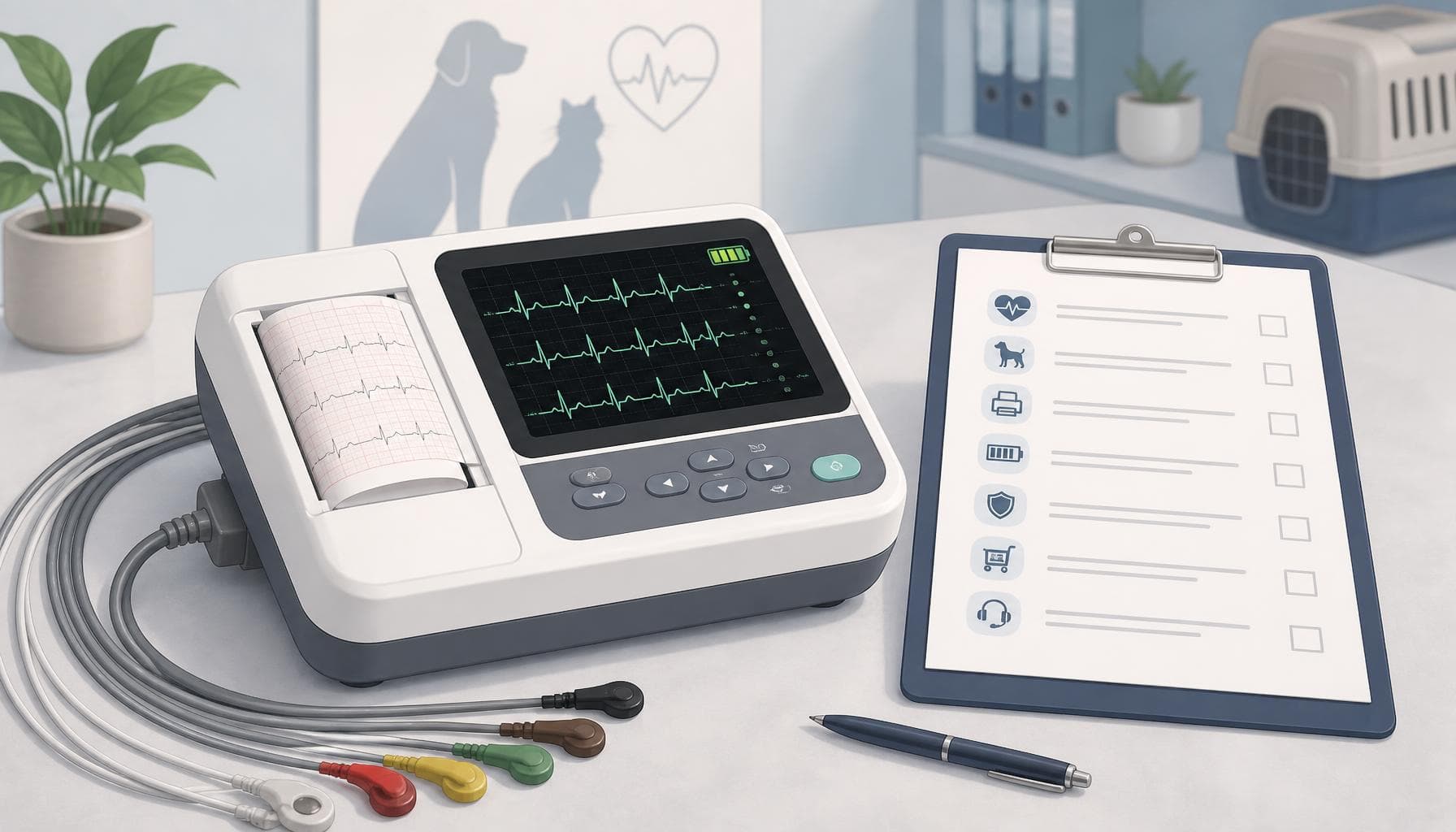
A 3-channel ECG Machine ECG-3G3 is supplied as a portable unit with a veterinary patient cable, electrodes, grounding cable, power cord, adapter, and fuses. Its published data lists three-channel recording, 80 mm roll paper, a rechargeable Ni-MH battery, USB and RS232 ports, and optional PC ECG management software. Those details are useful starting points, but they should be converted into purchase questions before a purchase order is issued.
For a broader view of available systems, clinics can compare models within the ECG Machine category. Do not assume that similarly named devices include the same patient accessories, software license, paper supply, regulatory documents, or warranty coverage.
Define the Clinical and Workflow Requirement
Start by separating what the clinic knows from what still needs confirmation. The known requirement may be a compact ECG machine for consultation rooms, pre-surgical checks, or mobile use between wards. The assumptions may include species compatibility, integration with existing records, or sufficient battery runtime for a full workday. Those assumptions need supplier confirmation in writing.
General-practice consultation and pre-anesthetic screening
A general companion-animal practice may prioritize a small footprint, quick printed records, straightforward storage, and the ability to move the unit between exam rooms and the surgical area. In this setting, three-channel output may be appropriate when the clinic’s clinicians primarily need a documented tracing rather than a larger simultaneous print format. The ECG-3G3 specification lists a 260 mm × 217 mm × 58 mm enclosure and a 1.4 kg weight, which supports a portability-focused evaluation.
High-throughput surgery or multi-room workflow
A clinic with several surgical stations, regular cardiac cases, or a need to review longer printed tracings may find output width and documentation workflow more important than the smallest unit. A six-channel alternative, such as the VET ECG Machine (Six Channel) ECG-6G6, is listed with 112 mm paper and recording modes including 6ch. It is larger and heavier on the supplied specification sheet, at 300 mm × 230 mm × 72 mm and 2.8 kg. That does not automatically make it a better purchase; it means the clinic should decide whether its review and filing workflow benefits from wider multi-channel output.
Emergency, inpatient, and referral-facing services
Emergency and inpatient services should distinguish a diagnostic ECG recorder from a continuous bedside monitor. A portable ECG machine can provide a formal tracing and stored case record, while an ICU or anesthesia station may also require ongoing waveform visibility and additional physiologic parameters. If continuous monitoring is part of the requirement, assess the ECG machine alongside the clinic’s veterinary patient monitor plan rather than expecting a recording ECG to fill both roles.
- List the species normally seen, including dogs, cats, horses, and exotic patients where applicable, and request written confirmation that the supplied cable, electrodes, and interpretation features are appropriate for those species.
- Decide whether records will be retained as paper strips, transferred by USB, managed through PC software, or entered into an existing practice record system.
- Identify where the device will live: a consultation room, procedure area, inpatient ward, ambulatory vehicle, or shared equipment cart.
- Set a realistic number of users and locations, because a single portable unit can create access delays even when its technical specification is adequate.
Read the Specifications That Affect the Decision
Published specifications are most useful when they describe a practical constraint. For the ECG-3G3, the manufacturer-supplied data states standard 7 leads with synchronous 7-lead acquisition at 12-bit/1000 Hz, recording modes of 1ch+V, 3ch, and 3ch+V, and paper speeds of 6.25, 12.5, 25, and 50 mm/s. These are verifiable product-sheet claims, not a substitute for evaluating trace quality on the species the clinic treats.
Three-channel output describes the print or display format, not necessarily the number of leads acquired at once. Buyers should ask the supplier to explain exactly which leads appear in each output mode, whether the system calculates derived information, and what is retained in exported records.
| Specification or feature | Published ECG-3G3 information | Why it matters to procurement | What to confirm before ordering |
| Recording format | 1ch+V, 3ch, and 3ch+V | Determines how much information is presented on each paper record and how clinicians review tracings. | Sample printouts for each format and the meaning of “+V” in the supplied documentation. |
| Lead acquisition | Standard 7 leads; 12-bit/1000 Hz synchronous 7-lead acquisition | Relevant to the breadth of data collected and how records are presented. | Lead naming, veterinary cable compatibility, species-specific electrode options, and whether all advertised functions are enabled in the quoted configuration. |
| Display and storage | 5-inch 800 × 480 color LCD; storage for up to 250 ECG cases | Useful for on-device review, but local storage is not a long-term records strategy by itself. | Export format, storage overwrite behavior, patient-data retrieval method, and backup process. |
| Paper system | 80 mm × 20 m roll paper | Paper width affects print layout; roll dimensions affect recurring supply planning. | Paper part number, local availability, approved equivalents, shelf life, minimum order quantity, and lead time. |
| Battery and power | Rechargeable Ni-MH battery; AC 110–230 V, 50/60 Hz | Matters for mobile use, charging arrangements, and replacement planning. | Battery replacement part number, expected service process, charger/adapter specification, and whether the quoted plug and cord match the installation country. |
| Connectivity | RS232 and USB; PC ECG management software listed as optional | Interfaces only add value when the clinic has a workable method to export, store, and retrieve files. | Whether software is included, license terms, supported operating systems, file formats, installation support, and any recurring software fees. |
The stated battery claim is continuous work for over four hours. Treat that as a manufacturer-supplied operating claim, not as a guarantee of runtime in a particular clinic. Ask whether the figure applies to recording, printing, display use, or a defined test condition. A battery-powered device also needs a replacement plan: a low initial quotation can be less attractive when battery packs must be shipped internationally or fitted only by the original supplier.
The ECG-3G3 data also lists 50/60 Hz AC filtering, 25 Hz/45 Hz EMG filtering, adaptive anti-drift filtering, and noise below 15 μVp-p. These are technical attributes relevant to signal handling, but they should not be used as standalone buying claims. Ask for the operating manual and confirm what settings are user-selectable, what defaults are used, and whether the manual addresses veterinary use rather than human-only workflows.
Compare Configuration Trade-Offs
The main configuration choice is usually not “basic versus advanced.” It is a trade-off between portability, paper format, workflow capacity, and long-term support. A compact three-channel device may suit a practice that values movement between rooms and a smaller paper footprint. A larger six-channel format may suit a team that regularly prints and reviews broader simultaneous layouts.
| Configuration question | Three-channel ECG-3G3 | Six-channel ECG-6G6 | Decision implication |
| Print media | 80 mm × 20 m roll paper | 112 mm × 20 m roll paper | Wider paper can support a different print layout, while narrower paper may reduce cabinet space and simplify portable use. Confirm supply availability for either format. |
| Listed recording modes | 1ch+V, 3ch, 3ch+V | 3ch, 3ch+V, 6ch | Select according to the clinic’s preferred review format, not channel count alone. |
| Display | 5-inch color LCD | 7-inch color touch LCD | A larger screen may be useful for review at the device, but it adds size and may not replace PC-based record storage. |
| Listed size and weight | 260 mm × 217 mm × 58 mm; 1.4 kg | 300 mm × 230 mm × 72 mm; 2.8 kg | Evaluate cart space, storage, cable management, and whether staff need to carry the device between rooms. |
| Battery claim | Rechargeable Ni-MH battery; over four hours continuous work | Rechargeable Li-ion battery; over six hours continuous work | Battery chemistry and stated runtime differ. Confirm replacement availability, charging policy, and warranty treatment for the battery. |
Both supplied product sheets list USB and RS232 communication, storage for 250 cases, and 12-bit/1000 Hz synchronous 7-lead acquisition. If the clinic intends to archive ECGs electronically, the critical differentiator may be the optional software package and its support terms rather than the physical communication port.
Installation is typically modest compared with larger diagnostic equipment, but it should still be planned. Provide a clean, accessible power outlet, a protected storage location, a stable work surface or equipment cart, and space for paper replacement and cable routing. If the unit is intended for the surgery area, coordinate placement with the veterinary anesthesia machine and patient-monitoring layout so that power cords, patient leads, and printed records do not create an avoidable clutter point.
- Request the exact mains plug type, adapter rating, and supplied power cord for the destination country.
- Confirm whether a transport case, cart, spare patient cable, spare electrodes, and extra paper rolls are included or separately quoted.
- Ask whether optional PC software requires a dedicated computer, local installation, internet access, or a specific operating system.
- Plan a secure process for patient data stored on the device and transferred through USB.
Verify Documentation and Service Scope
The supplied information for the ECG-3G3 and ECG-6G6 does not list certifications. That is not evidence that no certification exists; it means the buyer should request the applicable documents before making a compliance decision. Import requirements, electrical requirements, and medical-device obligations vary by destination and by the legal role of the purchaser or importer.
Ask for documents that match the exact model and quoted configuration. A certificate for a related device, an undated brochure, or a generic declaration should not be treated as confirmation for the delivered system.
- Current operating manual, including cleaning, storage, battery charging, troubleshooting, and user-maintenance instructions.
- Model-specific regulatory and electrical compliance documents applicable to the destination market, plus the manufacturer and importer information required for import processing.
- Warranty duration, covered parts, exclusions for batteries and accessories, claim process, response expectations, and who pays freight for warranty repairs.
- Itemized accessory list, including the veterinary cable, electrode type, grounding cable, fuses, adapter, paper, and any software or connectivity components.
- Spare-parts list with ordering codes for patient cables, electrodes, battery packs, printer components if serviceable, fuses, adapters, and paper.
- Service route: local technician, distributor support, remote troubleshooting, return-to-factory repair, or buyer-performed replacement of designated parts.
Interpretation features require particular scrutiny in veterinary purchasing. The ECG-3G3 introduction describes recording with interpretation, while its feature list includes analysis mode. Ask whether this function is designed for veterinary species, which species are supported, what output it produces, whether it can be disabled, and how clinicians should treat it within their own review process. An automated statement should not be purchased on the assumption that it replaces veterinary clinical interpretation.
Prepare the Configuration Request
Because no price information is supplied for either model, a responsible budget should separate the device quotation from the costs that appear after delivery. The purchase request should make those items visible rather than accepting a single headline figure.
Build the total-cost request around actual ownership items
- Main ECG machine, standard accessories, optional software, delivery, installation support, and any on-site or remote user orientation.
- Recurring paper rolls, electrode supplies where applicable, replacement patient cable, battery replacement, and software support or licensing if offered separately.
- Import freight, insurance, duties, brokerage, local taxes, electrical adapters, and documentation needed for clearance or registration where required.
- Warranty extension options, turnaround process for repairs, loan-unit policy if available, and shipping responsibility for service claims.
Send suppliers a requirement statement that can be quoted accurately
State the intended species, expected care settings, required print formats, electronic record workflow, destination country, power-plug requirement, and whether the device will be shared between rooms. Request photos of the included accessories, sample printouts, the current manual, and a line-by-line quotation. If optional PC software is needed, ask for its version, license model, supported operating systems, export capability, and support arrangement.
For many small and mid-sized clinics, the practical decision will come down to whether a portable three-channel format meets the team’s record-review needs and whether paper, battery, cable, and service support can be obtained without delay. The published ECG-3G3 specifications provide a useful basis for that assessment, but the final purchase should depend on written confirmation of the exact delivered configuration and its support pathway.