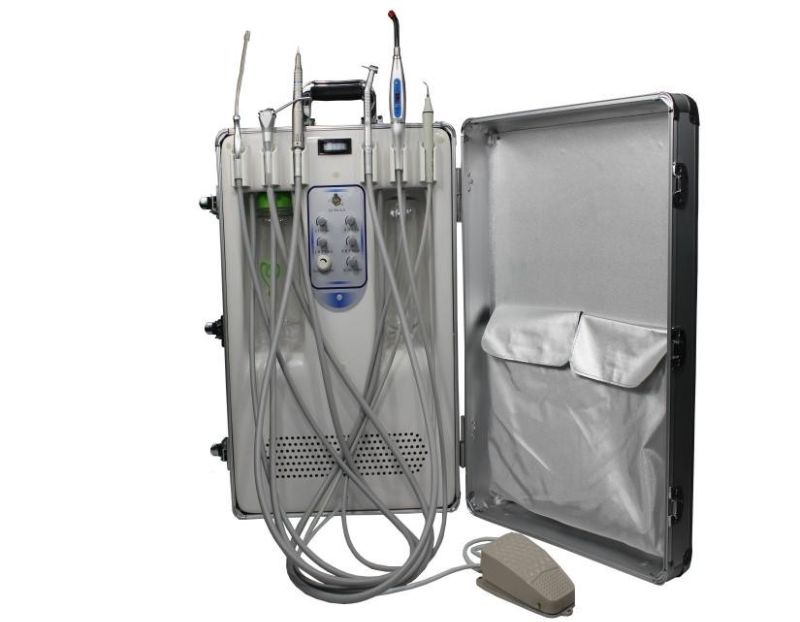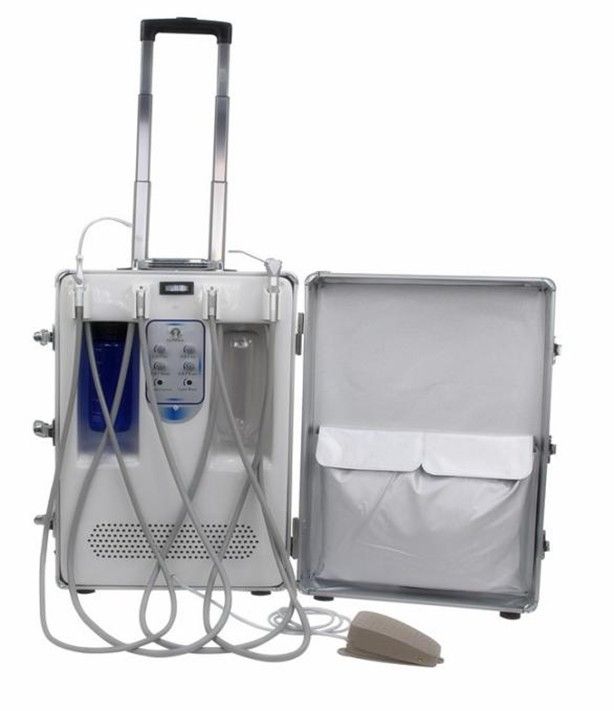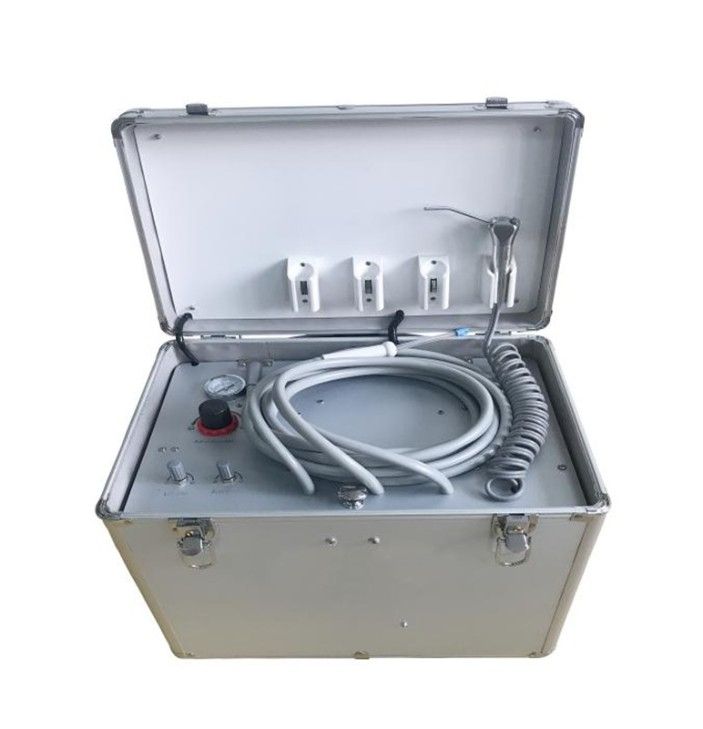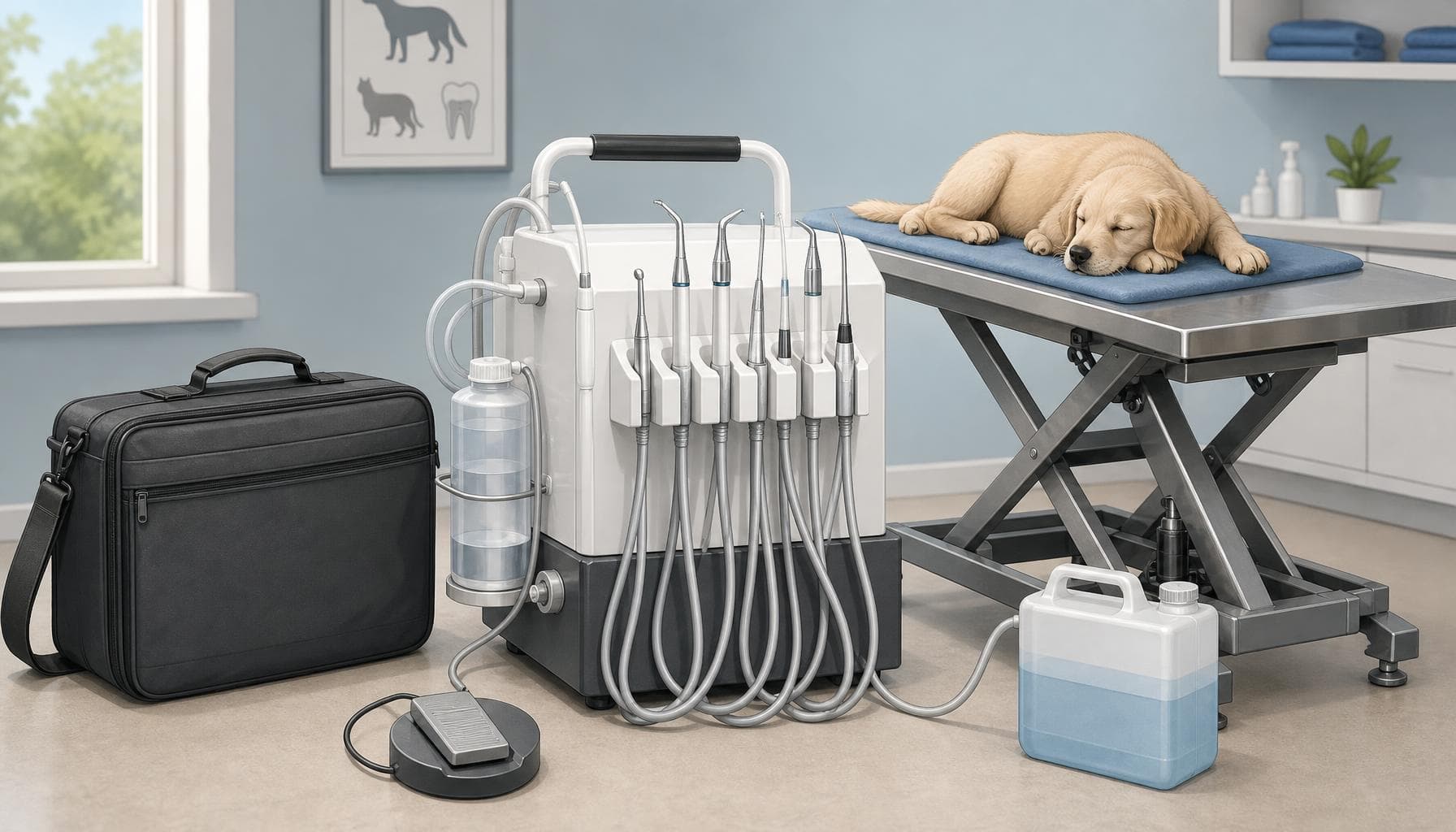
A Portable Dental Unit for a mobile veterinary clinic should be selected around transport, usable air supply, suction, and instrument compatibility—not its case alone. Compare the complete working configuration, then confirm power requirements, accessory interfaces, service access, and upgrade options. The right Dental Unit must support the planned dental procedures without exceeding the vehicle’s space or handling limits.
A portable veterinary dental unit is a transportable equipment package that supplies dental instruments with utilities such as compressed air, water, and suction. Its clinical value depends on the instruments it can support and the treatment environment available around it.
Which Portable Dental Unit specifications matter for mobile clinics?
Portable Dental Unit specifications are useful for shortlisting, but instrument compatibility and performance under the intended workload need configuration-specific confirmation.
HQS lists compressor airflow, pressure, power, weight, dimensions, and included components for its portable models. Those specifications support a comparison of transport burden and equipment configuration. They should not be treated as evidence that a particular handpiece will run satisfactorily, that multiple instruments can operate together, or that one model delivers better clinical outcomes.
Separate the published equipment rating from the requirement at the instrument connection. A compressor airflow figure is not, by itself, a guarantee of usable flow at a handpiece under load. Ask HQS to confirm the measurement conditions, outlet pressure regulation, and the intended instrument combination.
Clinical workload also changes the shortlist:
- For a mobile dog-and-cat service planning dental procedures at equipped host clinics, prioritize compatibility with existing instruments, manageable transport weight, and a clear division between equipment carried by the mobile team and equipment provided by the host.
- For a vehicle-based service completing several appointments before returning to base, assess setup space, water and waste capacity, sustained compressor operation, and the vehicle’s electrical supply as one system.
- For an equine dental service, start with the requirements of the planned instruments and treatment setting. Do not assume that a portable unit shortlisted for small-animal dentistry can support equine powered equipment without written confirmation.
DU-401 vs DU-402A vs DU-402B: documented configuration differences
The DU-401, DU-402A, and DU-402B present different transport and utility configurations, rather than a proven ranking of clinical capability.
The following comparison uses HQS published product specifications. Weight labels are retained so that a listed unit weight is not confused with net or gross weight.
| Model and product | Listed airflow (L/min) | Listed pressure (MPa) | Listed weight (kg) | Transport and suction configuration | Confirm with HQS |
| DU-401 Portable Dental Unit | 65 | 0.6 | 15, listed as weight | Backpack-style carrying case; suction system | Complete carrying weight with selected instruments; suction performance; connector specification |
| DU-402A Portable Dental Unit | 130 | 0.8 | 21 net / 24 gross | Aluminum box; pull rod; suction system | Usable instrument airflow; handling arrangement; compatibility with planned accessories |
| DU-402B Portable Dental Unit | 130 | 0.8 | 22 net / 25 gross | Aluminum box; pull rod; high suction system | Suction flow and vacuum under load; simultaneous-use limits; suction maintenance requirements |
HQS lists a three-way syringe, oilless air compressor, suction system, water bottle, drain bottle, foot control, and stainless steel air tank for all three models. HQS lists power at 410 W for the DU-401 and 600 W for the DU-402A and DU-402B.
The higher listed airflow and pressure of the DU-402A and DU-402B justify checking them against more demanding instrument requirements; they do not establish suitability without that check. Likewise, “high suction” identifies a configuration difference on the DU-402B, not a quantified performance advantage. Request suction flow, vacuum, and test conditions before making that distinction decisive.
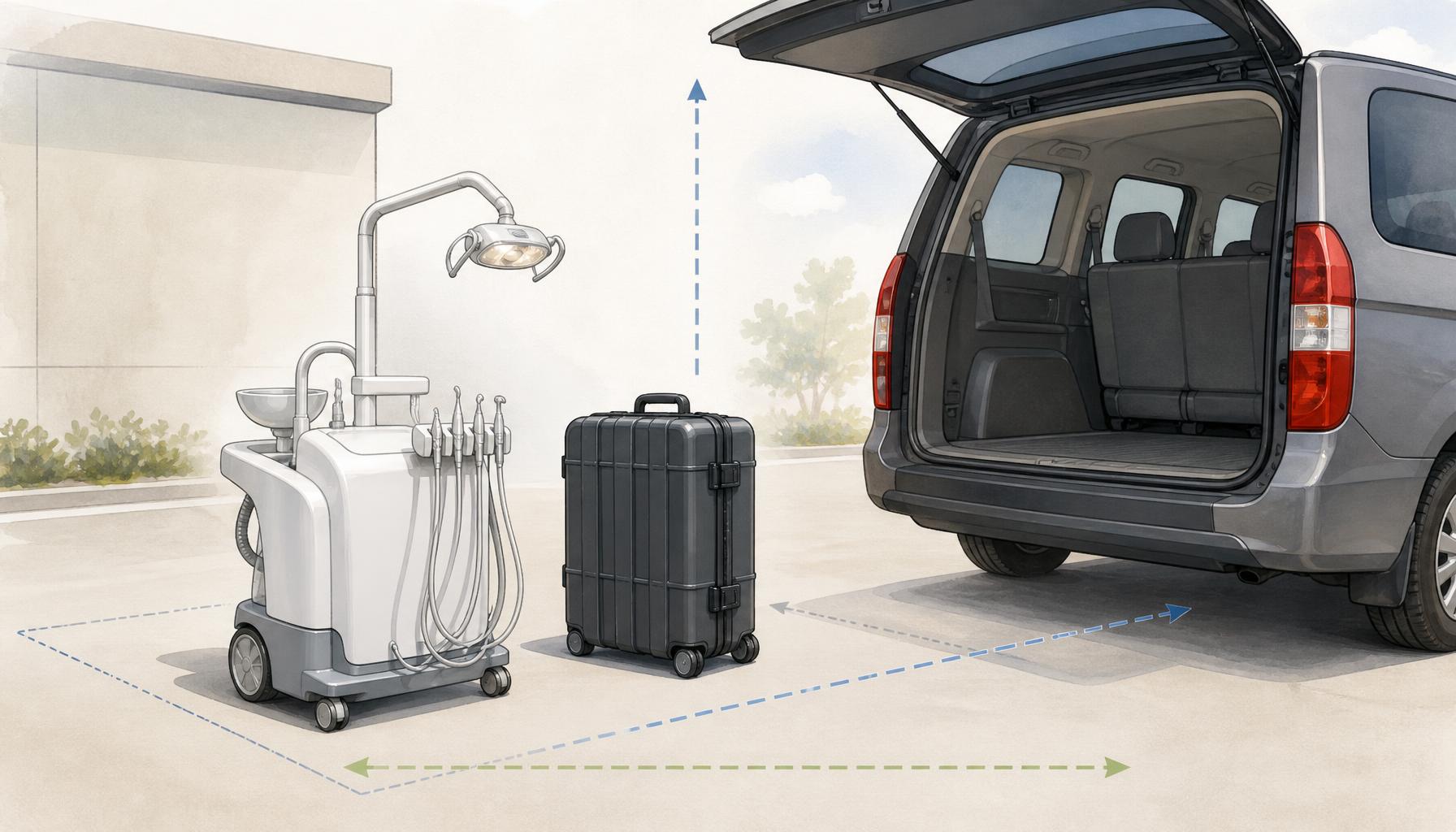
For transport planning, HQS lists dimensions of 51 × 32 × 31 cm for the DU-401 and 49 × 38 × 52 cm for both the DU-402A and DU-402B. Confirm whether the quoted dimensions cover the packed equipment and allow additional space for accessories and access during use.
Portable Dental Unit interfaces and upgrade compatibility
Portable Dental Unit upgradeability depends on documented interfaces and available utility capacity, not simply on whether optional accessories are offered.
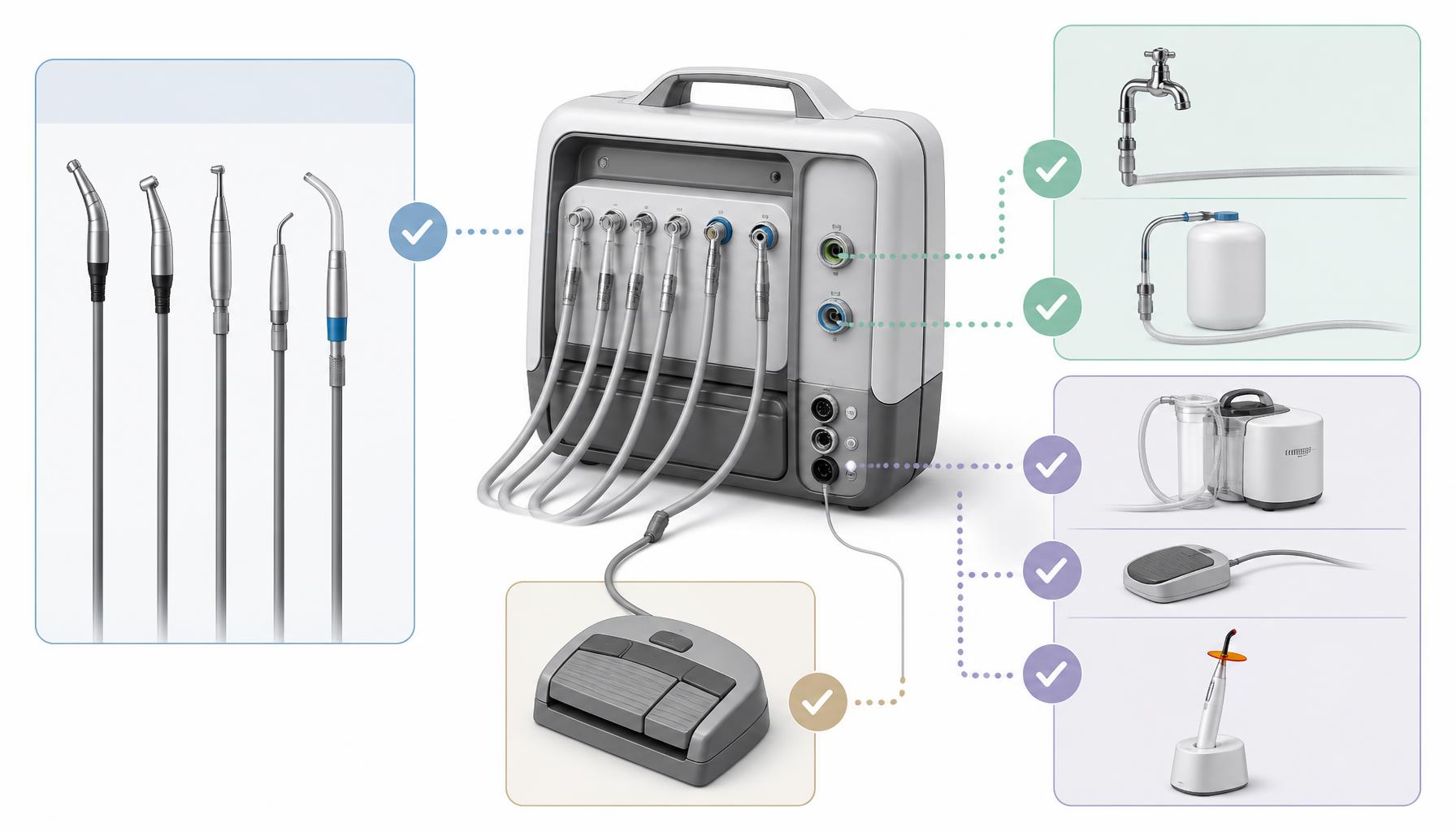
A useful capability progression is to define the initial instrument package, identify the next likely addition, and confirm what must change to support it. For example, adding a different handpiece or a separate scaler may involve more than replacing an instrument: the connection, water supply, electrical requirements, controls, and service arrangements all need checking.
Ask for a compatibility schedule tied to the exact quoted configuration:
- Instrument connections: hose coupling type, connection layout, and the exact handpiece models approved for use.
- Utility requirements: regulated pressure, available airflow during the intended workload, and water delivery requirements for each instrument.
- Accessory integration: whether a planned scaler or other accessory connects to the unit or needs its own power, water, and controls.
- Upgrade scope: whether an addition requires only an accessory, or also replacement hoses, valves, controls, or compressor components.
- Replacement continuity: whether compatible instruments and connection parts remain available if the original accessory is discontinued.
Do not confuse higher compressor ratings with an upgrade path. A unit can have sufficient air capacity yet still require an interface change. Conversely, a physically compatible instrument may exceed the unit’s supported workload. Ask HQS to identify both mechanical compatibility and operating compatibility in writing.
Portable Dental Unit power, space, and installation requirements
Portable Dental Unit installation should be assessed as part of the complete mobile treatment setup, including electrical supply, access, storage, and surrounding clinical equipment.
Confirm the voltage, frequency, plug, and electrical protection required for the destination and quoted configuration. The published power figure alone should not be used to size a vehicle inverter or generator. Ask about starting demand and account separately for other equipment operating from the same supply.
Integrated water and drain bottles make their capacity and servicing arrangements important purchase questions. Request usable capacities, approved water and cleaning requirements, and instructions for emptying and preparing the unit for transport. These details affect how many stops the team can plan before replenishment or servicing, but no appointment capacity should be inferred from the presence of bottles alone.
Check the working footprint as well as the closed-case dimensions. Instrument hoses, the foot control, opening panels, and access to bottles may need space beyond the storage envelope. Determine how the unit will be secured during travel and whether loading requires additional handling equipment.
The dental unit is only one part of the treatment environment. Define separately how the service will provide the required patient support, lighting, imaging, instrument reprocessing, and clinical workspace. A portable package should not be mistaken for a complete mobile dental clinic.
Portable Dental Unit maintenance, spare parts, and import documents
Portable Dental Unit ownership costs include accessories, scheduled maintenance, replacement parts, and service logistics—not just the initial equipment quotation.
Request an itemized quotation that distinguishes the base unit, selected instruments, adapters, transport accessories, delivery, and commissioning. Then ask which parts require routine replacement, what maintenance is scheduled, and what can be serviced locally.
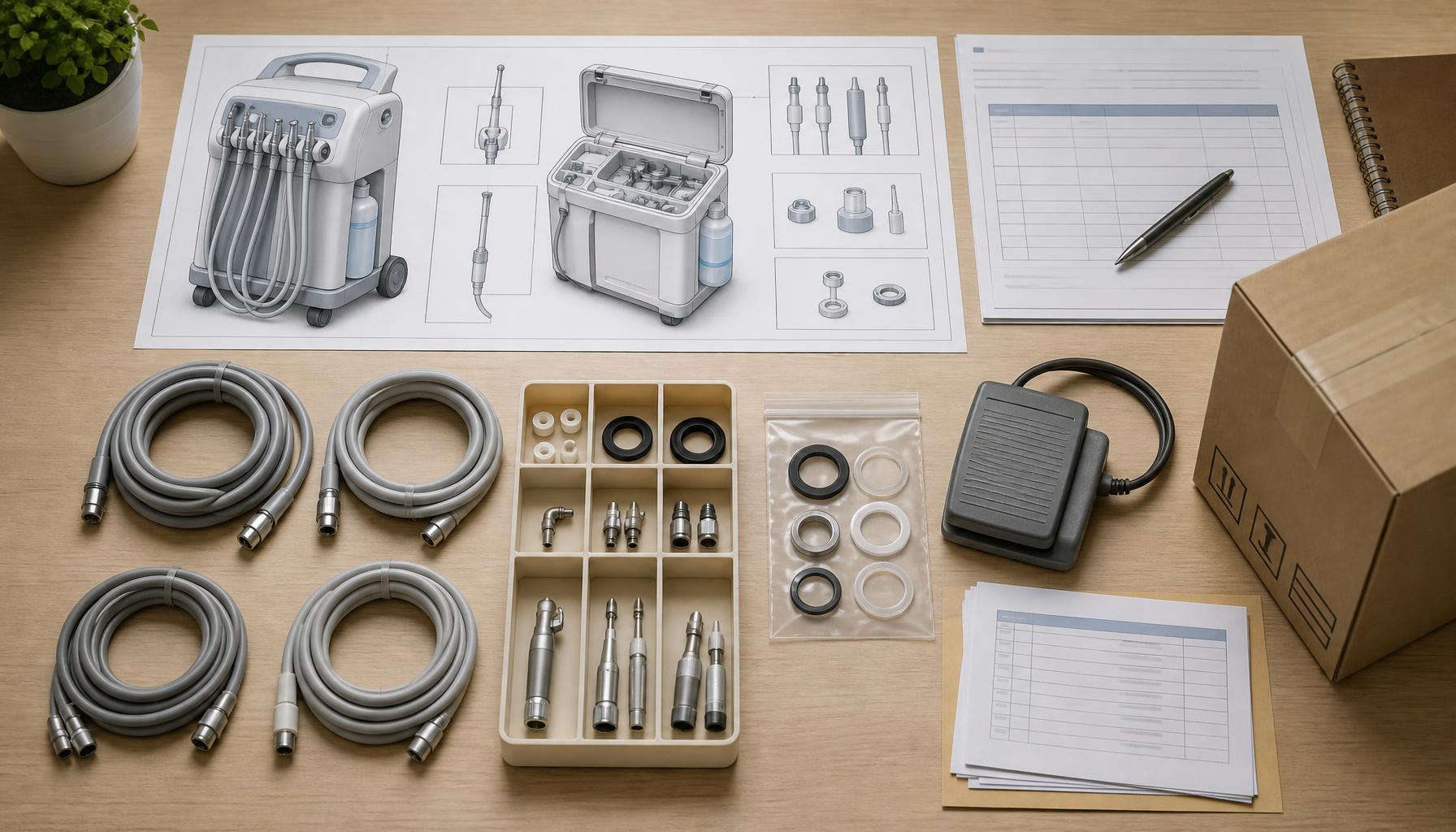
Give particular attention to hoses and couplings, bottle seals, suction components, foot controls, and compressor service parts. Ask HQS for part numbers, ordering arrangements, lead times, and any recommended spares for a mobile service. Confirm the service procedure for a fault that prevents clinical use, including who performs diagnosis and who pays transport costs.
Long-term replacement risk is easier to assess when the supplier identifies which components are standard replaceable items and which depend on a model-specific assembly. Ask whether alternative replacement instruments are supported and whether future accessory changes would require replacing the whole unit.
For imports, ask HQS to confirm the applicable documentation for the exact model, configuration, and destination market. Review the equipment’s intended use, electrical documentation, labeling, importer responsibilities, and any locally required registration or conformity evidence before placing the order. A document for a different model or accessory should not be assumed to cover the quoted package.
Which Portable Dental Unit configuration should your clinic quote?
A Portable Dental Unit should reach the quotation stage only after the clinic has defined its transport limits, instrument package, working environment, and likely upgrade needs.
Shortlist the DU-401 when its backpack-style format and lower listed weight align with the transport plan, subject to instrument and workload confirmation. Compare the DU-402A when the planned instruments warrant investigating its higher listed airflow and pressure. Include the DU-402B when suction requirements are a material purchasing factor, then request quantified suction performance rather than relying on the configuration name.
The final quotation should identify the exact included instruments and connections, supported workload, packed weight, power requirements, service terms, spare-parts arrangements, and destination-specific documents. Keep those answers alongside the model specifications in an equipment comparison worksheet. Choose the configuration that meets the documented workload with a practical replacement and upgrade path—not the one with the largest headline specification.