A veterinary exam table and a surgical table can look alike in a catalog photo, but they do different jobs. The exam table handles consultations, vaccinations and short procedures every day. The surgical table holds an anesthetized patient in a set position for a whole operation. Most clinics need both, plus one or two specialist tables. This guide covers the main types, what to compare and how to plan them into your rooms.
Veterinary exam table vs surgical table: the core difference
An exam table is built for short, frequent contact. An awake animal is lifted on, examined from both sides, and the surface is cleaned before the next patient. Working height, easy disinfection and footprint matter most.
A veterinary surgical table is built for long, controlled sessions. Positioning, stability and access for the surgical team matter more than fast turnover. Height adjustment lets the surgeon work standing or seated, tilt helps with certain approaches, and keeping the patient warm is a common requirement. Compare the two as separate purchases.
The tables a clinic typically needs
Consultation and examination tables
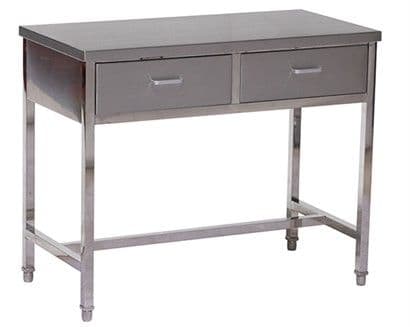
The standard vet exam table is a fixed-height stainless steel table. HQS lists the ST-03 at L140 × W65 × H85 cm and the ZL-01 at L110 × W60 × H80 cm, both with a 304 stainless steel body. The longer ST-03 gives more room for large dogs. The shorter ZL-01 is easier to fit into a small consultation room.
Where floor space is tight, a wall-mounted folding table is an option. The FT-01 folds against the wall when not in use and uses a counterbalanced lift. Its work surface is 560 × 1120 mm with a weight capacity of 50 kg, and the 304 stainless steel top has raised anti-drip edges to keep fluids on the table. Check the 50 kg rating against the heaviest patients you expect to see in that room.
Ultrasound positioning tables
Abdominal and cardiac scans often keep the patient in lateral or dorsal recumbency for several minutes while the sonographer handles the probe and the scanner controls. A dedicated ultrasound examination table makes this easier. The ZL-03 is a stainless steel table intended for B-mode ultrasound examinations, with rounded edges, universal brake wheels and a listed size of L110 × W55 × H70 cm. HQS notes that the size can be customized. It is used together with veterinary ultrasound scanners, so plan the table and the scanner trolley as one workstation. At 70 cm it sits lower than the consultation tables above; check this against whether your sonographer scans seated or standing.
Treatment and dental tables with height adjustment
Dental cleaning, wound care and trauma treatment take longer than a consultation, and staff of different heights share the table. Height adjustment reduces bending and lets staff load a patient low, then raise it. The ZL-07 and ZL-08 both adjust height with an electric foot pedal across 75–105 cm, which keeps hands free during adjustment. The ZL-07 (L120 × W60 cm) is listed for dental cleaning, trauma treatment and reception. The ZL-08 is more compact at L90 × W50 cm.
Surgical and operating tables
The surgery room needs a table designed for anesthetized patients. HQS groups its electric models under operating tables. The OT-001 has a 1,300 × 600 mm tabletop and the lowest listed minimum height, with a range of 450–1,050 mm. A low entry height can make patient transfer easier. The OT-002 and OT-003 share a larger 1,400 × 650 mm top and a 760–1,060 mm range, and both list a 45° plate tilt. The difference is the V-shaped top: it is adjusted manually on the OT-002 and motorized on the OT-003, which also lists a 15° tabletop tilt. All three list a 250 kg load capacity.
Large-animal operating tables
Equine and bovine surgery calls for a different class of equipment. The OT-005 is an electric-hydraulic table listed for cattle and horse surgery. It measures 3,700 × 1,200 mm overall, adjusts from 600 to 870 mm by foot-pedal hydraulic lift, tilts 0–30° and lists a 1,500 kg load capacity, with detachable leg supports. The packed weight is 700 kg, so freight, unloading and floor loading need planning before the order.
Where wet tables fit
A veterinary wet table, sometimes called a tub table, combines a work surface with a sink or tub and drainage under a grated top. Clinics use it for bathing, flushing wounds, water-heavy dental work and other procedures where fluids need to drain away. It is a separate table type with its own plumbing needs, and none of the HQS models in this guide is a wet table.
What to compare on a veterinary examination table
- Work surface: length and width against your largest regular patients, and whether the edges are raised or rounded.
- Height: fixed height (80–85 cm on the ST-03 and ZL-01) or electric adjustment (75–105 cm on the ZL-07 and ZL-08).
- Load: ask for the rated load of the exact model. Of the exam tables here, only the FT-01 lists one (50 kg).
- Material and cleaning: 304 stainless steel is the usual choice. Check welds, corners and the underside, where fluids collect.
- Mobility: the ZL-03 lists universal brake wheels. For other models, confirm whether the table stands on fixed feet or castors.
- Space: a wall-folding table such as the FT-01 frees floor area when the room has other uses.
What to compare on a veterinary surgery table
- Tabletop size and the full lift range, including the lowest height for patient transfer.
- Which positions are powered and which are manual. The V-top on the OT-002 and OT-003 is a clear example: same function, different operation.
- Tilt angles needed for the procedures you perform.
- Heating: the OT-002 and OT-003 list heating as optional. For any OT model, name the heating configuration in the quotation rather than assuming it is included.
- Accessories such as infusion stands, instrument trays and restraint attachments, quoted as separate line items.
- Rated load, cleaning access, electrical supply and installation arrangements.
Positioning and patient warming protocols are decisions for the veterinary team. The table only has to support them reliably.
HQS examination and operating tables compared
| Model | Type | Size | Height | Rated load | Notes |
|---|---|---|---|---|---|
| FT-01 | Wall-mounted folding exam table | 560 × 1120 mm work surface | Not listed | 50 kg | Counterbalanced lift; 304 stainless steel top with raised anti-drip edges |
| ST-03 | Exam table | L140 × W65 cm | 85 cm | Not listed | 304 stainless steel body |
| ZL-01 | Exam table | L110 × W60 cm | 80 cm | Not listed | 304 stainless steel body |
| ZL-03 | Ultrasound exam table | L110 × W55 cm | 70 cm | Not listed | Rounded edges; universal brake wheels; size can be customized |
| ZL-07 | Electric pedal exam table | L120 × W60 cm | 75–105 cm | Not listed | Dental cleaning, trauma treatment, reception |
| ZL-08 | Electric pedal exam table | L90 × W50 cm | 75–105 cm | Not listed | Compact footprint |
| OT-001 | Electric operating table | 1,300 × 600 mm | 450–1,050 mm | 250 kg | Lowest minimum height of the OT tables |
| OT-002 | Electric operating table | 1,400 × 650 mm | 760–1,060 mm | 250 kg | Manual V-shaped top; 45° plate tilt; heating optional |
| OT-003 | Electric operating table | 1,400 × 650 mm | 760–1,060 mm | 250 kg | Motorized V-shaped top; 15° tabletop tilt; 45° plate tilt |
| OT-005 | Electric-hydraulic large-animal table | 3,700 × 1,200 mm overall | 600–870 mm | 1,500 kg | Cattle and horse surgery; 0–30° tilt; foot-pedal hydraulic lift |
Planning tables into your rooms
Start with a room list, not a product list. For each room, note floor area, door widths, power outlets and the other equipment sharing the space.
- Consultation rooms: a fixed exam table, or a wall-folding one if the room has other uses. Leave clearance for the vet and a handler on opposite sides.
- Ultrasound room: lay out the table, scanner and sonographer's seat together, with the screen in view. A table on brake wheels can be moved aside when needed.
- Treatment area: height-adjustable tables where several staff members rotate, with the foot pedal reachable from the working side.
- Surgery room: the operating table at the center, with clearance for the surgeon, assistant, anesthesia machine and instrument trolley. Confirm the electrical supply at the table position.
- Large-animal theater: plan the induction and recovery route, how the animal is moved onto the table and the floor area for a 3,700 mm table before anything else.
Measure doorways and corridors as well. Large tables arrive packed, and the packed dimensions are usually larger than the product itself.
Preparing a quotation request
Specifications vary more than photos suggest, so put your request in writing. List the models you are considering, the rooms they are for, the heaviest patient you expect, the positions and adjustments you need, any heating or accessories, your electrical supply and the delivery address. HQS can then prepare a configured quotation for every veterinary table you need.
Frequently asked questions
What size should a veterinary examination table be?
Size it to your largest regular patient and the room. HQS fixed exam tables range from L110 × W60 cm (ZL-01) to L140 × W65 cm (ST-03), and the compact ZL-08 is L90 × W50 cm. Leave working clearance on both long sides.
Can one vet table be used for both exams and surgery?
Rarely in practice. An exam table usually has no tilt, V-top or heating, and consultations on the surgery table disrupt theater preparation.
What is an ultrasound examination table used for?
It holds the patient steady during scanning. The ZL-03 is a stainless steel table for B-mode ultrasound examinations, with rounded edges and universal brake wheels.
Do I need heating on a veterinary surgical table?
Patient warming during anesthesia is a clinical decision for your veterinary team. If heating is needed, list it in your quotation request: the OT-002 and OT-003 offer heating as an option, and the configuration should be confirmed for any OT model.
Is a vet examination table with electric height adjustment worth it?
For dental and treatment work, often yes. The ZL-07 and ZL-08 adjust from 75 to 105 cm by electric foot pedal, so staff can work without stooping.