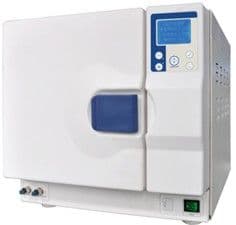
A class B autoclave removes air from the chamber with repeated vacuum pulses before it admits steam, so it can sterilize wrapped packs, drapes and hollow instruments. A Class N unit cannot do that reliably. For a clinic choosing its next sterilizer, this matters more than chamber size or display type. This guide covers how steam sterilization works, the EN 13060 classes, chamber sizing, routine checks and when steam is the wrong method, then compares units from the HQS veterinary autoclave range.
How does an autoclave work?
An autoclave sterilizer uses saturated steam under pressure. Higher pressure keeps water as steam above 100 °C, usually at 121 °C or 134 °C. When steam touches a cooler instrument, it condenses and releases latent heat straight onto the surface. Moist heat destroys microorganisms, including bacterial spores, much faster than dry air at the same temperature.
The weak point is air. Air trapped in a pouch, a folded drape or the bore of a cannula keeps steam away from that surface, and the cycle can finish with a spot that never reached sterilizing conditions. Most differences between autoclave types come down to how well they remove air.
A typical cycle has four phases:
- Air removal, by steam displacement (simpler units) or by repeated vacuum pulses (Class B).
- Heat-up to the set temperature and pressure.
- Holding time, for example 121 °C for 20 minutes or a shorter exposure at 134 °C, as set by the validated program.
- Exhaust and drying, so packs leave dry and stay sterile in storage.
Class N, Class S and Class B under EN 13060
EN 13060 is the European standard for small steam sterilizers, with chambers under 60 L. It groups cycles by the loads they are validated for.
- Class N: unwrapped solid instruments only. No pouches, textiles or hollow items.
- Class S: loads specified by the manufacturer, which may include some wrapped or hollow items, but only those named in its documentation.
- Class B: all load types in the standard, including wrapped instruments, porous loads such as drapes and gowns, and hollow items with narrow lumens. A fractionated pre-vacuum removes the air, and vacuum drying follows.
Many compact cassette autoclave designs, built for quick turnaround of small unwrapped instruments, belong to the Class S group. Check which loads their cycles were validated for before assuming they can process wrapped packs.
Which veterinary loads need a class B autoclave?
For autoclave veterinary use, list what actually goes into the chamber in a normal week, then match each load to a class.
- Unwrapped solid instruments used straight away, such as forceps and scissors in a consulting room: Class N is acceptable.
- Instruments sealed in pouches or wrap for storage: Class B, or a Class S cycle validated for wrapped loads.
- Surgical packs with drapes, gowns or swabs: Class B. Textiles are porous and trap air.
- Hollow items rated for steam, such as suction tips, cannulas and dental handpieces: Class B.
A simple rule: if anything in the load is wrapped, porous or hollow, plan for Class B. Once a practice runs a regular surgical list, vacuum air removal is usually needed.
Chamber size planning: portable, table-top and vertical
Nominal litres are only a rough guide. Check that your largest pack and daily volume fit the usable chamber and trays, with room for steam to circulate. Also confirm your mains voltage, since the units below are listed for 220 V.
Portable units
A manual portable sterilizer suits mobile work, small clinics and backup capacity. The YX-280A comes with an 18, 24 or 30 L chamber (Ø300 mm), reaches a maximum of 129 °C at 0.165 MPa and uses a 2.0 kW heater. Pressure is read on a gauge rather than set by a program, so confirm whether you need a drying stage.
Table-top units
Table-top units are the usual choice for a prep room. The 16L-N is a 16 L unit listed as European Class N (Ø250 × 355 mm), with 121 °C / 20 min and 134 °C / 6 min cycles and an 1,800 W supply. The 18L-V(LCD) is a pulse vacuum unit listed as European Class B, with 121 °C and 134 °C programs, vacuum drying, Bowie & Dick and leak tests, and an optional printer or USB record. Its series runs from 18 L to 50 L, so you can pick the chamber that fits your packs.
Vertical units
Vertical sterilizers add volume for drapes and large surgical packs. The LX-BSeries offers 35, 50, 75, 100, 120 or 150 L chambers, a set temperature of 115–129 °C, a maximum of 0.165 MPa, a 0–80 minute timer and 2.5–4.0 kW heating. Drying is an add-on, so specify it if needed, and confirm which load types its cycles cover.
When steam is the wrong method
Steam is the default because it is fast, leaves no toxic residue and needs only water. Some items cannot tolerate 121–134 °C and moisture, such as flexible endoscopes, some cameras and cables, and certain plastics. These need a low-temperature method approved by the device maker.
- Hydrogen peroxide plasma: the HO-DZ100,DZ130,DZ220 has 100, 135 or 190 L chambers, works at 40–60 °C with a 35–55 minute cycle, uses 58–60% H₂O₂ cartridges and keeps records of 500 cycles. Confirm material and lumen compatibility, and the supply of cartridges and biological indicators.
- Ethylene oxide: the EO-H40 is a desktop unit with a 23 L effective volume. It sterilizes at 50 ± 3 °C and 45–80% humidity, with 5 automatic ventilation cycles. Ethylene oxide is toxic, so plan gas supply, room ventilation and aeration time, and check local rules first.
Both models are listed on the veterinary sterilizer category page next to the steam units.
A dry heat sterilizer is a separate method again. It uses hot air at higher temperatures, commonly 160–180 °C, with long exposure times. It suits materials steam cannot penetrate, such as oils and powders, and some glassware, but it is slower and harder on many instruments. The HQS catalog lists low-temperature and other non-steam units separately from its steam autoclaves, so check each device's documented intended use.
Routine checks: leak test, Bowie-Dick and the spore test for autoclave cycles
Choosing the right class is half the job. The other half is showing, day after day, that the cycles work.
- Vacuum leak test: confirms the chamber holds vacuum. A leak lets air back in and weakens air removal.
- Bowie-Dick test: a test pack or sheet run in an empty, warmed-up chamber before the first load. An uneven colour change points to residual air.
- Hollow load test: a helix device that checks steam penetration into lumens.
- Chemical indicators: show that each pack was exposed to the process. They do not prove sterility on their own.
- Cycle records: printed or saved temperature, pressure and time data for each load.
How biological indicators work
A biological indicator carries a known population of highly heat-resistant bacterial spores, usually Geobacillus stearothermophilus for steam. Place it in the hardest-to-reach spot of a normal load, run the cycle, then incubate it next to an unprocessed control from the same lot. No growth in the test vial, with growth in the control, means the cycle killed the spores. Growth in the test vial is a failure: take the sterilizer out of use, review loads processed since the last pass under your protocol and investigate. Low-temperature methods use their own indicators.
Compare HQS veterinary autoclave and sterilizer models
The table shows one published example of each type, with figures from the HQS model pages.
| Model | Type | Key facts | Check before quoting |
|---|---|---|---|
| YX-280A | Portable, manual pressure steam | 18, 24 or 30 L; max 129 °C at 0.165 MPa; 2.0 kW | Chamber size; drying stage |
| 16L-N | Table-top steam, Class N listed | 16 L; 121 °C / 20 min and 134 °C / 6 min; 1,800 W | Unwrapped solid instruments only |
| 18L-V(LCD) | Table-top pulse vacuum, Class B listed | 121 °C and 134 °C programs; vacuum drying; Bowie & Dick and leak tests | Chamber within the 18–50 L series; printer or USB |
| LX-BSeries | Vertical pressure steam | 35–150 L; 115–129 °C; timer 0–80 min | Largest pack size; drying add-on |
| HO-DZ100,DZ130,DZ220 | Hydrogen peroxide plasma | 100, 135 or 190 L; 40–60 °C; 35–55 min | Material and lumen compatibility |
| EO-H40 | Desktop ethylene oxide | 23 L effective; 50 ± 3 °C | Gas supply, ventilation, local rules |
For a configured quotation, send the load types you process, your largest pack dimensions, cycles per day, mains voltage and whether you need printed or USB records. Start from the sterilizer category page and confirm the validated cycles for your loads with the exact model.
Frequently asked questions
What is the difference between a Class B and a Class N autoclave?
A Class N cycle is validated only for unwrapped solid instruments. An autoclave class B sterilizer removes air with repeated vacuum pulses, so it can also process wrapped, porous and hollow loads, and it dries them under vacuum.
What size vet autoclave does a small clinic need?
Measure your largest wrapped pack and count the loads on a busy day. A compact table-top chamber can cover routine instrument sets, while practices that sterilize drapes and gowns often need a larger table-top or vertical unit.
How often should you run a spore test?
Follow local guidance and your infection-control policy. Many practices test on a fixed schedule, such as weekly, and after repairs or a change in load type.
Can a cassette autoclave sterilize wrapped instruments?
Only if its cycles are validated for wrapped loads. Check the documented load types before relying on one for packs that will be stored.