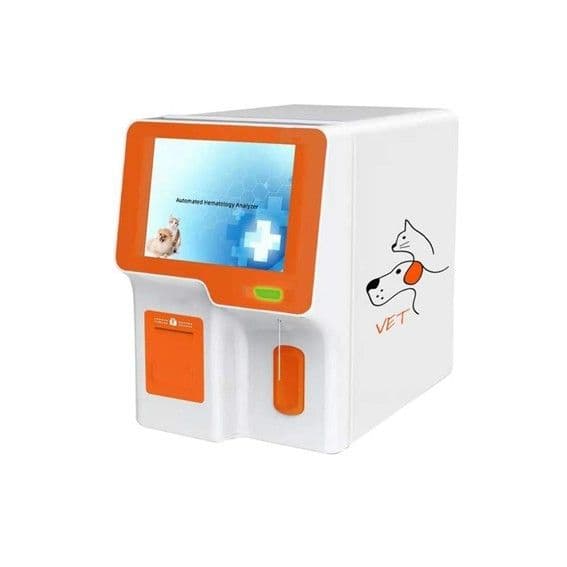
A CBC machine gives a veterinary clinic a complete blood count while the patient is still in the building. Before comparing models, it helps to know what the instrument measures, how the two common counting methods differ, and what the clinic has to supply to keep it running. This guide covers those points and compares two HQS models: the 3-part HH-8300 and the 5-part HH-8500.
What an in-clinic CBC machine measures
A complete blood count machine counts and sizes the cells in a small sample of anticoagulated whole blood, usually collected in an EDTA tube. The results fall into three groups.
- Red cells: red blood cell count (RBC), hemoglobin (HGB), hematocrit (HCT) and the indices derived from them, such as MCV, MCH, MCHC and red cell distribution width (RDW).
- White cells: the total white blood cell count (WBC) and a differential that splits white cells into subgroups, either three or five depending on the analyzer.
- Platelets: the platelet count (PLT) and, on most instruments, mean platelet volume (MPV) and related values.
Alongside the numbers, the analyzer produces graphs. Histograms show the size distribution of red cells, white cells and platelets. Laser-based analyzers also draw scatter plots that separate white cell populations. These graphs help staff spot results that need a smear review, for example clumped platelets or an unusual cell population.
Impedance vs laser scatter: how cells are counted
Electrical impedance
In the impedance method, diluted blood passes through a small aperture with an electric current across it. Each cell interrupts the current for a moment, and the size of the pulse is proportional to the cell's volume. Counting the pulses gives the number of cells. Sorting them by size gives the histogram.
Impedance works well for red cells and platelets. After a lysing reagent shrinks the white cells, it can also separate them into three size bands. What it cannot do is look inside the cell, so it does not reliably tell eosinophils apart from neutrophils of a similar size.
Laser scatter
With laser scatter, cells flow one at a time through a laser beam while detectors measure the light scattered at different angles. Low-angle scatter relates to cell size. Wider-angle scatter relates to internal complexity, such as granules and the shape of the nucleus. Combining these signals separates neutrophils, lymphocytes, monocytes, eosinophils and basophils into distinct clusters on a scatter plot.
Most 5-part analyzers use both methods together: laser scatter for the white cell differential, impedance for red cells and platelets, and a separate photometric channel for hemoglobin.
3-part vs 5-part differential, and what "CBC with differential" means
A basic CBC reports the total white cell count together with red cell and platelet values. A CBC with differential also reports how the white cells divide into types, as both percentages and absolute counts.
A 3-part differential groups white cells by size: lymphocytes, mid-sized cells (monocytes plus some eosinophils and basophils) and granulocytes, which are mostly neutrophils. That answers many first questions, such as whether there is a neutrophilia, a lymphopenia or a stress pattern.
A 5-part differential reports neutrophils, lymphocytes, monocytes, eosinophils and basophils separately. Eosinophil counts matter in parasitic and allergic workups, and having them as a separate number reduces manual counting. The trade-off is a more complex instrument that uses more reagents.
- Clinics that mostly run wellness and pre-anesthetic screening often find a 3-part differential sufficient, with a smear review when results look abnormal.
- Referral hospitals, emergency services and practices with a heavy internal medicine caseload tend to value the extra detail of a 5-part differential.
Species profiles
Animal blood differs from species to species. Feline red cells are smaller than canine ones, cat platelets are large enough to overlap with red cells in size, and equine blood settles quickly in the tube. A vet hematology analyzer handles these differences with species profiles: sets of counting thresholds and reference intervals that the operator selects before each run.
Check that the built-in profiles cover the animals you treat, and whether custom profiles can be added. The HH-8300 lists 11 preset species profiles (dog, cat, horse, pig, cow, sheep, monkey, mouse, goat, rabbit and potbellied pig) plus 14 custom profiles.
Sample volume and sample modes
Sample volume matters most for small patients such as cats, puppies, rabbits and rodents. A smaller aspiration volume leaves more of a limited sample for chemistry or a repeat test.
- Whole blood mode: venous blood in EDTA is aspirated directly. The HH-8300 uses 9.6 µL of whole blood and the HH-8500 uses 20 µL.
- Prediluted mode: a small capillary sample is diluted outside the analyzer and then run. The HH-8300 offers a capillary predilution mode with 20 µL.
Speed is rarely the deciding factor. Both HQS models list 60 tests per hour, so the decision usually comes down to the differential, the sample volume and the running costs.
Reagents, controls and calibration
An automated hematology analyzer uses reagents on every run and during its startup and shutdown cleaning cycles. Plan for these running requirements before you compare instruments.
- Reagent set: impedance analyzers typically use a diluent, a lyse and a cleaning solution. Laser analyzers usually need additional reagents for the differential channel. Ask for consumption per test and per day, including cleaning cycles.
- Controls: commercial control blood at normal, low and high levels, run on a fixed schedule to confirm the analyzer reads correctly.
- Calibration: periodic calibration with a calibrator material, and again after major service or repairs.
- Local supply: reagents have shelf lives and storage temperatures, and an opened pack has a limited in-use life. A reliable local source matters as much as the instrument.
Running cost depends on daily sample numbers, cleaning cycles, and whether opened reagent packs are used up before they expire.
The HH-8500 includes QC and calibration management on the analyzer, which keeps control records in one place. For either model, request the reagent and control set as part of the quotation, not as an afterthought.
Data: storage, printing and LIS
- Storage: both HQS models store more than 200,000 results, so earlier counts can be reviewed on the analyzer itself.
- Printing: decide whether you need printed reports in the consult room. For the HH-8300, list an external printer in the quotation if you need one.
- LIS connection: a link to a laboratory information system or practice software removes manual transcription. The HH-8500 supports two-way LIS communication. Confirm the connection method with your software provider before ordering.
HH-8300 vs HH-8500 comparison
The table below lists the published specifications of the two HQS models in the hematology analyzer category. Where a cell says "confirm", the item is not listed on the model page and should be checked with the quotation.
| Item | HH-8300 | HH-8500 |
|---|---|---|
| White cell differential | 3-part | 5-part |
| Measuring method | Electrical impedance, SFT hemoglobin | Triangular laser scatter, impedance, SFT hemoglobin |
| Reported parameters | 21 | 23 |
| Graphs | 3 histograms (RBC, WBC, PLT) | 4 scatter plots, 3 histograms |
| Whole blood sample | 9.6 µL | 20 µL |
| Prediluted capillary mode | 20 µL | Confirm |
| Throughput | 60 tests per hour | 60 tests per hour |
| Species profiles | 11 preset, 14 custom | Confirm |
| Result storage | More than 200,000 | More than 200,000 |
| Touch screen | 10-inch | 11.5-inch |
| LIS | Confirm | Two-way |
| QC and calibration management | Confirm | Yes |
| Power supply | Confirm | AC 110–240 V |
The HH-8300 suits clinics that want a small whole blood sample, a capillary predilution option and a wide set of preset species. The HH-8500 suits practices that want eosinophils and basophils reported separately, scatter plots for review, and results sent straight to practice software.
When a clinic also needs a chemistry analyzer
A CBC machine is only one kind of blood analysis machine, and it looks only at cells. Organ function, glucose, proteins and electrolytes need a chemistry analyzer, and pre-anesthetic panels, senior wellness checks and most sick-patient workups use both. If you are planning an in-house lab, look at the two together: total sample volume per patient, bench space, and how reagents for both will be supplied.
HQS offers two approaches in its veterinary chemistry analyzer range. The HC-120VP is a rotor-based point-of-care analyzer that uses 90–120 µL of sample, with 12 minutes per rotor. The HC-3002B1 is a semi-automatic open system; ask which reagent kits are supported for it.
Checklist before you request a quotation
- Decide between a 3-part and a 5-part differential, and confirm which parameters the exact model reports.
- List the species you test and check them against the preset and custom profiles.
- Estimate daily sample numbers so reagent consumption and pack sizes can be matched to your workload.
- Ask for the reagent set, controls, calibrator and local supply arrangements.
- Confirm sample modes and volume, printer or LIS connection, power supply, training and service.
Frequently asked questions
What is the difference between a CBC and a CBC with differential?
A CBC reports red cell values, platelets and the total white cell count. A CBC with differential adds the split of white cells into types: three groups on a 3-part analyzer, five on a 5-part analyzer.
Is a hemogram machine the same as a CBC analyzer?
Yes. "Hemogram", "complete blood count" and "CBC" describe the same set of tests, so a hemogram machine and a CBC analyzer are the same type of instrument. Check the differential, species profiles and sample volume rather than the name.
Can one CBC test machine run dogs, cats and horses?
Yes, if it has a profile for each species. The analyzer applies different counting thresholds per species, so the operator selects the right profile before each sample. The HH-8300 lists 11 preset profiles, including dog, cat and horse, plus 14 custom ones.
How often should controls be run on a veterinary hematology analyzer?
Follow the manufacturer's instructions and your own quality policy. Many clinics run controls on each day of use and again after a new reagent lot, maintenance or calibration.
Do I still need a microscope if I have a CBC machine?
Yes. The analyzer counts cells and flags unusual patterns, but a stained smear is still needed to check morphology, platelet clumps, parasites and cells the analyzer cannot classify. Interpretation stays with the veterinarian.