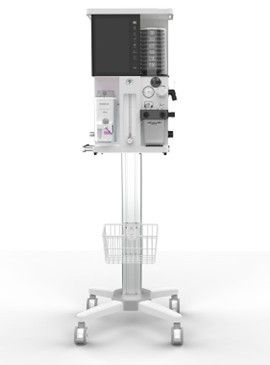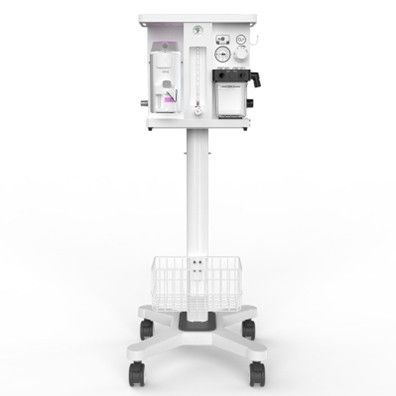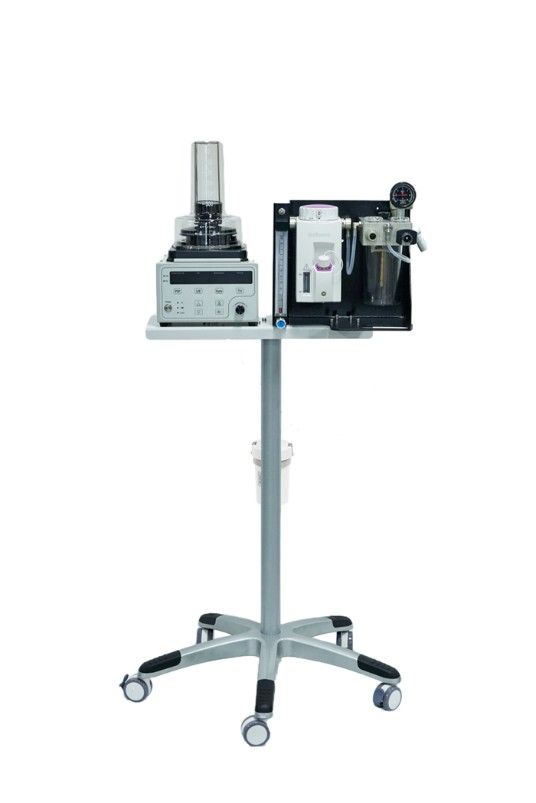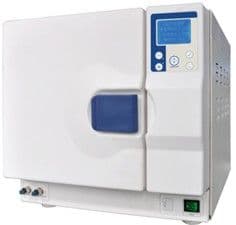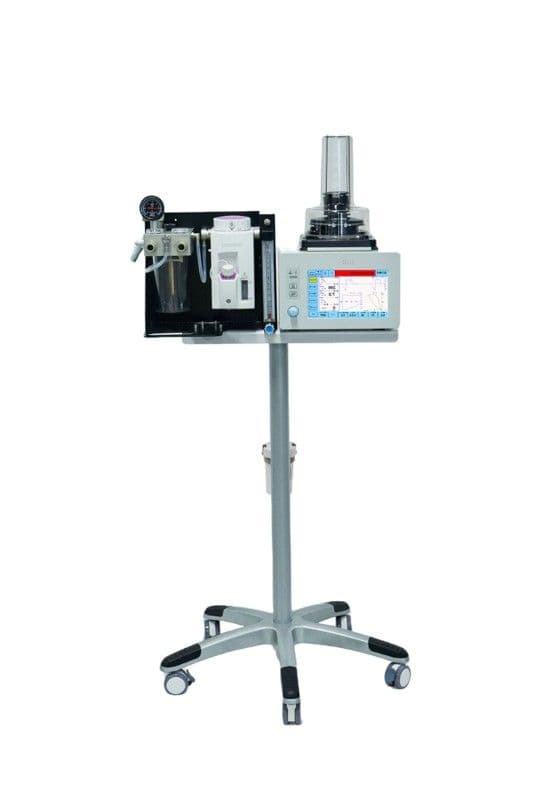
A vet anesthesia machine is a gas-delivery system, not a single box. It takes oxygen from a supply, meters it, adds a controlled concentration of inhalant agent and delivers the mixture through a breathing circuit to the patient, while waste gas is carried away. When you compare machines for a clinic or hospital, the useful questions are about those parts and how they fit your caseload, your oxygen supply and your scavenging arrangement.
Below we cover the main components, circuit types, ventilators, machine formats and quotations, then compare the HQS anesthesia machine range.
The main parts of a vet anesthesia machine
Every machine, from a compact manual unit to a ventilator workstation, follows the same gas path.
Oxygen supply and flowmeter
Oxygen arrives from a cylinder, a central pipeline or an oxygen concentrator, usually through a pressure regulator. The flowmeter sets the fresh gas flow in litres per minute. Check its range against your smallest and largest patients; a low range gives finer control for cats and small dogs. The oxygen flush valve delivers a high, unmetered flow that bypasses the vaporizer.
Anesthesia vaporizer
The vaporizer turns liquid inhalant into vapor at a set percentage. Precision vaporizers are agent-specific, so an isoflurane vaporizer is filled only with isoflurane and a sevoflurane vaporizer only with sevoflurane. Ask about the mounting system (fixed, or a removable bar mount such as Selectatec), the filling system (funnel fill or a keyed filler) and the service interval the manufacturer recommends.
Common gas outlet
After the vaporizer, fresh gas leaves the machine at the common gas outlet. Some machines add an auxiliary common gas outlet (ACGO) with a switch, so one machine can feed either a circle system or a non-rebreathing circuit.
Breathing circuit and CO2 absorber
The breathing circuit links the machine to the endotracheal tube or mask. In a circle system, exhaled gas passes through a canister of CO2 absorbent granules and is reused. The absorbent changes color as it is exhausted and must be replaced regularly.
Pop-off (APL) valve and pressure gauge
The pop-off valve, also called the adjustable pressure-limiting (APL) valve, lets excess gas leave the circuit. For a spontaneously breathing patient it normally stays open. It is closed briefly to give a manual breath or to run a leak test, then reopened. A valve left closed lets pressure build in the patient's airway, so the pressure gauge should always be in view.
Reservoir bag
The reservoir bag holds gas for each breath, shows how the patient is breathing and is squeezed for manual breaths. Bag size follows patient size, so most clinics stock several.
Scavenging
Waste gas leaving the pop-off valve should be captured, not released into the room. Active systems connect to an extraction unit; passive systems route gas outdoors or into an activated charcoal canister. Scavenging parts are often quoted separately.
Rebreathing vs non-rebreathing circuits
Rebreathing (circle) systems
A circle system uses one-way valves and a CO2 absorber, so exhaled gas can be cleaned and breathed again. Fresh gas flows can be lower, which saves oxygen and inhalant and keeps the gas warmer and more humid. The trade-off is extra resistance and dead space, which matters more as patients get smaller. Circle systems are generally used for medium and large dogs and for many cats.
Non-rebreathing circuits and the Bain
These circuits have no absorber. They rely on a high fresh gas flow to wash exhaled CO2 out of the circuit. Common versions include the Bain, a coaxial design with fresh gas in the inner tube, the Jackson-Rees and the Ayre's T-piece. Resistance is low, which is why these circuits are generally chosen for very small patients such as kittens, toy breeds and small exotics. The cost is higher oxygen and agent use per minute.
The weight at which a team switches circuits varies between references and clinics; circuit, flows and protocol for each patient are decisions for the veterinary team. For purchasing, the point is simple: if you see very small patients and larger dogs, you need a machine that supplies both circuit types, with the hoses, bags and connectors for each.
Anesthesia ventilator options
On a manual machine, the anesthetist squeezes the bag whenever breathing support is needed. An anesthesia ventilator takes over that task during longer procedures. The common drive types are:
- Pneumatic (gas-driven) bellows ventilators, which use compressed gas, usually oxygen, to drive the bellows. Your supply must cover both drive gas and fresh gas.
- Electronically controlled ventilators, with digital settings for tidal volume, rate and I:E ratio, often with an internal battery.
- Turbine ventilators, which generate the drive flow internally instead of consuming compressed drive gas.
When you compare a veterinary ventilator, look at the tidal volume range and bellows sizes first. A bellows sized for a large dog is hard to control for a 3 kg cat, which is why some machines offer two bellows. Then check modes, PEEP, alarms and battery backup.
Portable, trolley and large-animal machines
A portable anesthesia machine is light enough to move between rooms or take on ambulatory work, and manual units that need no electricity suit sites with unreliable power. The trade-off is usually fewer flowmeters, one vaporizer mount and no integrated ventilator.
Trolley machines and workstations are the usual choice for a dedicated surgery room. They have room for a ventilator, monitor shelf, drawers and gas cylinders.
Large-animal machines for horses and cattle are a separate class, with much larger circuits, absorbers, bellows and flow capacity. If you treat large animals, check tidal volume and flow ranges against your actual patients before shortlisting.
HQS veterinary anesthesia equipment compared
The HQS range runs from manual machines that need no electricity to workstations with a built-in ventilator. H902-C and H-A30 are manual machines. H1200-1 is a gas-driven main unit to which a ventilator can be added. H1200-2, H1200-3, H1200-5 and H-A70 include a ventilator. Compare the ventilation you need first, then the vaporizer, flowmeter and CO2 absorber of each veterinary anaesthetic machine.
| Model | Type | Key specifications | Check in the quotation |
|---|---|---|---|
| H902-C | Manual machine | No electricity needed; closed, semi-closed and semi-open circuits; O2 and N2O flowmeters 0–10 L/min; manual tidal volume 20–1,500 mL | A ventilator (TH-1 or TH-1A) is optional; list it separately |
| H-A30 | Compact manual machine | Rebreathing and non-rebreathing circuits (ACGO switch); O2 flowmeter 0–4 L/min; one Selectatec vaporizer mount; CO2 absorber 1,400 mL; ≤22 kg with stand | Agent and filling system for the vaporizer; whether the trolley is included |
| H1200-1 | Gas-driven machine, ventilator optional | Main unit without ventilator; V-60V or V-80V optional; airway pressure gauge −30 to 60 cmH2O; vaporizer isoflurane 0.2–5% or sevoflurane 0.2–8% | Ventilator model, if needed; oxygen supply connection |
| H1200-2 | Integrated ventilator | 9-inch touch screen; VCV, PCV, spontaneous and manual modes; tidal volume 20–1,600 mL; PEEP 3–20 cmH2O; two bellows, 50–300 mL and 300–1,500 mL | Bellows for your smallest and largest patients; vaporizer agent |
| H1200-3 | Pneumatic ventilator | IPPV and manual; I:E 3:1 to 1:3; tidal volume 20–1,600 mL (machine), 5–1,600 mL (manual); O2 flush 25–75 L/min | Driving-gas supply for the ventilator; vaporizer included |
| H1200-5 | Digital ventilator | IPPV, machine or manual control; 4–60 bpm; tidal volume 20–1,500 mL; minute volume ≥18 L/min; internal battery over 2 h | Bellows size for your patients; vaporizer agent |
| H-A70 | Workstation with turbine ventilator | Modes VS, VPS, VCV, PCV and SIMV; tidal volume 5–1,500 mL; 10.1-inch touch screen; Li-ion battery, at least 120 min | CO2 and anesthetic-gas monitoring are options; mainstream or sidestream sampling |
What to itemize in a quotation
Two quotations for the same model can describe very different packages. Ask for each item on its own line:
- The machine itself, and whether the trolley or stand is included.
- The vaporizer: model, intended agent, filling system and mounting arrangement.
- Breathing circuits, reservoir bags, masks and connectors for your patient range.
- The ventilator, if any, with its bellows sizes.
- Patient monitoring, including any CO2 or anesthetic-gas module.
- Oxygen source and the oxygen inlet the machine requires.
- Scavenging components.
- Electrical supply, installation training, leak-test instructions and replacement consumables.
A ventilator, monitor or oxygen concentrator pictured next to a machine is not automatically part of the quoted package. When two offers differ in cost, the itemized list usually explains why.
Routine checks before each anesthetic
A pre-use check takes a few minutes. Follow the instructions for your model; a typical leak test on a circle system runs like this:
- Check the oxygen supply, the vaporizer fill level and the color of the absorbent.
- Assemble the circuit and attach the reservoir bag.
- Close the pop-off valve and block the patient end of the circuit.
- Fill the circuit with oxygen until the gauge reads about 30 cmH2O, then turn the flow off.
- The pressure should hold steady. A falling reading points to a leak in a hose, seal, canister or bag.
- Open the pop-off valve to release the pressure, and confirm it is open before connecting the patient.
A Bain needs its own check that the inner fresh gas tube is intact and connected.
Frequently asked questions
What are the main anesthesia machine parts?
Oxygen supply and regulator, flowmeter, vaporizer, common gas outlet, breathing circuit, CO2 absorber, pop-off (APL) valve, pressure gauge, reservoir bag and scavenging connection. A ventilator and monitor may be added.
When is a Bain circuit used in anesthesia?
A Bain is a low-resistance non-rebreathing circuit, generally used for very small patients, and it needs a higher fresh gas flow than a circle system. The final choice rests with the veterinary team.
What does the pop-off valve on an anesthesia machine do?
It releases excess gas from the breathing circuit to the scavenging system. It stays open during spontaneous breathing and is closed only briefly, for a manual breath or a leak test.
Is a portable anesthesia machine enough for a small clinic?
For short procedures with spontaneous breathing, a compact manual machine is often enough. For longer surgery or mechanical ventilation, compare ventilator models on the anesthesia machine category page and request a configured quotation.