A Chemistry Analyzer can bring routine biochemical testing closer to the consultation room, supporting clinical decisions for dogs, cats, horses, and other veterinary patients without sending every chemistry profile to an outside laboratory. For a small clinic, however, capacity is not only a question of result speed or stored records. It depends on whether the analyzer’s sample format, consumable supply, environmental limits, training requirements, and service support fit the clinic’s actual workflow.
Before comparing individual units, purchasers can review the broader veterinary Chemistry Analyzer category alongside the clinic’s hematology, imaging, anesthesia, and inpatient-monitoring plans. Chemistry results are often interpreted with other clinical findings, so an analyzer purchase should not be isolated from the wider diagnostic workflow.
Evidence Available for This Decision
The available information consists of manufacturer-supplied specifications for two veterinary chemistry analyzers: the HC-3002B1 and the HC-120VP. These data describe stated functions, physical specifications, operating conditions, sample requirements, storage capacity, and selected workflow features. They do not provide independent clinical validation, local distributor coverage, consumable pricing, certification documents, import registration status, warranty duration, repair turnaround, or installed-base service data.
No external sources were supplied for this comparison. Consequently, procurement decisions should treat the published specifications as a basis for supplier questions rather than as proof that a particular configuration will meet every clinic’s throughput, compliance, or service requirement.
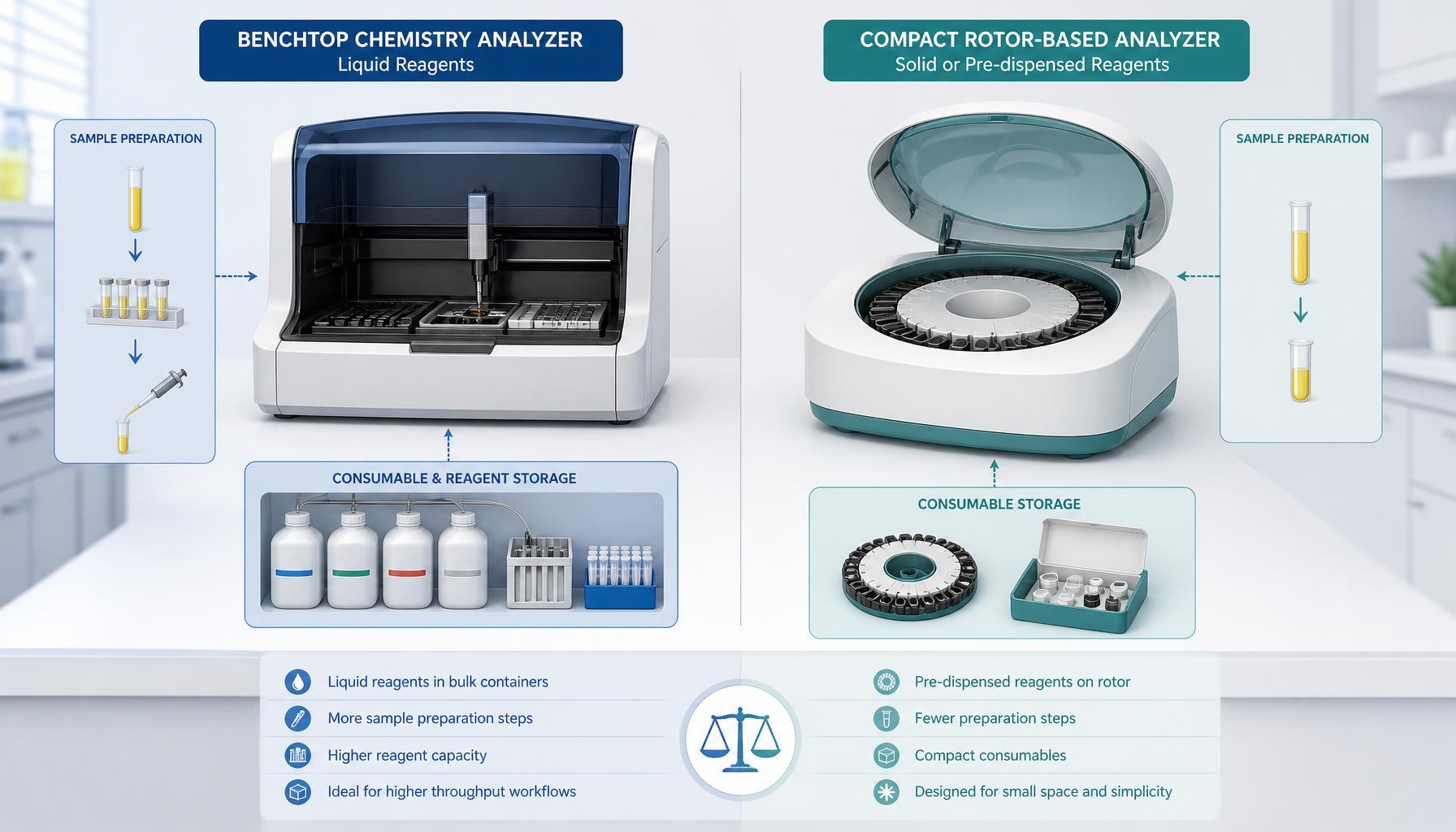
AI-generated illustration showing two different Chemistry Analyzer workflow concepts; it is not a photograph of either listed model and does not represent comparative performance testing.
What the Specifications Support
HC-3002B1: Benchtop chemistry workflow with listed liquid-handling specifications
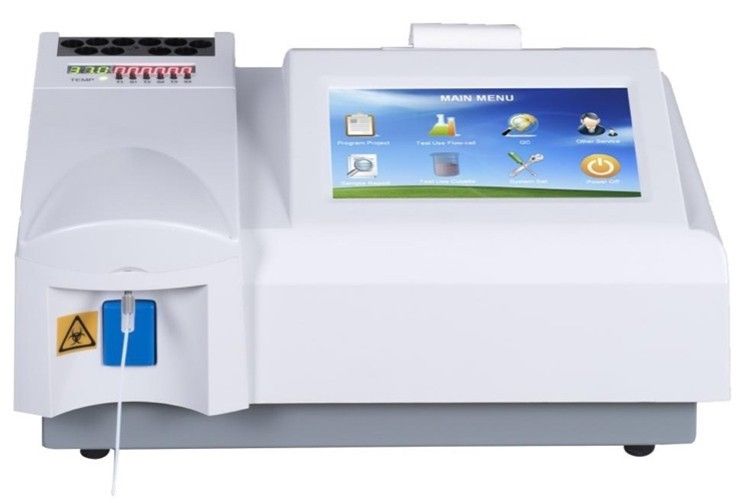
The manufacturer describes the HC-3002B1 as a veterinary chemistry analyzer with kinetic, end point, two-point, and absorbance test modes. Its documentation lists seven standard filter wavelengths at 340, 405, 492, 510, 546, 578, and 630 nm, plus one free position. The stated sample-volume range is 0 to 3000 µL, with at least 500 µL recommended.
For site planning, the supplied specifications list a 340 × 270 × 160 mm footprint, 5 kg weight, 100–240 VAC power at 50–60 Hz, and 100 VA consumption. The published operating environment is 0°C to 40°C with humidity at or below 80%. The unit is described as having 10 incubators, three timers, an internal thermal printer, an RS-232 interface, and storage for at least 10,000 results.
These details support a procurement discussion about bench allocation, power availability, sample-volume suitability, printer-paper supply, and data-export expectations. They do not establish which reagents, controls, calibrators, cuvettes, tubing, or cleaning materials are included, approved, or locally stocked. Those items need to be specified in a quotation and service agreement.
HC-120VP: Compact rotor-based workflow
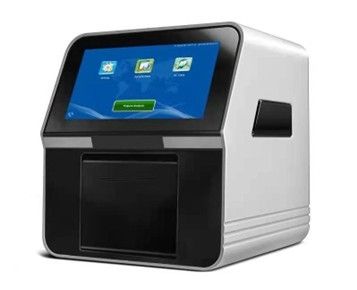
The HC-120VP is described as a veterinary POCT automated biochemistry analyzer using order-coded microfluidic rotors. The published sample range is 90–120 µL of anticoagulated whole blood, serum, or plasma. Its brochure states a 12-minute result time for the described rotor workflow and lists endpoint, kinetic, fixed-time, and turbidimetry methods.
The documentation lists a 7-inch touchscreen, built-in thermal printer, two USB ports, and storage for up to 500,000 results. Published installation information includes 100–240 VAC, 50/60 Hz, 100 VA power, a 4 kg weight, and an operating environment of 10–30°C with humidity at or below 85%.
The rotor format may simplify procurement for a clinic that prefers a panel-based consumable model, but the exact veterinary rotor order codes and analytes are not specified in the available data. A purchaser should therefore obtain the current panel menu, per-rotor packaging, storage conditions, expiry policy, minimum-order terms, and supply lead time before treating the stated workflow as a fit for routine chemistry demand.
Compare the Documented Configurations
| Decision point | HC-3002B1 | HC-120VP | What to confirm before purchase |
| Published sample format | 0–3000 µL listed; at least 500 µL recommended | 90–120 µL whole blood, serum, or plasma | Which sample types and volumes match the clinic’s most common patients, including small patients and exotic species |
| Consumable concept described | 32 µL quartz glass flow cell listed in configuration | Order-coded veterinary microfluidic rotors | Included consumables, required reagents or rotors, controls, calibrators, cleaning materials, storage conditions, and expiry management |
| Published workflow features | Multiple test modes, 10 incubators, three timers, internal printer | Barcode rotor identification, automatic workflow functions described, built-in printer | Which workflow steps remain the clinic’s responsibility and what training is included for each staff role |
| Operating environment | 0°C to 40°C; humidity at or below 80% | 10–30°C; humidity at or below 85% | Whether the proposed laboratory location remains within the model-specific environmental limits throughout the year |
| Connectivity stated | RS-232 | Two USB ports | Whether the analyzer can export results in a usable format for the practice-management system or electronic records |
| Data storage stated | At least 10,000 results | Up to 500,000 results | Data retention, backup responsibility, export process, software version, and support for result retrieval |
| Published physical data | 340 × 270 × 160 mm; 5 kg | 4 kg; dimensions not supplied in available data | Actual installed footprint, clearance for consumables, paper replacement, ventilation, and service access |
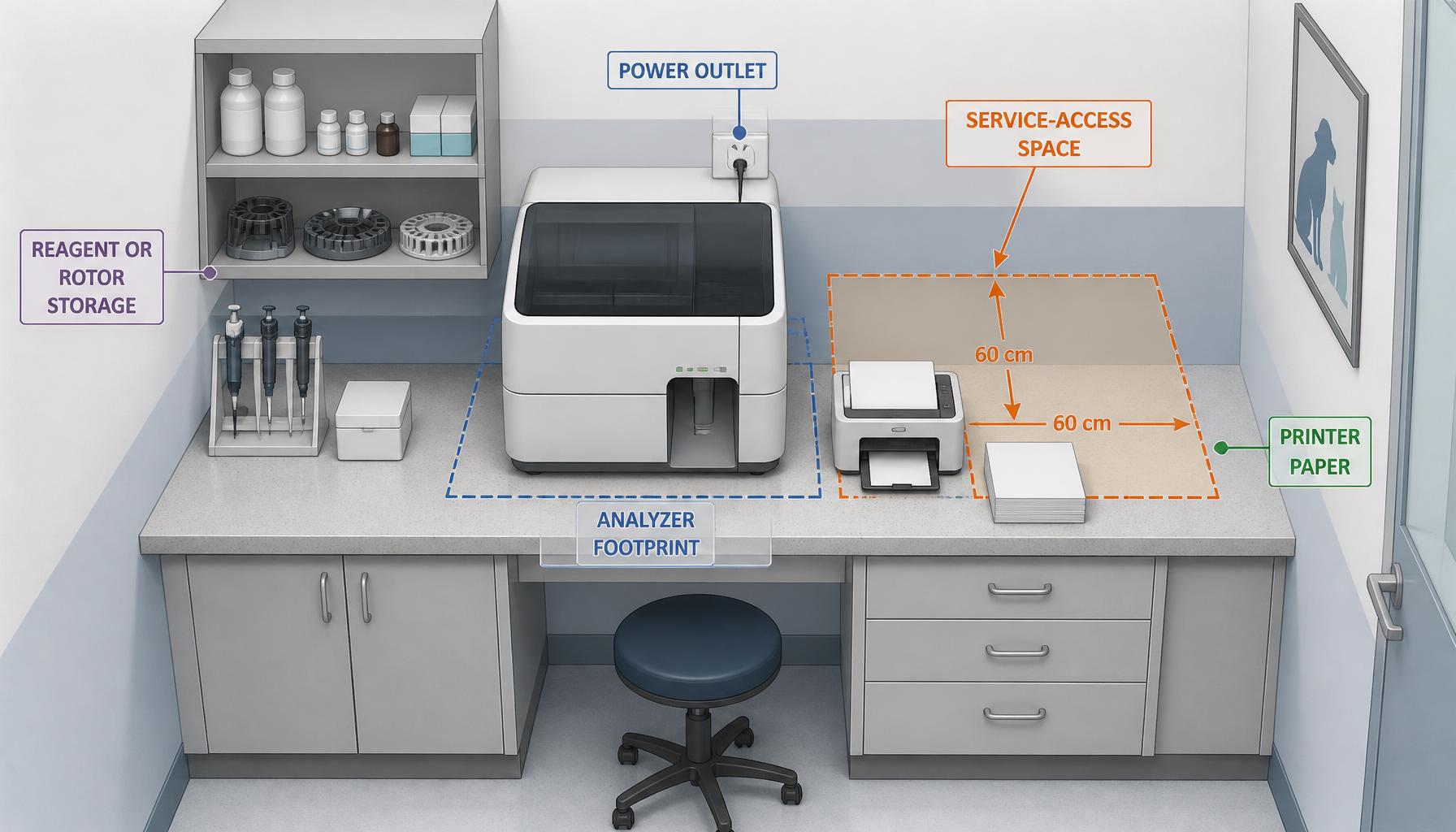
AI-generated illustration of installation planning for a compact veterinary laboratory; dimensions and clearances are conceptual and must be confirmed against the selected model’s current documentation.
Prepare a Model-Specific Enquiry
A meaningful enquiry should distinguish included hardware from recurring requirements. Do not assume that a printer, a stated flow cell, or a rotor workflow means that the first months of consumables, quality-control materials, training, and support are included.
- Request the exact configuration code, software version, language options, included accessories, and a packing list for the quoted analyzer.
- Ask for the current veterinary assay or rotor menu, including analytes, sample types, order codes, pack size, shelf-life requirements, and storage requirements.
- Ask which consumables are mandatory for routine use: reagents or rotors, controls, calibrators, sample cups or tubes, printer paper, flow cells, cleaning materials, and any proprietary accessories.
- Confirm whether the supplier or local distributor stocks consumables and critical spare parts, and request written lead times for items not held locally.
- Request the warranty terms, exclusions, labor coverage, travel charges, remote support process, on-site service availability, and expected repair route if the unit cannot be restored locally.
- Ask who provides installation acceptance, initial staff training, refresher training, and documentation of completed training.
For the HC-120VP, the quotation should identify the exact rotor panels that will be supplied. The manufacturer data explicitly advises confirmation of starter rotors, controls, printer paper, sample tools, warranty, export format, software version, language, and service terms. Those items should be documented contractually rather than left to a brochure description. The listed HC-120VP configuration provides a useful starting point for that discussion.
For the HC-3002B1, ask whether the 32 µL quartz glass flow cell is supplied as standard, whether replacement cells are stocked, and which parts are treated as consumables versus service parts. The published 7-inch screen, internal thermal printer, and RS-232 interface do not answer whether a clinic will receive cabling, printer paper, export software, or integration assistance. These should appear on the supplier’s final offer for the HC-3002B1 Chemistry Analyzer.
Procurement Implications
A low-volume companion-animal clinic that mainly needs same-visit chemistry panels may place more weight on small sample requirements, panel availability, consumable shelf life, and the practicality of maintaining an adequate rotor inventory. On the documented information alone, the HC-120VP is the configuration to investigate when whole-blood, serum, or plasma samples in the stated 90–120 µL range and a rotor-based workflow are priorities. That is not a conclusion about clinical superiority; it is a workflow question that depends on the final panel menu and consumable contract.
A clinic with a planned laboratory bench, staff who can support a more conventional chemistry workflow, and a need to discuss multiple test modes may instead examine the HC-3002B1 more closely. Its available specification lists broader stated sample volumes, multiple measurement modes, controlled incubator settings, and a defined benchtop footprint. The decision still depends on reagent availability, routine cleaning responsibilities, replacement-part support, and training terms that are not contained in the supplied specifications.

AI-generated illustration of a procurement review for veterinary diagnostic equipment; it represents contract and workflow evaluation rather than a real clinic, supplier, or service outcome.
Clinics that also perform in-house blood counts should consider whether analyzer data can be exported and retained consistently with their hematology workflow. The relevant equipment category is available at veterinary hematology analyzers, but compatibility should be confirmed with the actual practice-management and laboratory-record systems rather than assumed from a USB or serial connection.
The practical capacity of a Chemistry Analyzer is therefore the capacity the clinic can sustain: an installed location within the specified environment, trained staff, available consumables, documented cleaning and maintenance responsibilities, accessible spare parts, and a service pathway that is clear before the purchase order is issued.