Choose a veterinary oxygen concentrator by adding up the flow your busiest moment needs, then buying the next size up. A 5 L/min unit suits a small clinic with one or two oxygen stations. An 8 L/min unit covers a recovery area plus an anesthesia machine or a few kennels. A 10 L/min unit suits a hospital with a busy ICU or several stations running together. This guide explains how to size the flow, what a concentrator can and cannot do, and how the six HQS oxygen concentrators compare.
How many liters per minute does a veterinary clinic need?
The rated flow of a concentrator is shared by everything connected to it. Start from the stations that can be in use at the same moment, not from the number of patients you treat in a day.
- List every oxygen point: anesthesia machine, recovery bed, ICU kennels or oxygen cage, nebulizer, flow-by or mask station.
- Write down the flow your own protocols use at each point, and mark which points are likely to run at the same time.
- Add those flows together. For illustration only, three stations drawing 2 L/min each at once need 6 L/min before any margin.
- Leave headroom. A unit working at its limit all day has no spare capacity for a busy afternoon or for a new station next year.
If your total sits between two sizes, take the larger one. If two separate rooms need oxygen at the same time, compare one large unit with a splitter against two smaller units, because a single unit also means a single point of failure.
What does an oxygen concentrator deliver, and what can't it do?
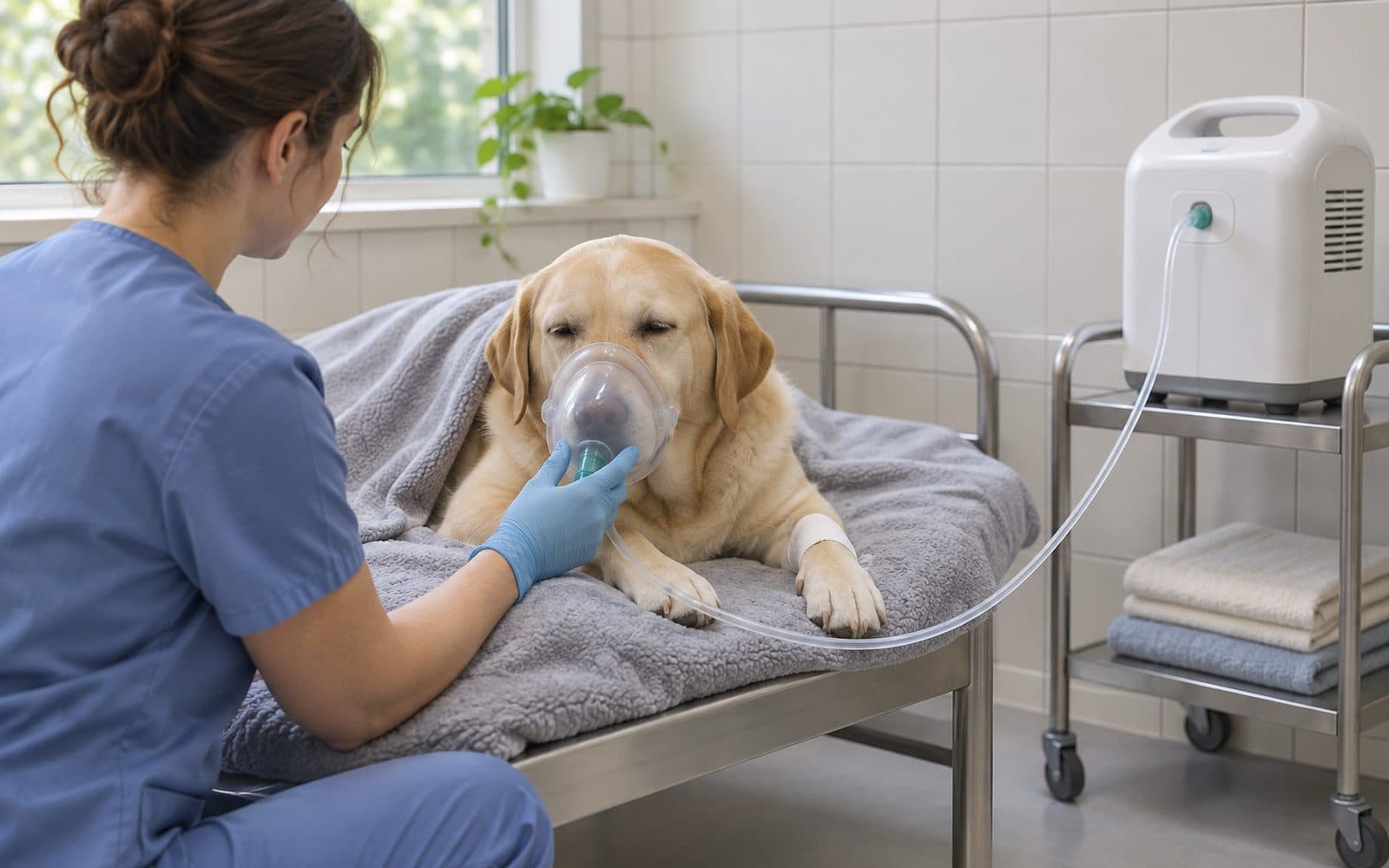
A concentrator takes in room air and separates oxygen from nitrogen using sieve beds, a method known as pressure swing adsorption (PSA). All six HQS models list an oxygen concentration of 93% (±3%), not 100%. That is suitable for oxygen supplementation by mask, flow-by, cage or nasal cannula, and many clinics also use it as the oxygen supply for anesthesia equipment, but check the points below first.
- Outlet pressure. The listed output is 6–10 PSI on the OC-5, OC-5BW and OC-10 (the OC-10 also lists 20 PSI), 58.6 kPa on the OC-5D and OC-8, and 50–70 kPa on the OC-10N. Confirm in the manual of your anesthesia machine or ventilator what inlet pressure it expects before connecting a concentrator to it.
- Power dependence. A concentrator stops when the power stops. Keep a cylinder as a backup for critical patients and for outages.
- Purity at flow. Read the purity statement together with the flow it applies to. The OC-8 page, for example, states 93% purity at 8 L/min.
- Oxygen safety. Keep open flames, smoking and oil or grease away from oxygen equipment.
5 L vs 8 L vs 10 L: how to choose
5 L/min: OC-5, OC-5D and OC-5BW
Right for a small animal clinic with a recovery bed and a couple of kennels, or one anesthesia station. The OC-5D is a double-flow model with a two-way splitter, so two points can be fed from one unit, and it has the lowest sound level in the range at under 45 dB(A). The OC-5 and OC-5BW are single-outlet units, and the OC-5 page notes that double-flow versions are available.
8 L/min: OC-8
The middle size for a clinic that has outgrown 5 L but does not need 10 L. It lists a flow of 1–8 L/min, maintains 93% purity at 8 L/min, weighs 19.2 kg and offers an optional 4-way oxygen splitter for several points. It can also be customized to a client's request.
10 L/min: OC-10 and OC-10N
For hospitals with an ICU, several kennels on oxygen, or more than one anesthesia room fed from the same machine. The OC-10 lists 0–10 L/min with double-flow versions available. The OC-10N is single-flow, has two sieve beds, lists five alarms (power failure, pressure, compressor error, overload and low oxygen) and can take an optional alloy barb for a 5-way splitter.
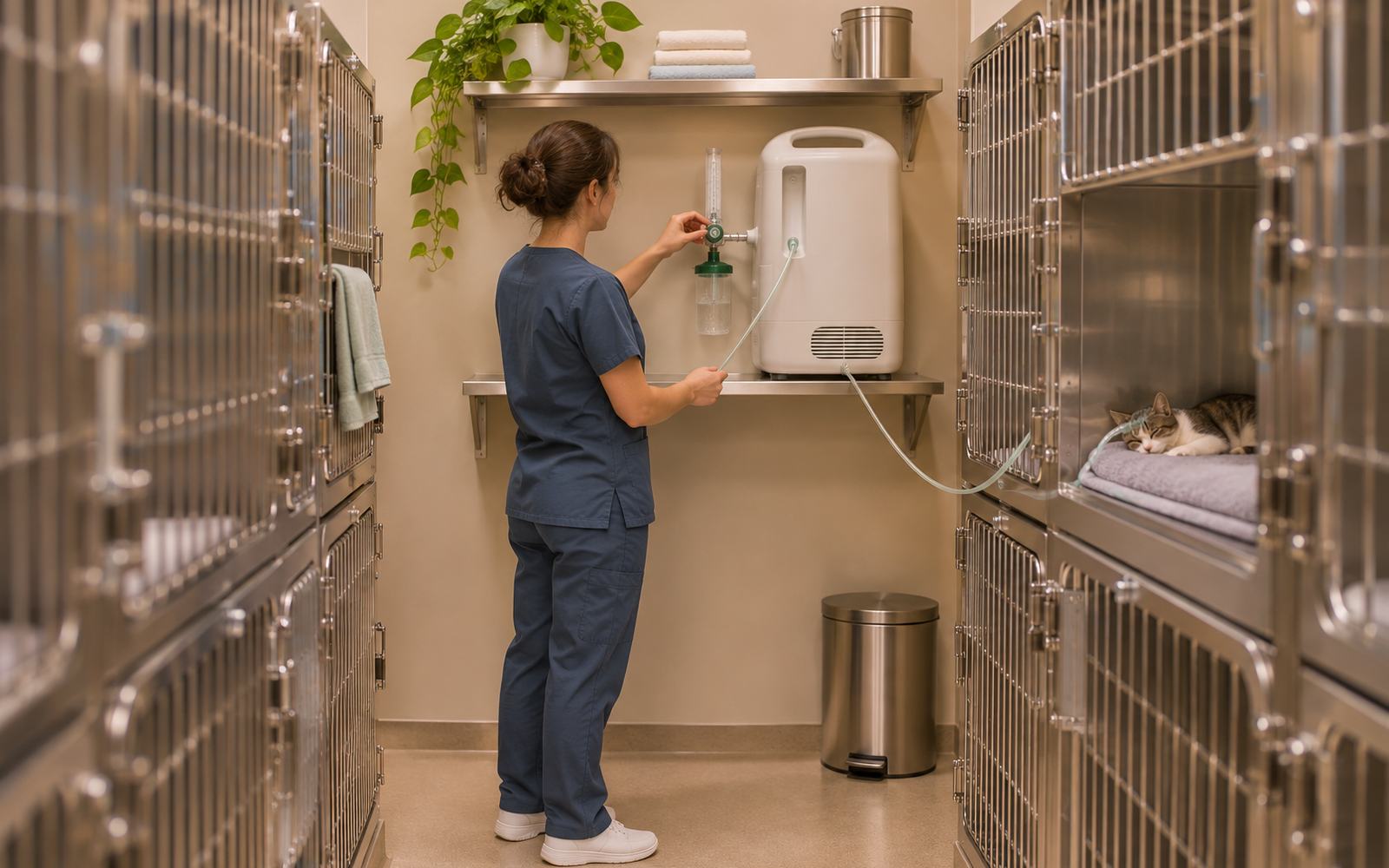
HQS oxygen concentrators compared

| Feature | OC-5 | OC-5D | OC-5BW | OC-8 | OC-10 | OC-10N |
|---|---|---|---|---|---|---|
| Oxygen flow | 0–5 L/min | 1–5 L/min | 0–5 L/min | 1–8 L/min | 0–10 L/min | 1–10 L/min |
| Oxygen concentration | 93% (±3%) | 93% (±3%) | 93% (±3%) | 93% (±3%) | 93% (±3%) | 93% (±3%) |
| Outlet pressure | 6–10 PSI | 58.6 kPa | 0.04–0.07 MPa | 58.6 ± 6 kPa | 6–10 PSI / 20 PSI | 50–70 kPa |
| Flow outlets | Single; double flow available | Double flow | — | Optional 4-way splitter | Single; double flow available | Single; optional 5-way barb |
| Power | ≤ 550 W | 510 VA | ≤ 480 W | 510 VA | ≤ 880 W | 800 W |
| Sound level | ≤ 50 dB | < 45 dB(A) | ≤ 50 dB | < 50 dB(A) | ≤ 50 dB | < 55 dB |
| Weight (net) | 24 kg | 15.9 kg | 23 kg | 19.2 kg | 27 kg | 28 kg |
| Size | 435 × 435 × 640 mm | 32 × 43 × 62 cm | 430 × 380 × 690 mm | 43 × 32 × 62 cm | 435 × 435 × 640 mm | 41 × 34 × 62 cm |
| Alarms and display | LCD with timing; power failure and high/low pressure alarms | Power off, pressure circulation fault and compressor fault alarms; optional OCSI indicator | LCD with accumulated and set time | Optional OCSI indicator | LCD with timing; power failure and high/low pressure alarms | Five alarms including low oxygen and overload |
Power is listed in watts for some models and in VA for others, so compare the figures only within the same unit and ask for the full electrical data when planning the circuit. The OC-5D and OC-8 list mains of 220 V ± 22 V at 50 Hz or 110 V ± 10 V at 60 Hz, and the OC-10N lists 220 V/50 Hz or 110 V/60 Hz.
Single flow or double flow, and what about splitters?
A single-flow unit feeds one flow meter. A double-flow unit has two outlets that are set separately, which helps when a recovery bed and a kennel need different settings. A splitter divides one flow among several points, so each extra point lowers what is left for the others. Add splitter points to the sizing exercise above rather than treating them as free capacity. The OC-5D uses a two-way splitter, the OC-8 offers a 4-way splitter as an option and the OC-10N an optional barb for a 5-way splitter.
Installation, noise and maintenance checks
- Place the unit where it can draw in room air freely, with space around the vents, and away from heat sources and dust.
- Check the floor space and the doorway against the size and weight in the table. All six units are on the order of 60–70 cm tall.
- Compare sound levels with where the unit will stand. A model under 45–50 dB(A) is easier to live with in a ward than one that is audible across the room.
- Look at how filters are replaced. The OC-5D, OC-8 and OC-10N pages state that filters can be changed without opening the machine shell.
- Ask for the supplied accessories. The OC-10N page lists a bacterial filter, humidifier bottle, filter, two nasal cannulas and two pre-filters.
- Read the hour counters. The OC-5, OC-5BW and OC-10 show present and accumulated working time on the LCD, which makes service planning easier.
FAQ
Can a veterinary oxygen concentrator run 24 hours a day?
The OC-5, OC-5D, OC-8 and OC-10 pages state that the units support 24-hour continuous operation, and the OC-10N describes stable 24-hour operation. Ask for the duty details of the exact configuration you plan to order.
What oxygen concentration do these units deliver?
All six models list 93% (±3%). The concentrator does not supply 100% oxygen, so plan for that if a protocol calls for it, and keep a cylinder available.
Can one concentrator supply two kennels or an anesthesia machine?
Yes, if the total flow of the connected points stays within the unit's rated flow and the outlet pressure suits the equipment. The OC-5D has two outlets, and splitters are offered on the OC-8 and OC-10N. Check the equipment manual for the pressure it needs.
Which model is the quietest?
The OC-5D lists the lowest sound level, under 45 dB(A). The OC-8 lists under 50 dB(A), the OC-5, OC-5BW and OC-10 list up to 50 dB, and the OC-10N lists under 55 dB.
Do I need a backup if I have a concentrator?
Yes. A concentrator needs mains power, so keep a cylinder or another backup for critical patients and for power cuts.
For specifications, configurations and quotations, see the product pages for the OC-5, OC-5D, OC-8 and OC-10. For how oxygen flow fits into an anesthesia setup, read our veterinary anesthesia machine guide. Warranty terms vary by model and order.