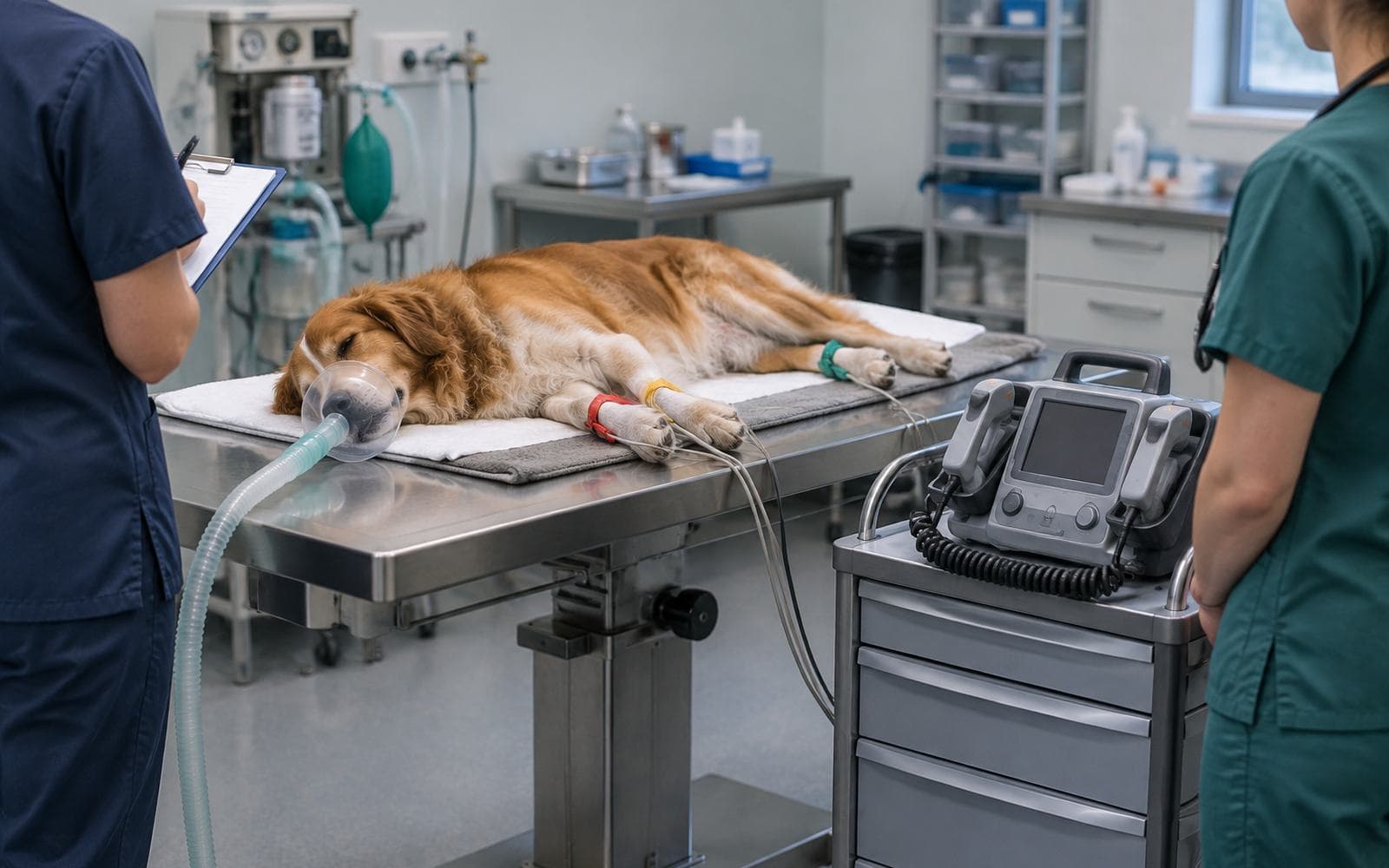
A veterinary defibrillator is needed when a patient's heart goes into ventricular fibrillation or pulseless ventricular tachycardia, the two arrest rhythms that an electric shock can correct. It does nothing for asystole or pulseless electrical activity, so it only earns its place in a clinic that already monitors ECG during anesthesia and has a team trained to run CPR. If your practice anesthetizes patients every day, runs an emergency or ICU service, or performs cardioversion, a defibrillator belongs on the crash cart. This guide explains when the device is used, what separates a basic unit from a defibrillator-monitor, and how the three HQS veterinary defibrillators compare.
What does a veterinary defibrillator do?
A defibrillator delivers a short, high-energy current across the heart. In ventricular fibrillation the ventricles quiver without pumping. The shock depolarizes the heart muscle at once, which gives the heart's own pacemaker a chance to restart an organized rhythm.
The same machine can also perform synchronized cardioversion. In this mode the shock is timed to the R wave on the ECG, so it does not land in the vulnerable part of the cardiac cycle. Cardioversion is used under anesthesia for some tachyarrhythmias, for example atrial fibrillation in dogs, and is mostly done in cardiology and referral settings. It needs a synchronized mode and a clean ECG signal.
Shockable and non-shockable rhythms
The decision to shock is made from the ECG, never from the clinical picture alone.
- Shockable: ventricular fibrillation (VF) and pulseless ventricular tachycardia (pulseless VT).
- Not shockable: asystole and pulseless electrical activity (PEA). These are treated with chest compressions, ventilation and drugs, not with a shock.
In dogs and cats, arrests often present as asystole or PEA, but VF can appear at any point during resuscitation, after drug administration, or in patients with heart disease, electrolyte problems or a long anesthetic. Veterinary CPR guidelines from the RECOVER initiative place defibrillation directly after rhythm diagnosis for VF and pulseless VT, followed by an immediate return to compressions. When the rhythm is shockable, time to the first shock matters, so the device has to be charged, close at hand and familiar to the team.
Does your clinic need one?
A defibrillator is one part of resuscitation readiness, not the first part. Check the basics before buying one:
- ECG monitoring during anesthesia and in the ICU, so a rhythm change is seen when it happens.
- A stocked crash cart with airway equipment, an oxygen source and emergency drugs.
- A team that has practised CPR roles and knows who calls the rhythm.
With those in place, a defibrillator is a reasonable purchase for:
- Clinics with a daily surgical list, especially those anesthetizing older, cardiac or critically ill patients.
- Emergency and 24-hour hospitals, and any practice with an ICU.
- Referral and cardiology services that plan elective cardioversion.
- Equine and mixed practices that run anesthesia for foals or small ruminants and want a unit with mains, battery and vehicle power.
A small consult-only practice that rarely anesthetizes will usually get more value from a good multiparameter monitor first. See the veterinary patient monitor range and our guide on setting up a mini veterinary monitor.
What to compare when choosing a veterinary defibrillator
Waveform and energy steps
Biphasic defibrillators reverse the current direction during the shock and are designed to work at lower energy than older monophasic units. All three HQS models use a biphasic waveform. Energy for animals is chosen by body weight, following published veterinary CPR guidance and the device manual, so the low end of the scale matters as much as the maximum. A cat or a toy-breed dog needs only a few joules. All three units offer steps of 0, 3, 5, 7, 10, 20, 30, 50, 100, 200, 300 and 360 J, which covers patients from cats to large dogs.
Manual, synchronized and AED modes
- Manual asynchronous: the clinician reads the ECG, selects the energy and delivers the shock. This is the mode used for VF and pulseless VT.
- Synchronized: needed for cardioversion. The DEF-8000C and DEF-8000D have it. The DEF-8000A is a non-synchronized unit.
- AED programs: automatic programs follow human energy protocols. On the DEF-8000C the options are adult 150/150/200 J or 120/120/150 J and child 50/50/75 J or 30/30/50 J. AED rhythm analysis was developed on human ECGs, so in veterinary work the manual mode, where the clinician confirms the rhythm and selects weight-based energy, is the one to rely on.
How the ECG is read
A defibrillator that can read the rhythm through its paddles lets you confirm VF without attaching separate leads, which saves seconds at the start of an arrest. The DEF-8000D reads ECG through paddles or a 3-lead or 5-lead cable. The DEF-8000C uses a 3-lead or 5-lead cable or the paddles and adds ST and arrhythmia analysis. The DEF-8000A has no built-in monitoring, so it needs a separate ECG monitor beside it.
Battery, charging and power
Charge time to full energy is under 10 seconds on all three models. Battery type and endurance differ more:
- DEF-8000A: sealed rechargeable lead-acid battery, 3.5 hours to full charge, about 35 shocks at 360 J on a full charge. Mains 110 V/60 Hz or 220 V/50 Hz, plus DC 12 V vehicle input.
- DEF-8000C: rechargeable lithium battery, two supplied. At least 4 hours for a full charge, then 120 minutes of monitoring and 30 discharges at 360 J. Mains 110 V/60 Hz or 220 V/50 Hz, plus DC 12 V vehicle input.
- DEF-8000D: two 11.1 V, 4000 mAh Li-ion batteries. Up to 10 hours of ECG monitoring or 60 full-energy discharges, 80% recharge in 3 hours and 100% in 5 hours. Mains 100–240 V, 50/60 Hz. DC 12 V vehicle power is an option.
Recording and documentation
A built-in printer records the rhythm before and after each shock, which helps with case notes and team debriefs. The DEF-8000C and DEF-8000D have a 50 mm thermal recorder with real-time, timed, alarm-triggered and discharge-triggered printing. The DEF-8000D also gives voice and visual charge prompts, and its display shows both selected and delivered energy.
HQS veterinary defibrillators compared

| Feature | DEF-8000A | DEF-8000C | DEF-8000D |
|---|---|---|---|
| Waveform | Biphasic (sine wave) | Biphasic | Biphasic |
| Modes | Non-synchronized external | Manual, synchronized and asynchronous | Manual external synchronous and asynchronous |
| Energy steps | 0–360 J (12 steps) | 0–360 J (12 steps) | 0–360 J (12 steps) |
| Charge time to 360 J | Under 10 s | 10 s maximum | Under 10 s |
| Monitoring | None built in | ECG, NIBP, temperature, SpO2, pulse | ECG (heart rate 20–350 bpm); SpO2 optional |
| ECG input | — | 3/5-lead cable or paddles | 3/5-lead cable or paddles |
| Display | — | 7-inch colour, 480 × 234 | 7-inch, 480 × 272 |
| Recorder | — | 50 mm thermal | 50 mm thermal |
| Battery | Lead-acid; about 35 shocks at 360 J | Lithium ×2; 120 min monitoring and 30 shocks at 360 J | Li-ion 4000 mAh ×2; up to 10 h ECG or 60 full-energy shocks |
| Power | 110/220 V AC, DC 12 V | 110/220 V AC, DC 12 V | 100–240 V AC; DC 12 V optional |
| AED | — | Optional adult and child programs | Optional |
In short, the DEF-8000A is a basic shock-only unit for a clinic that already has a separate ECG monitor at the table. The DEF-8000C combines a defibrillator with a five-parameter monitor, which suits a single resuscitation station. The DEF-8000D focuses on defibrillation with paddle ECG, the longest battery endurance of the three and a wide-range mains input, which suits emergency rooms, mobile work and regions with unstable power.
Practical setup and routine checks
- Keep the unit on the crash cart, plugged in, with paddles in their holders and conductive gel stored with it. Do not use alcohol on the paddles or the patient's skin, as it can ignite.
- Run the daily or per-shift check described in the manual, including battery status and the test the manufacturer specifies.
- Post a weight-based energy chart from your CPR protocol on the cart so nobody has to calculate during an arrest.
- Practise the sequence as a team: rhythm check, charge while compressions continue, clear, shock, and straight back to compressions.
- Check that the paddle sizes supplied suit your usual patients, and ask about accessories before ordering.
FAQ
Can a human defibrillator be used on animals?
A manual human defibrillator can deliver the shock, but it must offer low energy steps for small patients, and the clinician has to read the rhythm. Automatic AED analysis was designed for human ECGs and should not decide whether an animal is shocked.
Which rhythms should never be shocked?
Asystole and pulseless electrical activity. Shocking them does not help and delays compressions. Only ventricular fibrillation and pulseless ventricular tachycardia are shockable.
How much energy is used for a cat or small dog?
Energy is chosen by body weight according to published veterinary CPR guidelines such as RECOVER and the device manual. That is why the 3, 5, 7 and 10 J steps on these units matter for small patients.
Which HQS model can perform synchronized cardioversion?
The DEF-8000C and DEF-8000D both offer synchronized and asynchronous modes. The DEF-8000A is non-synchronized only.
Can the defibrillator run without mains power?
Yes. All three run on internal batteries, and all accept DC 12 V vehicle power (standard on the DEF-8000A and DEF-8000C, optional on the DEF-8000D). The DEF-8000D has the longest battery endurance: up to 10 hours of ECG monitoring or 60 full-energy discharges.
For specifications, configurations and quotations, see the DEF-8000D, DEF-8000C and DEF-8000A product pages. Warranty terms vary by model and order.