A veterinary nebulizer is a device that turns a liquid, usually sterile saline or a solution prescribed by a veterinarian, into a fine mist that an animal breathes in through a mask or inside a closed chamber. The mist moistens the airways and carries medication directly to the trachea, bronchi and lungs instead of through the bloodstream. Most clinics use a compressor (jet) nebulizer: a small air pump forces air through a narrow nozzle, the fast air stream pulls liquid up from the medicine cup and breaks it into droplets a few micrometres across, small enough to reach the lower airways.
What is a veterinary nebulizer?
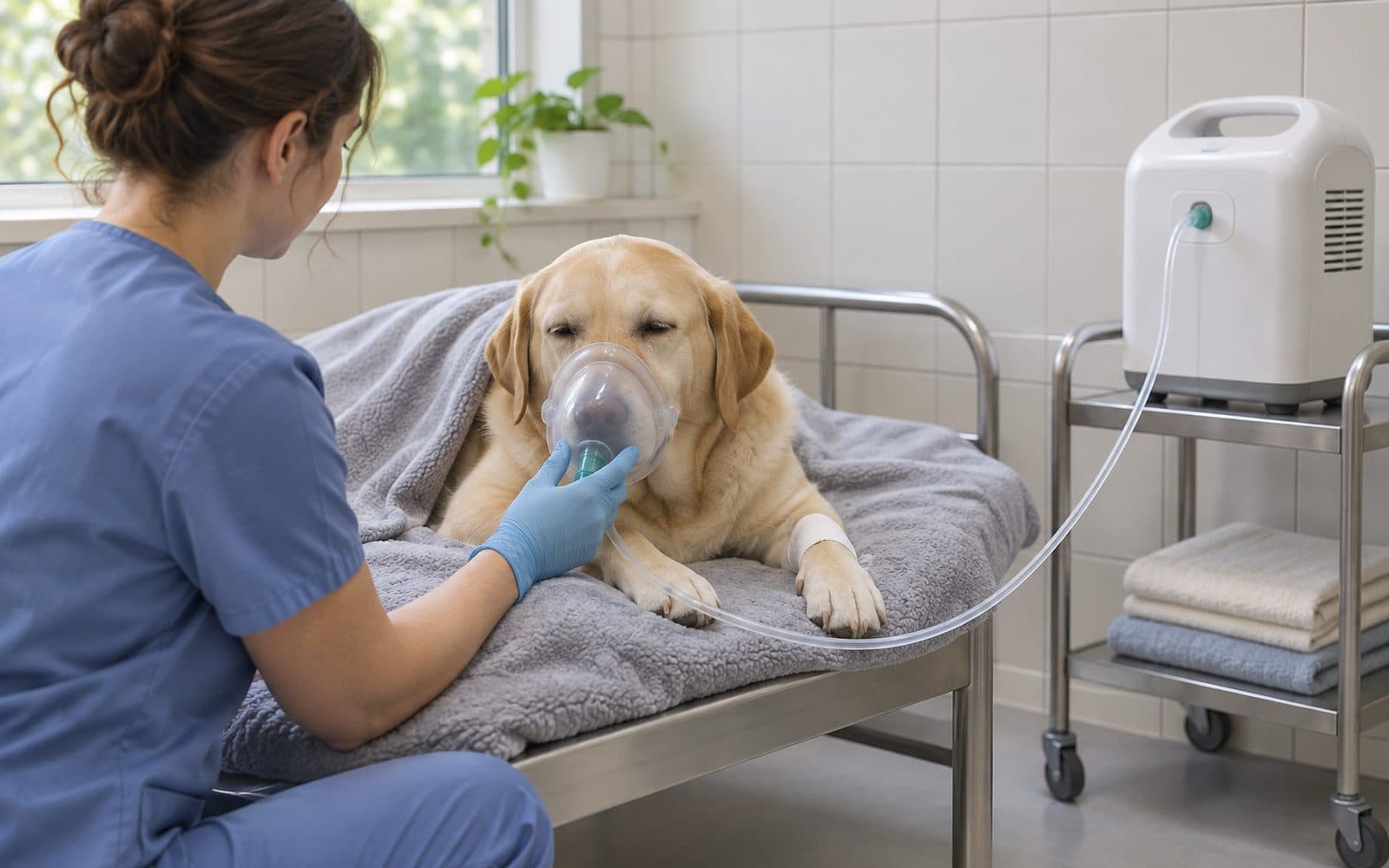
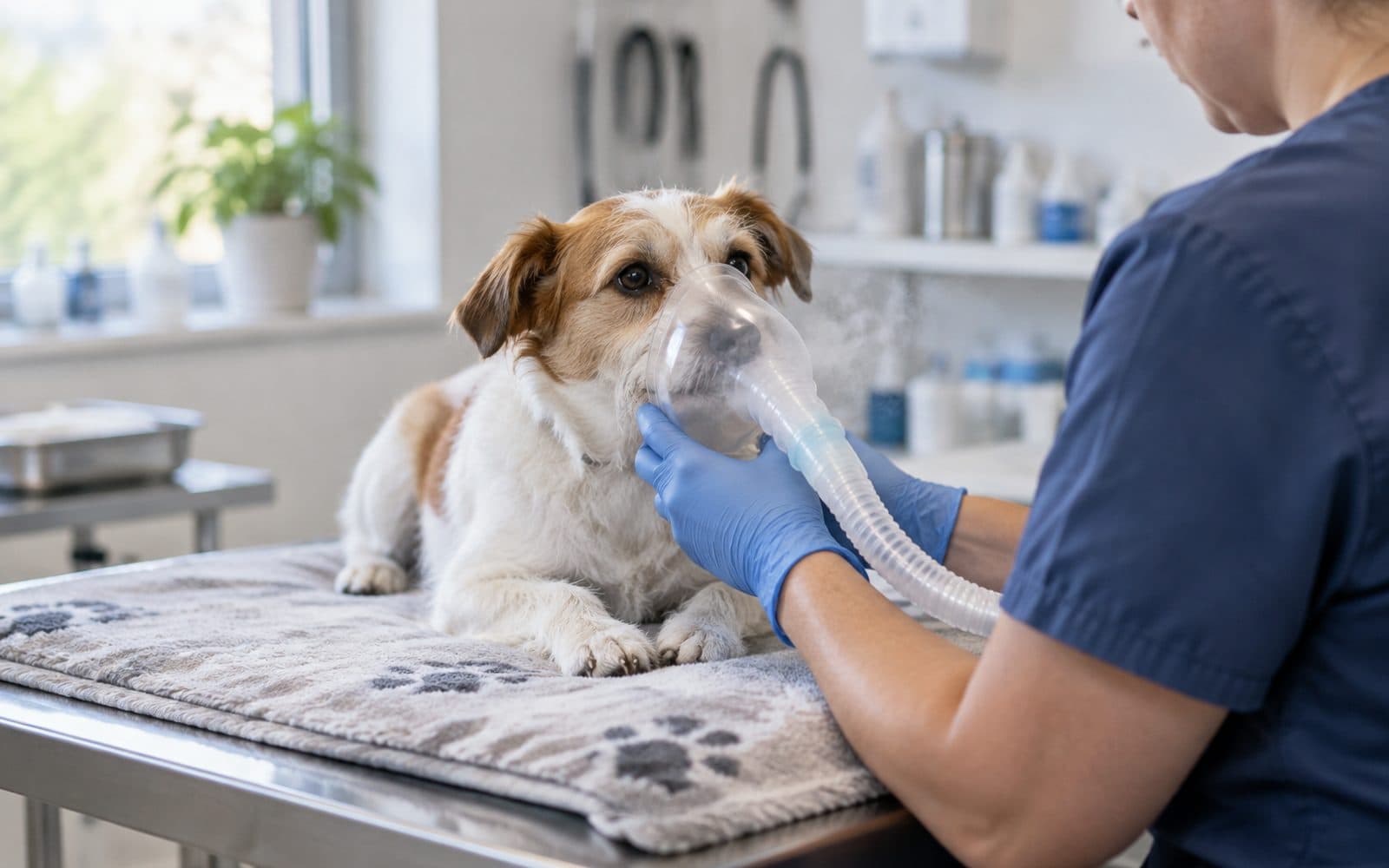
A nebulizer is an aerosol generator. It does not create oxygen and it does not ventilate the patient; it only converts a liquid into breathable droplets. In veterinary practice it is used for dogs, cats, small mammals and horses with airway conditions where a veterinarian wants moisture or a drug delivered to the respiratory tract, for example to loosen thick secretions or to treat inflamed airways. The same device can be used with a face mask held over the muzzle, with a mask fixed by a strap, or connected to a clear box or cage so that the animal breathes the mist without anything touching its face.
Veterinary units differ from home devices mainly in the masks and accessories supplied for different head shapes and sizes, and in being built for repeated daily use in a clinic. The nebulizing principle is the same.
How does a compressor nebulizer work?
A compressor nebulizer has three parts: the compressor, the nebulizer cup (also called the medicine cup or atomizer) and the patient interface. The process runs in four steps:
- The compressor draws in room air through a filter and pressurises it. The HQS HV-N2, for example, produces an output pressure of 60–130 kPa with a free flow of at least 4.5 L/min.
- The pressurised air leaves through a small jet at the bottom of the cup. Its speed creates low pressure around the jet (the Venturi effect), which draws the liquid up a feed tube.
- The liquid is torn into droplets as it meets the air stream and hits a baffle inside the cup. Large droplets fall back into the reservoir and only the fine ones leave with the air.
- The mist flows through the tubing to the mask or chamber, where the animal inhales it with normal breathing.
Droplet size decides where the medication lands. Droplets in the range of a few micrometres can travel past the nose and upper airway into the bronchi, while much larger droplets mostly deposit in the nose and throat. Manufacturers state droplet size as mass median diameter (MMD).
Types of nebulizers used in veterinary practice
Three technologies are common. Which one a clinic chooses depends on the drugs it uses, how often the device runs and whether it needs to be portable.
| Type | How it makes mist | Typical strengths | Points to check |
|---|---|---|---|
| Compressor (jet) nebulizer | Compressed air through a jet nozzle | Works with most solutions and suspensions; robust; simple to clean | Compressor noise; needs mains power unless a battery version is used |
| Ultrasonic nebulizer | A vibrating crystal shakes the liquid into mist | Quiet; high output | Can warm the liquid; not suitable for every drug or suspension |
| Vibrating mesh nebulizer | Liquid pushed through a mesh with very fine holes | Small, quiet, low residual volume, often battery powered | Mesh needs careful cleaning; replacement parts cost |
Separately from the generator, clinics choose the interface: a mask for cooperative patients and short sessions, or a nebulization chamber for cats, small dogs and patients that resist a mask. Some ICU incubators, such as the H-1805 pet ICU incubator, have a connection for an external nebulizer so mist can be given inside the cabinet.

Key specifications and what they mean
A nebulizer data sheet usually lists the values below. The figures in the right-hand column are those published for the HQS HV-N2 compressor nebulizer.
| Specification | What it tells you | HV-N2 |
|---|---|---|
| Mist particle size (MMD) | Median droplet size; smaller droplets reach deeper airways | 4 µm ±25% |
| Maximum atomization rate | How fast liquid is turned into mist; sets session length | 0.2 mL/min |
| Residual volume | Liquid left in the cup that cannot be nebulized | ≤1.0 mL |
| Output pressure | Pressure delivered by the compressor to the jet | 60–130 kPa |
| Compressor free flow | Air volume the pump moves without load | ≥4.5 L/min |
| Noise | Matters for anxious animals and shared wards | ≤60 dB(A) |
| Power and weight | Mains supply and how easy it is to move | AC 220 V 50 Hz, ≤100 W; about 1,250 g |
The atomization rate lets you estimate session time: at 0.2 mL/min, about 2 mL of liquid in the cup is nebulized in roughly 10 minutes, plus the residual volume that stays behind.
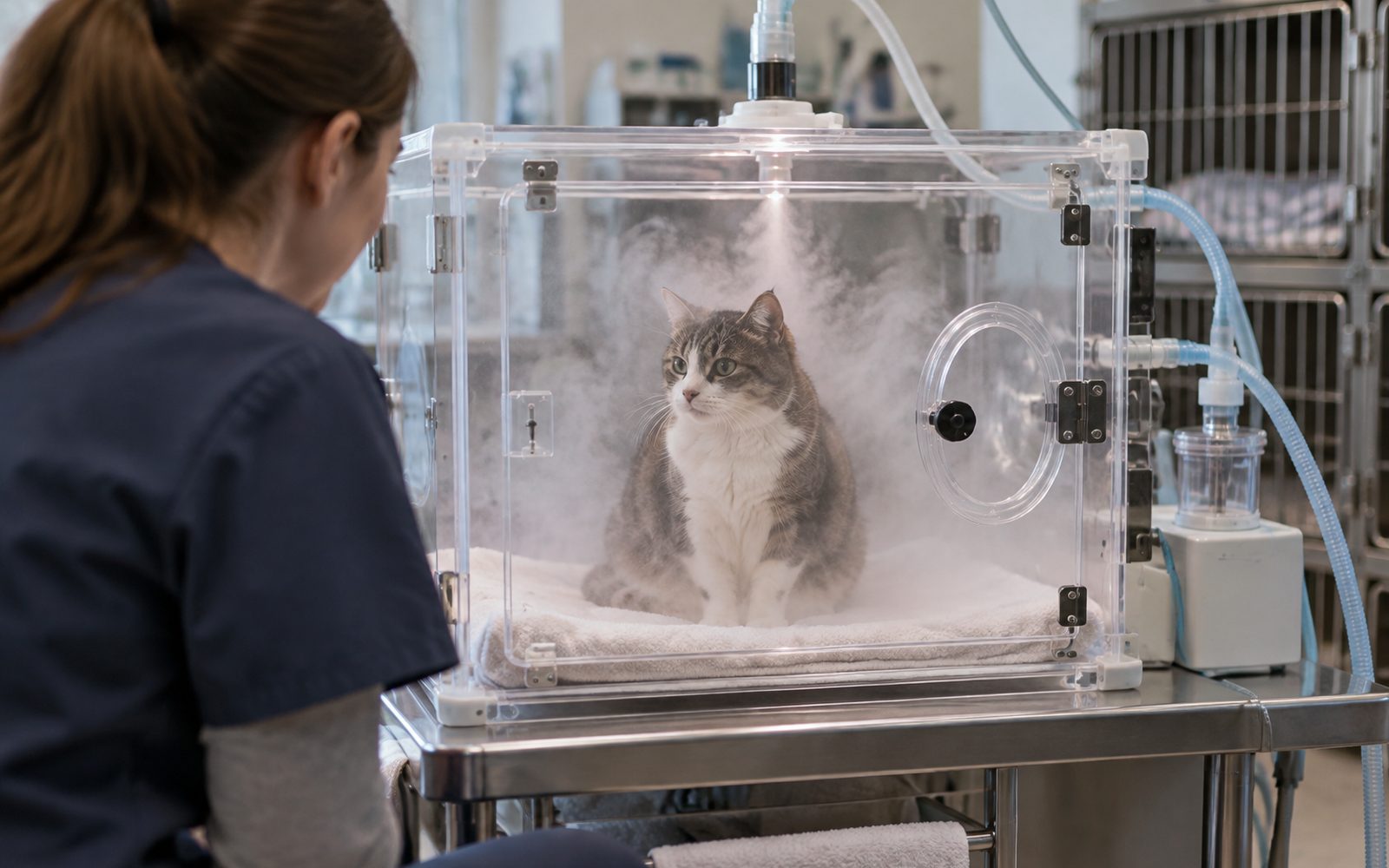
How nebulization is done in dogs and cats
The solution, volume, frequency and duration of nebulization are prescribed by the treating veterinarian. Sterile isotonic saline is commonly used on its own to humidify the airways; any medication added to the cup should be one the veterinarian has chosen for nebulized use. A typical workflow looks like this:
- Fill the cup with the prescribed volume and check the tubing, filter and mask or chamber connection.
- Choose the interface: a well-fitting mask for calm dogs, or a closed chamber for cats and small or stressed patients.
- Run the session while watching the patient's breathing and comfort, and stop if the animal struggles or shows signs of distress.
- Wipe moisture from the face and fur after a mask session.
Nebulization is often combined with other respiratory support. Oxygen comes from a separate source, such as an oxygen concentrator; the nebulizer itself does not raise the oxygen level of the inhaled air.
Cleaning and maintenance
Because the cup and tubing stay moist, they need cleaning after every patient to prevent contamination:
- Empty the cup, rinse the cup and mask with clean water and let them air-dry; disinfect according to the manufacturer's instructions.
- Use a separate mask or a disinfected chamber for each patient.
- Check and replace the compressor's air filter at the interval given in the manual.
- Keep the compressor dry and away from flammable anaesthetic gases. The HV-N2 data sheet states that it must not be used in the presence of flammable anaesthetic gas mixtures.
HQS HV-N2 veterinary nebulizer
The HV-N2 veterinary nebulizer is a compressor nebulizer made by HQS Medical. It uses an oil-free lubricated pump, produces mist with a median particle size of 4 µm ±25% at up to 0.2 mL/min, and measures 15 × 15 × 9 cm. It runs on AC 220 V, 50 Hz and operates at 5–40 °C and 30–80% relative humidity. For a comparison of nebulizer setups for equine and small animal clinics, see the guide to professional veterinary nebulizers.
FAQ
What is saline nebulization used for in cats and dogs?
Nebulized sterile saline adds moisture to the airways, which can help loosen thick secretions so the animal can clear them more easily. Whether and how often to nebulize is a decision for the treating veterinarian.
Can a human nebulizer be used on animals?
The principle is the same, but veterinary units come with masks and accessories sized for animal muzzles and are built for frequent clinic use. A mask that does not seal around the muzzle wastes most of the mist.
How long does a nebulization session take?
It depends on the volume in the cup and the device's atomization rate. At 0.2 mL/min, 2 mL takes roughly 10 minutes. The prescribed volume and number of sessions come from the veterinarian.
Is a nebulizer the same as an oxygen chamber?
No. A nebulizer turns liquid into mist; an oxygen chamber or ICU incubator controls the oxygen level and environment around the patient. They are often used together, with the nebulizer connected to the chamber.
Who makes the HV-N2 nebulizer?
The HV-N2 is made by HQS Medical, a veterinary equipment manufacturer based in Jinhua, Zhejiang, China, which supplies distributors and veterinary clinics directly.