A laboratory centrifuge is a machine that spins sample tubes at high speed so that the components of a liquid separate by density. In a veterinary clinic it is mainly used on blood: spinning a tube of whole blood pushes the heavier red cells to the bottom and leaves clear serum or plasma on top, ready for biochemistry tests, while spinning a thin capillary tube gives the packed cell volume (PCV, also called haematocrit). The same machine is used for urine sediment and other fluids. How well a centrifuge separates a sample depends on the relative centrifugal force (RCF, written as × g), which comes from both the speed in revolutions per minute (RPM) and the radius of the rotor.
What is a centrifuge used for in a veterinary clinic?
Most in-house laboratory work starts with separation. Typical uses are:
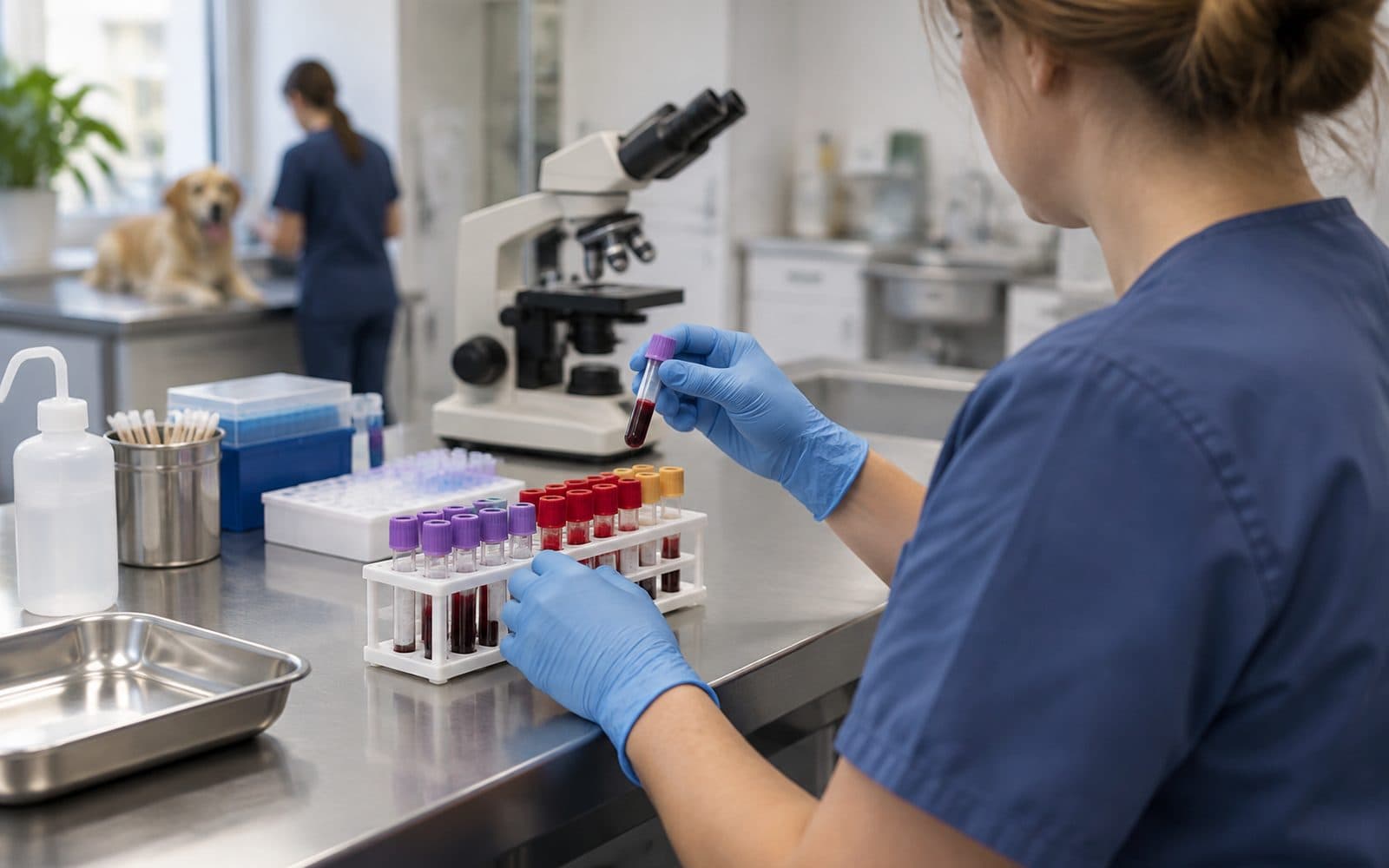
- Serum and plasma for biochemistry: chemistry analysers need cell-free serum or plasma, so blood tubes are spun after collection (serum tubes after clotting).
- Packed cell volume (PCV): blood in a narrow capillary tube is spun in a haematocrit centrifuge, and the height of the red cell column is read against the total, giving the percentage of red cells. The buffy coat and the colour of the plasma above it are also checked.
- Urine sediment: spinning urine concentrates cells, crystals and casts at the bottom of the tube for examination under a microscope.
- Other fluids and preparations: body cavity fluids, faecal flotation in some methods, and small-volume preparations in microtubes.
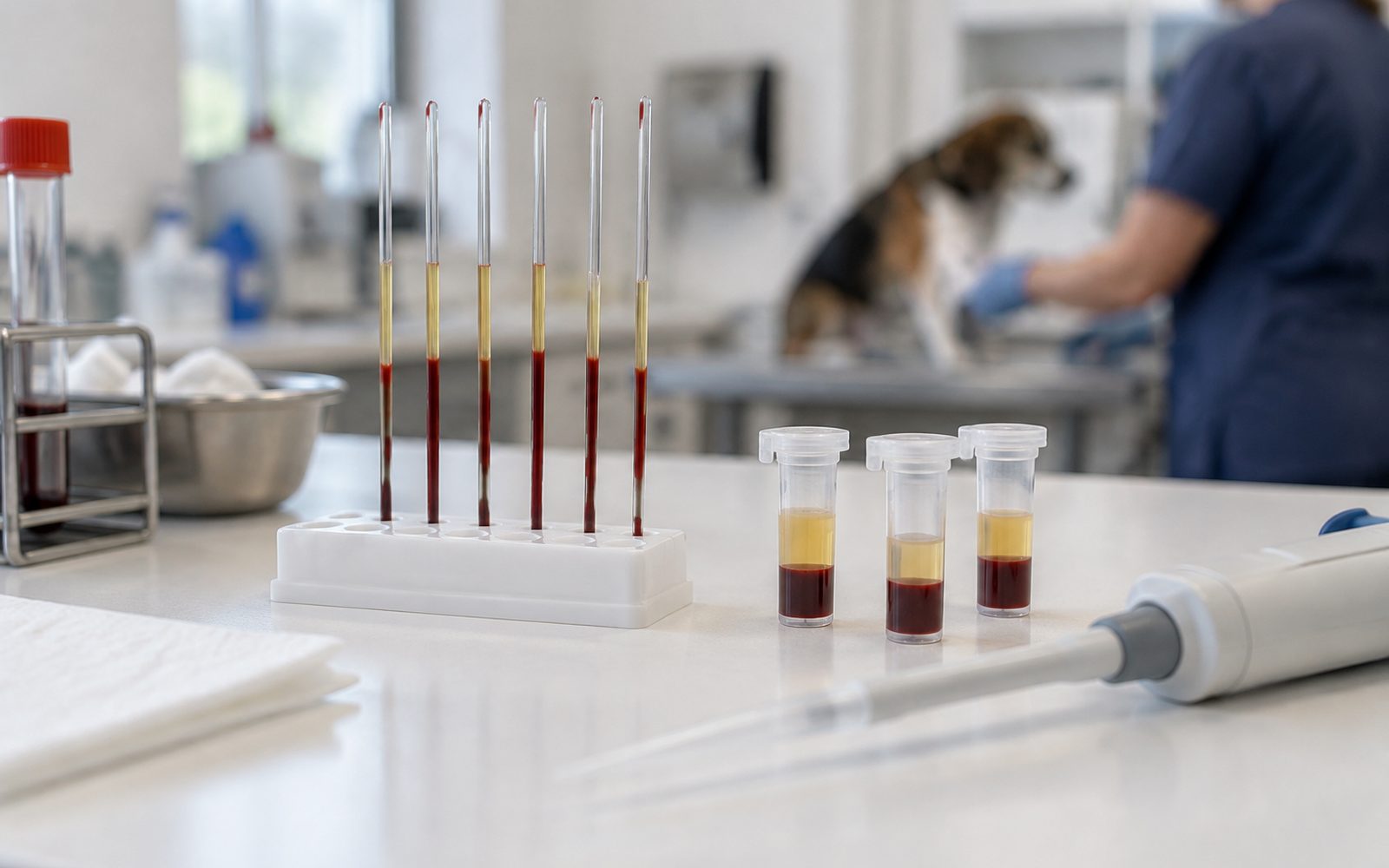
How does a centrifuge work?
When a tube spins around a central axis, every particle in it is pushed outward with a force many times stronger than gravity. Denser particles, such as red blood cells, move outward faster than lighter ones and collect at the bottom of the tube (the end farthest from the axis). Lighter liquid stays above. After the run, the layers stay separate long enough to take off the serum or read the PCV.
A centrifuge has four main parts: an electric motor, a rotor that holds the tubes, a lid with a safety lock, and a controller for speed and time. Modern units use brushless motors, which run quietly and need little maintenance, and they stop automatically and stay locked until the rotor has stopped.
RPM vs RCF: why × g matters more than speed
RPM is how fast the rotor turns. RCF is the force the sample actually experiences, and it grows with the square of the speed and in direct proportion to the radius:
RCF (× g) = 1.118 × 10⁻⁵ × r × RPM², where r is the rotor radius in centimetres.
For example, a tube at a radius of 10 cm spun at 4,000 RPM experiences about 1,790 × g. The same speed on a smaller rotor gives less force. That is why test kit and analyser instructions are best followed in × g, and why the maximum RCF on a data sheet is more useful than the maximum RPM when comparing centrifuges.
Types of centrifuges and rotors
| Type | Rotor | Typical veterinary use |
|---|---|---|
| Benchtop clinical centrifuge | Fixed-angle rotor for blood tubes | Serum and plasma separation, urine sediment |
| Low-speed centrifuge with swing-out rotor | Buckets swing horizontal during the run | Larger tubes, clear horizontal separation lines, plasma and serum work |
| Haematocrit (microhaematocrit) centrifuge | Flat rotor for capillary tubes | PCV measurement |
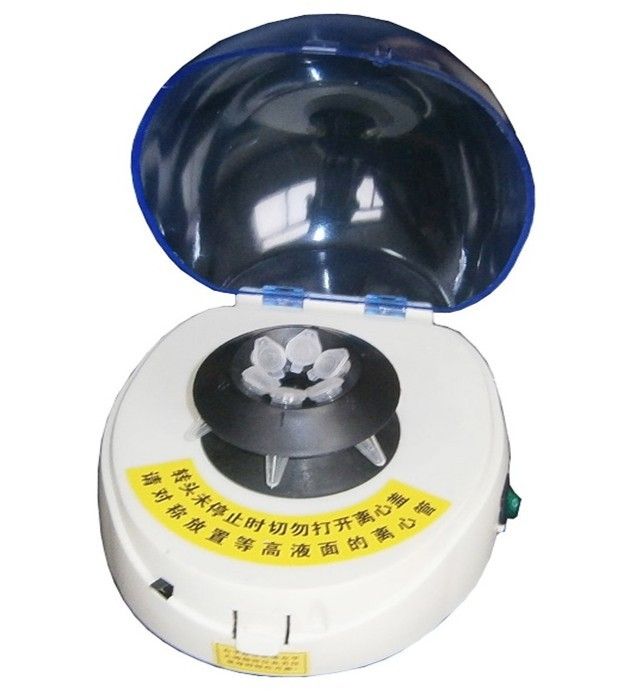
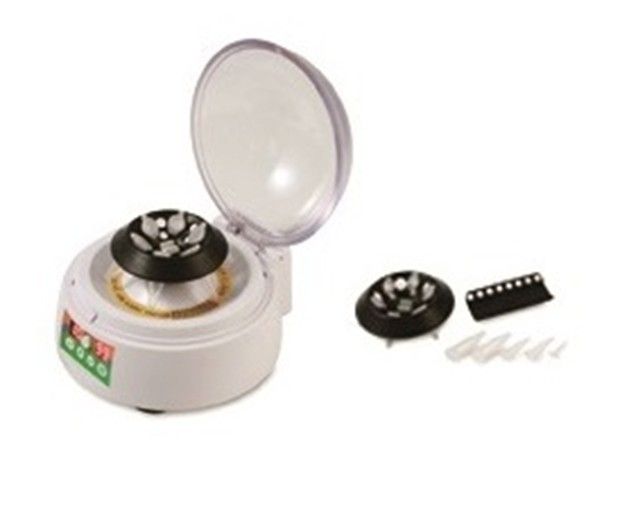
| Mini centrifuge | Small rotor for microtubes and PCR strips | Spinning down small volumes, quick preparations |
| Refrigerated centrifuge | Several interchangeable rotors, cooled chamber | Temperature-sensitive samples, research and reference labs |
In a fixed-angle rotor the tubes are held at a set angle, which gives fast pelleting. In a swing-out rotor the buckets swing out to horizontal, so the layers form flat across the tube, which makes it easier to remove serum or plasma cleanly. Refrigeration matters when samples must not warm up during long or high-speed runs, because friction heats the chamber.
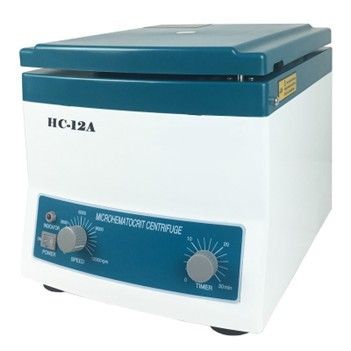
Specifications compared: HQS centrifuge range
| Model | Type | Max speed | Max RCF | Capacity |
|---|---|---|---|---|
| 80-2A | Benchtop clinical | 4,000 r/min | 2,325 × g | 20 mL × 12 |
| TDL-6C | Low speed, swing-out | 6,000 RPM | 4,470 × g | 100 mL × 4 |
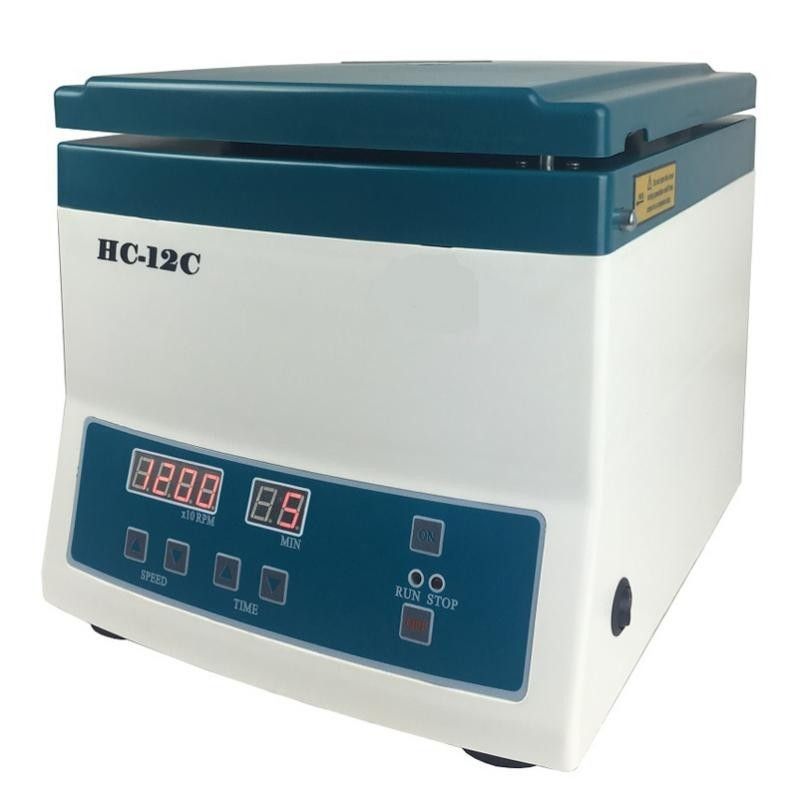
| HC-12A | Haematocrit | 12,000 RPM | 15,300 × g | 24 capillary tubes (Ø1.5 × 75 mm) |
| MCKS-1000 / 1200 | Compact microtube | 10,000 / 12,000 RPM | 5,500 / 7,900 × g | 1.5/0.5/0.2 mL × 6 and 0.2 mL × 8 × 2 PCR tubes |
| MC-04 / 07 / 12 | Mini | 4,000 / 7,000 / 12,000 rpm | Not listed | 0.2–2 mL × 6; 0.2 mL × 16 |
| LC-05F | Refrigerated, low speed | 5,000 RPM | 4,390 × g | 250 mL × 4 swing rotor; −5 to +30 °C |
| HC-16F | Refrigerated, high speed | 16,000 RPM | 17,800 × g | 8 rotors, 0.5–100 mL tubes and microplates; −20 to +40 °C |
For a general practice, a benchtop clinical centrifuge for blood tubes plus a haematocrit centrifuge covers most daily work. Refrigerated models are mainly for laboratories that process temperature-sensitive samples or large volumes. A buying-focused comparison is in the veterinary centrifuge guide: RPM, PCV testing and choosing the right model.
How to use a centrifuge safely
- Balance the rotor. Place tubes of equal weight opposite each other; fill a blank tube with water to balance an odd number. An unbalanced rotor vibrates, can damage the motor and may break tubes. Models such as the TDL-6C have an imbalance alarm.
- Close tubes and use the lid. Capped tubes prevent aerosols. The lid lock should stop the run when the lid is opened; never try to open the lid or slow the rotor by hand.
- Use the right speed and time. Follow the tube, test kit or analyser instructions, ideally stated in × g. Too much force or time can damage cells and affect some results.
- Use compatible tubes. Each rotor has a maximum tube size and rated force; glass tubes and capillaries should be in good condition.
- Clean spills promptly. Disinfect the chamber and rotor after any broken tube, following the manufacturer's instructions.
FAQ
What does a centrifuge do to blood?
It separates blood by density. Red cells collect at the bottom, a thin buffy coat of white cells and platelets forms above them, and serum or plasma sits on top.
What is the difference between serum and plasma?
Plasma is the liquid part of blood taken in a tube with anticoagulant, so it still contains clotting factors. Serum is the liquid left after blood has clotted in a plain or clot-activator tube and been spun.
Do I need a separate centrifuge for PCV?
PCV uses capillary tubes, which need a haematocrit rotor and a high RCF. Some clinics use a dedicated haematocrit centrifuge such as the HC-12A, which comes with a reader; others use a combination rotor if their model offers one.
How do I convert RPM to × g?
Use RCF = 1.118 × 10⁻⁵ × r × RPM², with the rotor radius r in centimetres. The radius is usually listed in the centrifuge manual.
Who makes these centrifuges?
The models above are supplied by HQS Medical, a veterinary equipment manufacturer based in Jinhua, Zhejiang, China, which supplies distributors and veterinary clinics directly.