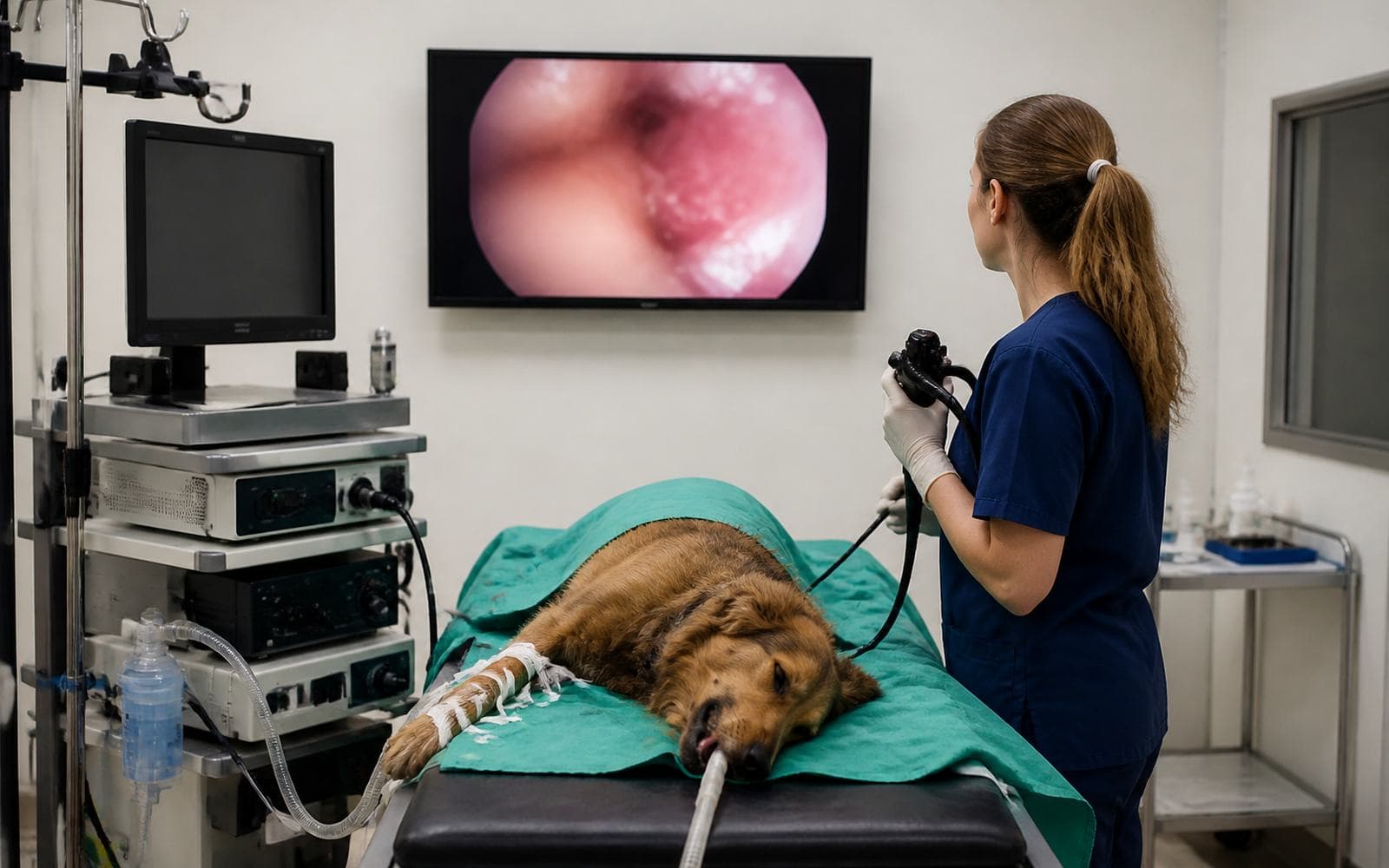
Choose a veterinary video endoscope by the patient first: the insertion tube must be thin enough for the smallest animal you scope, long enough to reach the target in the largest, and the working channel must pass the biopsy forceps you plan to use. For small dogs, cats and exotic pets that means an insertion tube of roughly 6 to 9 mm; for cattle and horses it means a 12.8 mm tube and 3 m of working length. This guide explains how diameter, length, channel size and the video tower change what you can do, and compares the FEC-800, FEC-8800, FEC-8600, FEC-400D and FEC-6000B flexible video endoscopes.
How do you match an endoscope to the animal?
Three dimensions decide whether a scope is usable on a given patient: the outer diameter of the insertion tube, the working length, and the working channel inside it. A thicker tube carries a larger channel and usually a brighter image, but it will not pass through a small esophagus or pylorus. A longer tube reaches further, but it is harder to handle in a small animal and needs more space in the room.
| Patient group | Insertion tube to look for | Working length to look for | Channel to check |
|---|---|---|---|
| Cats and small dogs | Slim tube, around 6.5 to 8 mm | 1,200 to 1,500 mm | 2.0 mm, for small biopsy forceps |
| Medium and large dogs | 8 mm class | 1,500 mm or more | 2.0 to 2.2 mm |
| Cattle and horses | 12.8 mm class | 3,000 mm | 3.2 mm |
| Airway and urinary work in small patients | 2.8 to 3.6 mm | 600 mm | 1.0 mm |
These are selection ranges, not rules. Species, breed, body weight and the organ being examined all change the choice, and the scope you pick should match the instruments you already own.
Flexible or rigid endoscope: which one fits the procedure?
A flexible endoscope bends at the tip and follows the lumen, so it suits the esophagus, stomach, duodenum, colon, airways and urinary tract. A rigid endoscope is a straight telescope used through a port, so it suits laparoscopy, arthroscopy and similar work where the surgeon creates the access. The two are not alternatives for the same job.
The REC-4000 laparoscope system is the rigid example in this range. It combines a Full HD 1080P video processor and a 100 W LED cold light source in one unit, with an electrosurgical unit, CO2 insufflator, suction pump, irrigation pump and LCD monitor listed as parts of the system. Its illuminance is listed as 3,000,000 lux or more at a colour temperature of 5700 K or higher. If your plan is diagnostic endoscopy of the digestive or airway tract, start with the flexible scopes below.
What do working channel and bending angle change?
Working channel
The channel is the lumen that carries biopsy forceps, grasping instruments, and the air, water and suction paths. A 1.0 mm clamp aperture, as on the slim airway and urinary scopes, limits you to the smallest forceps. A 2.0 to 2.2 mm channel covers standard small-animal biopsy forceps, and a 3.2 mm channel is the large-animal class.
Tip deflection
Bending range decides how easily you can retroflex in the stomach or turn a bend in the colon. The FEC-800 lists up 180°, down 90° and left / right 100°. The FEC-8800 lists up 210° or more, with the same down and left / right values. The FEC-400D lists up 210° or more with a maximum of 230°, and the FEC-6000B lists up 180°, down 90° and left / right 100°.
Field of view and depth of field
All five gastroscope models list a field of view of 140° and a depth of field of 3 to 100 mm, so close inspection of the mucosa and a wider overview are both possible without changing scope.
What does the video tower need to include?
The scope is only part of the system. For a stomach or colon examination you also need a light source, an air pump to insufflate the lumen, suction, a display, and a way to record images. The two small-animal towers listed here are the FEC-8800 and FEC-8600 set-ups, which share an REC-3000 processor and light source with an air pump and a USB disk for pictures and video. They list an 80 W white LED lamp, 0 to 10 brightness levels, a 30 to 60 kPa air pump with three power levels and 4 to 10 L/min flow, a suction vessel of at least 1 L and a maximum suction volume of 20 L/min, plus HDMI x2 and DVI video outputs and a 24-inch monitor.
The portable USB models work differently. The FEC-800 and FEC-6000B connect to a laptop that displays and records the image, with a separate cold light source and a portable air pump. Their light source is listed at 15 V / 150 W halogen, 220 to 240 V, 70,000 lx and a colour temperature of 3000 to 7000 K. A trolley is available as an option on the FEC-800 and FEC-6000B. Decide early whether you want a tower with recording built in or a portable kit that travels between sites.
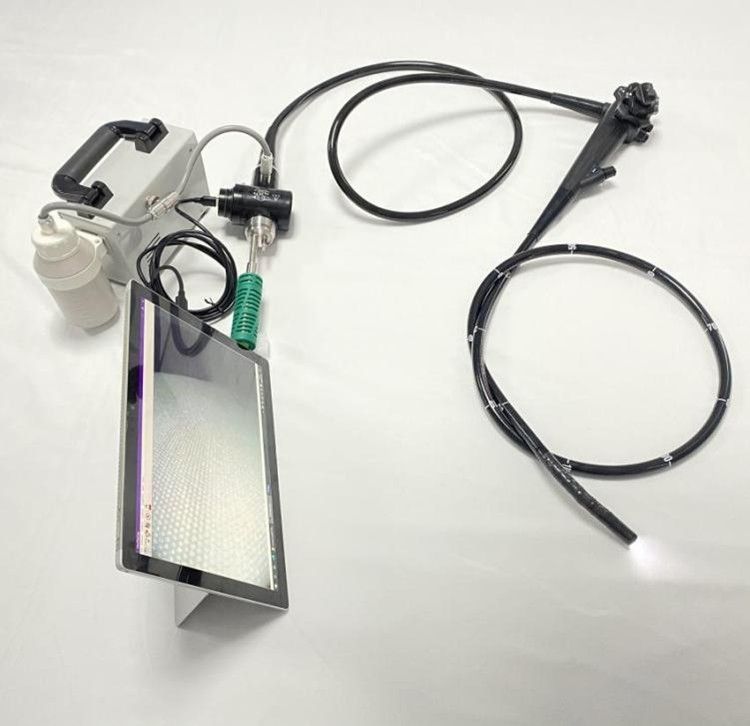
HQS flexible video endoscopes compared
| Feature | FEC-800 | FEC-8800 | FEC-8600 | FEC-400D | FEC-6000B |
|---|---|---|---|---|---|
| Insertion tube / distal end | 8.0 mm | 8.0 mm or less | 6.5 mm or less | 12.8 mm or less | 12.8 mm |
| Working channel | 2.2 mm | 2.0 mm or more | 2.0 mm or more | 3.2 mm or more | 3.2 mm |
| Working length | 1,500 mm | 1,500 mm or more | 1,200 mm or more | 3,000 mm or more | 3,000 mm |
| Total length | 1,800 mm | 1,800 mm or more | 1,500 mm or more | 3,300 mm or more | Not listed |
| Field of view / depth | 140° / 3 to 100 mm | 140° or more / 3 to 100 mm | 140° or more / 3 to 100 mm | 140° or more / 3 to 100 mm | 140° / 3 to 100 mm |
| Image sensor | CMOS, 1,000,000 pixels | CMOS, 1,000,000 pixels or more | CMOS, 1,000,000 pixels or more | CCD, 480,000 pixels or more | CMOS, 1,000,000 pixels |
| Tip deflection | Up 180°, down 90°, L/R 100° | Up 210° or more, down 90° or more, L/R 100° or more | Up 180° or more, down 90° or more, L/R 100° or more | Up 210° or more, down 90° or more, L/R 100° or more | Up 180°, down 90°, L/R 100° |
| Display and light | Laptop; separate cold light source (option) | REC-3000 tower, 24-inch monitor | REC-3000 tower, 24-inch monitor | 19-inch LCD monitor; REC-3000 listed | Computer display; separate light source (option) |
For slim airway and urinary work, the FEC-12CA / FEC-12CB portable nasopharyngoscope and bronchoscope lists insertion tubes of 2.8 mm and 3.6 mm, a 1.0 mm clamp aperture, a 600 mm working length, a 120° field of view and a 3.5-inch display. The FEC-GBS3 video ureteroscope lists a 2.8 mm tube, 1.0 mm clamp aperture, 600 mm working length and 860 mm total length.
How should you clean and reprocess a flexible endoscope?
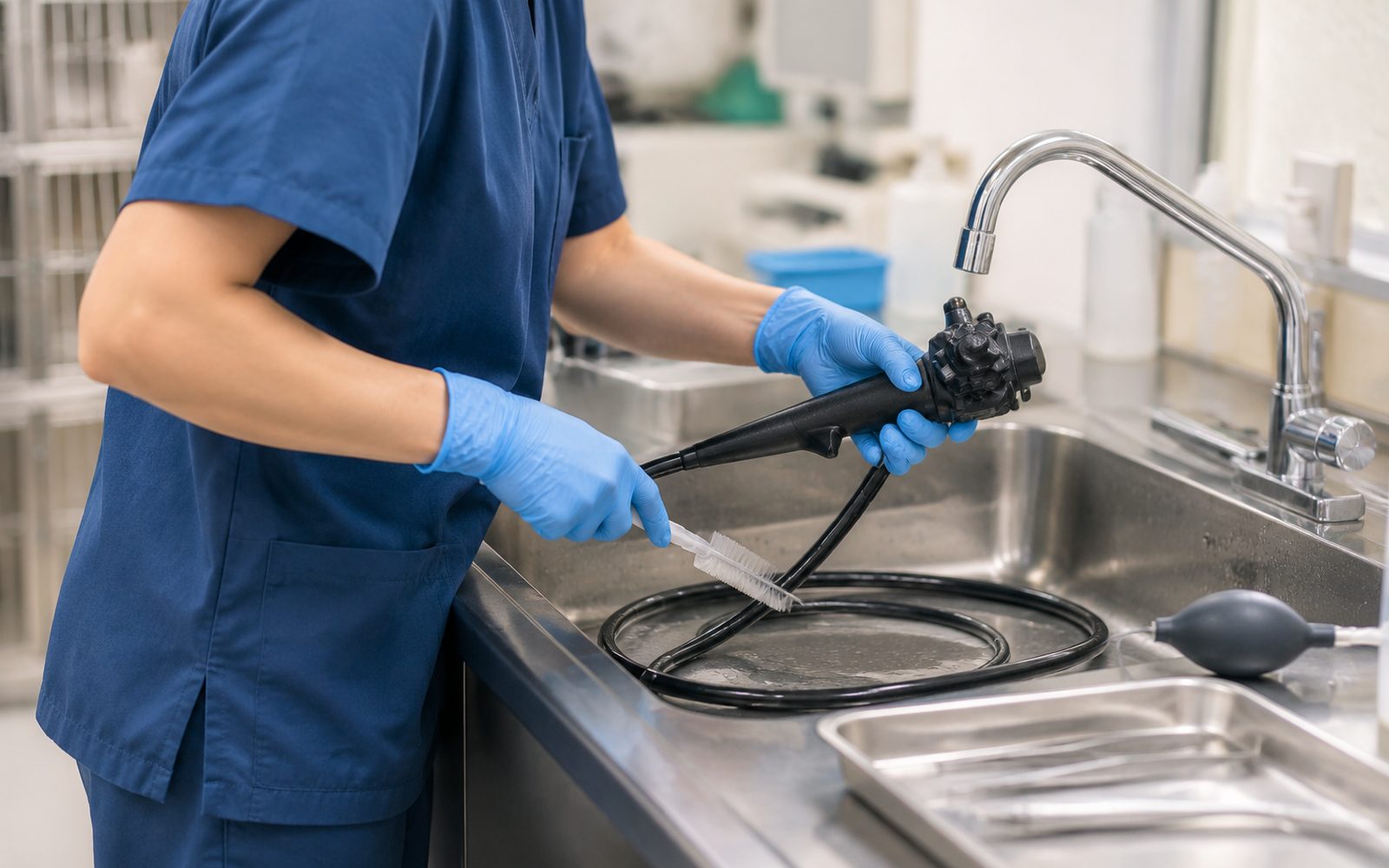
Reprocessing is part of the cost of ownership. After each case the scope is leak-tested, the channels are brushed and flushed, the valves are removed and cleaned, and the scope is disinfected and dried following the manufacturer's instructions for use. The standard kits listed for these models include a leak detector, cleaning brush, biopsy forceps, valve covers and an endoscope case, so ask which parts are in your configuration. A scope that fails the leak test must go out of service until it is repaired.
What should you confirm before ordering?
- The species and body-size range you will scope, matched to insertion tube diameter and working length.
- The smallest and largest instruments you need to pass, matched to channel size.
- Whether you want a recording tower, a laptop-based portable kit, or both.
- Which accessories are in the configuration and which are options, such as the monitor, trolley, laptop and cold light source.
- Mains voltage and frequency for the processor and light source.
- Reprocessing supplies and the cleaning procedure your team will follow.
Veterinary endoscope FAQ
Can one flexible endoscope cover both cats and large dogs?
An 8 mm class scope with a 2.0 to 2.2 mm channel and 1,500 mm working length is the usual compromise for small and medium patients. A very small cat or an exotic pet may need a slimmer tube, and a giant breed may need more length.
What is the difference between the FEC-800 and the FEC-8800?
Both list an 8 mm class tube and 1,500 mm working length. The FEC-800 is a portable USB kit that displays and records on a laptop, while the FEC-8800 is used with a REC-3000 processor and light-source tower, a suction device, a trolley and a 24-inch monitor.
Which models suit cattle and horses?
The FEC-400D and FEC-6000B list a 12.8 mm tube, a 3.2 mm channel and a working length of 3,000 mm, which is the large-animal class in this range.
Do I need a rigid endoscope as well?
Only if you plan laparoscopic or similar surgery. Diagnostic work in the digestive or airway tract uses flexible scopes, and rigid systems such as the REC-4000 are a separate purchase.
Does the system include a monitor?
It depends on the model. The tower configurations list a monitor, while the portable USB models use a laptop or computer display that is an option, so confirm this in the quote.