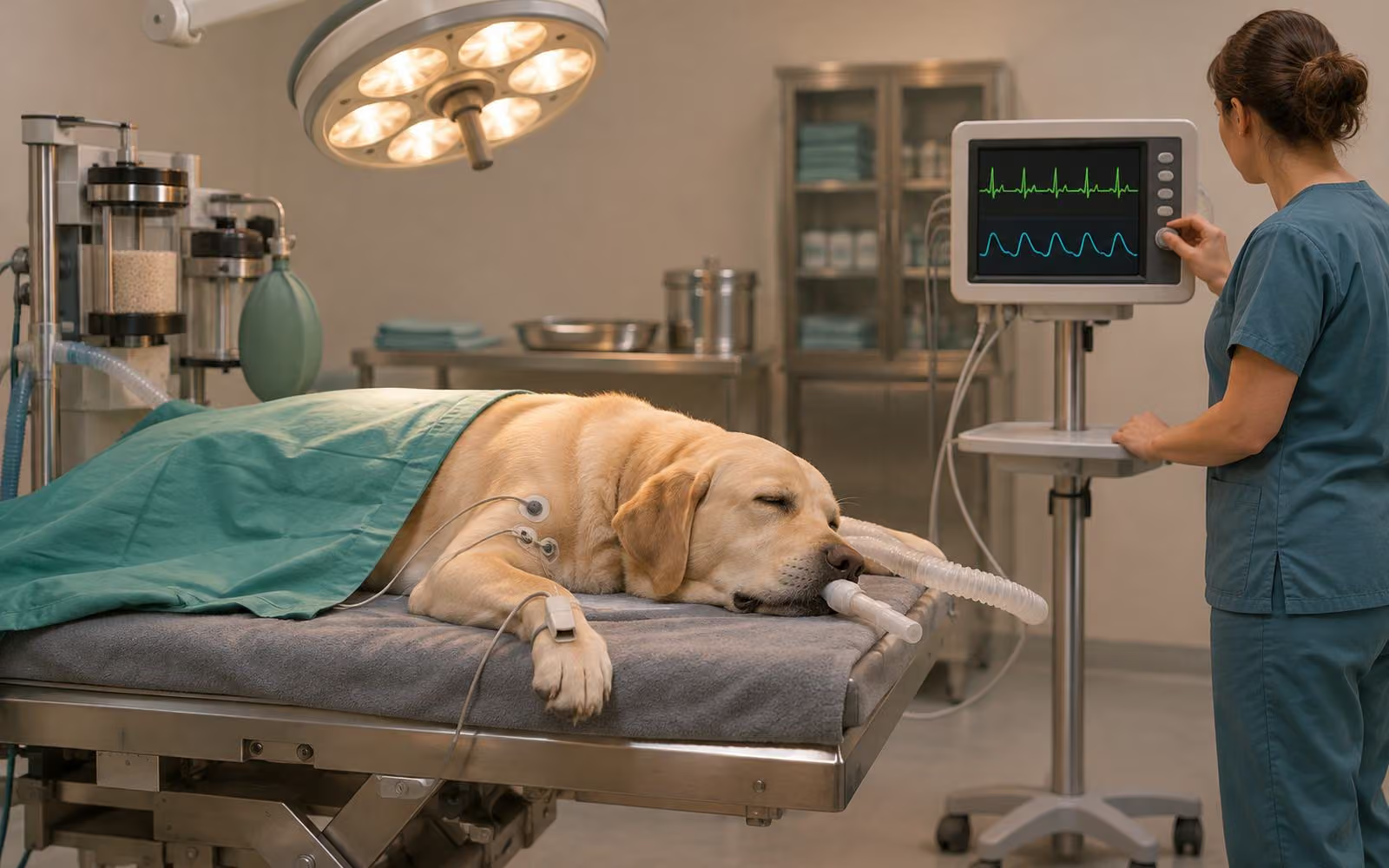
For surgery and ICU work, a veterinary multiparameter monitor should show ECG, SpO2, non-invasive blood pressure (NIBP), temperature and respiration at minimum, and add end-tidal CO2 (EtCO2) when the patient is intubated and ventilated. A compact monitor limited to SpO2, NIBP and temperature is enough for spot checks, recovery and neonates, but it cannot show cardiac rhythm. This guide explains what each parameter tells you, which ones your clinic needs for each job, and how the three HQS veterinary patient monitors differ.
Which parameters does a veterinary monitor need?
Each parameter answers a different question about the anesthetized or critically ill patient. No single sensor covers all of them, which is why a monitor is judged by its parameter set before its screen size.
- ECG: heart rate and rhythm. It is the only parameter that detects arrhythmias, and the one you read first when a patient deteriorates.
- SpO2 and pulse rate: oxygen saturation of hemoglobin from a probe on the tongue, ear, lip or paw. It shows how well the patient is being oxygenated.
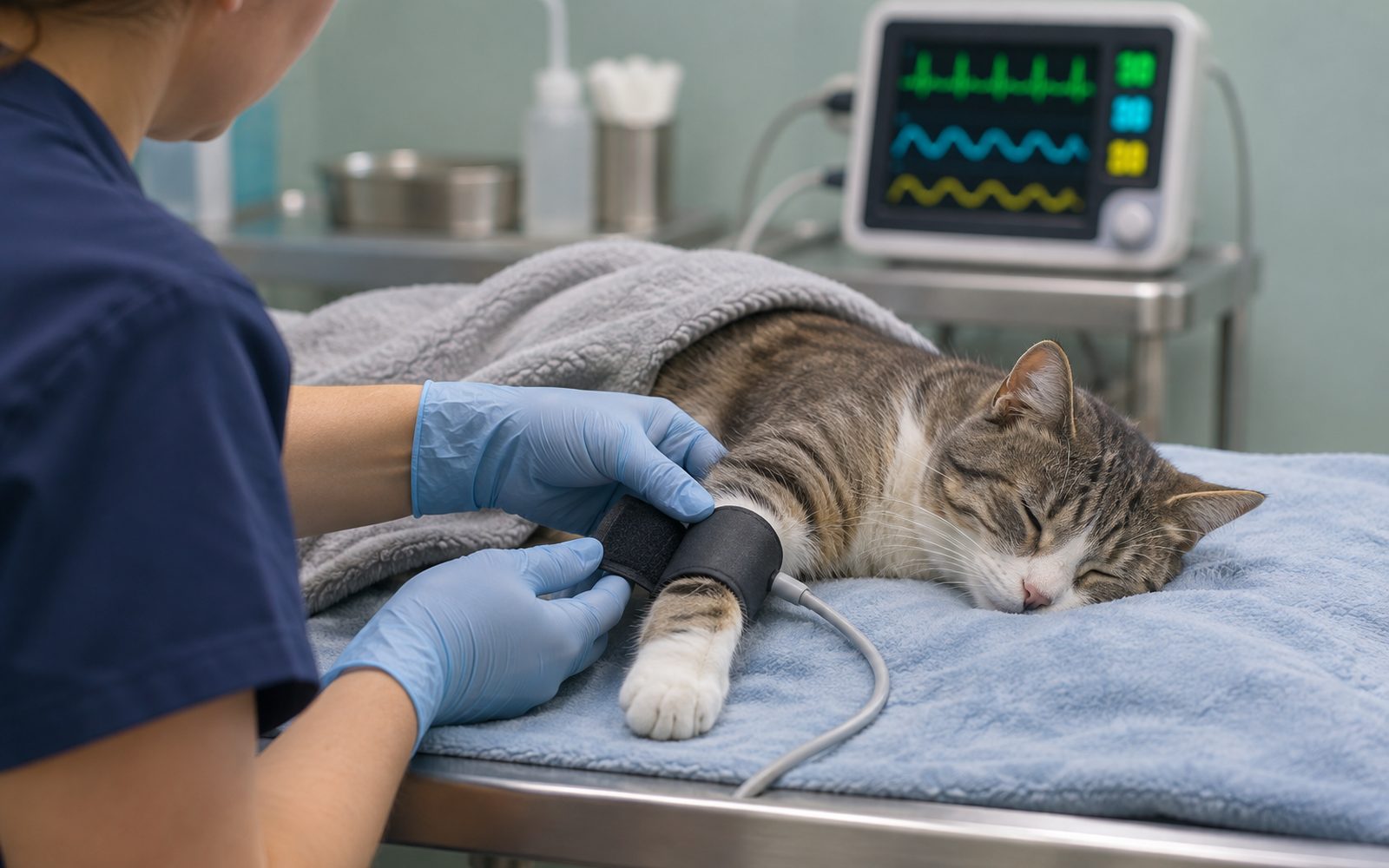
- NIBP: systolic, mean and diastolic pressure by oscillometric cuff, at set intervals. Falling pressure under anesthesia is a common warning sign.
- Temperature: anesthetized small animals lose heat quickly, so a core probe tells you when to start warming.
- Respiration rate: from the ECG leads or from the CO2 sampling line.
- EtCO2: the CO2 in exhaled gas, which confirms intubation, shows ventilation adequacy and gives an early signal of circulatory problems. It is usually an optional module or a separate unit.
Cuff size, probe placement and patient size affect every reading, so trends and the clinical picture matter more than any single number.
Which parameters for which job?
| Use | Minimum parameters | Add when possible |
|---|---|---|
| Routine anesthesia and surgery | ECG, SpO2, NIBP, temperature | Respiration, EtCO2 |
| ICU and critical care | ECG, SpO2, NIBP, temperature, respiration | EtCO2, central station |
| Recovery and post-op checks | SpO2, NIBP, temperature | ECG |
| Neonates, shock and field visits | SpO2, NIBP, temperature | Docking station for charging |
| Ventilated patients | ECG, SpO2, NIBP, EtCO2 | Respiration, temperature |
How to choose between a mini, mid-size and full-size monitor
Screen and footprint
A 3.5-inch handheld suits a pocket or a recovery cage, a 7-inch screen suits a surgical table, and a 12.1-inch screen suits an ICU wall or trolley where several people read waveforms from a distance. Bigger screens carry more waveforms and are easier to read across a room, but they weigh more and need a stand.
ECG leads and waveform channels
A five-lead ECG (RA, LA, RL, LL and V) lets you select leads I, II, III, V, aVF, aVL and aVR and show one or three waveform channels. Lead II is the usual choice for rhythm monitoring under anesthesia. A monitor with no ECG, such as the smallest unit here, cannot replace this.
Alarms and recording
Adjustable upper and lower alarm limits keep the alarm useful for different species. The larger monitor adds a three-level visual and audible alarm and a wide-angle alarm indicator that can be seen from across the room. Trend and stored data help with case notes and handovers.
Battery and power
Battery endurance matters when a patient is moved between the prep room, theatre and recovery. The mini monitor runs about 8 hours on its lithium-ion battery. The HM-200V and HM-500V run about 4.5 hours and take 3 hours to charge fully, with mains input of 100 to 240 V, 50 / 60 Hz.
Expansion
EtCO2, a recorder, a trolley, a brace and central station software are options on the HM-500V. The HM-200V lists CO2 as an optional module. Decide on EtCO2 before ordering, because retrofitting is easier when the option is part of the configuration.
HQS veterinary multiparameter monitors compared

| Feature | HM-3T | HM-200V | HM-500V |
|---|---|---|---|
| Parameters | SpO2, NIBP, temperature | ECG, respiration, SpO2, NIBP, temperature; CO2 optional | ECG, respiration, SpO2, NIBP, temperature; EtCO2 optional |
| Display | 3.5-inch colour TFT, 320 × 480 | 7-inch colour LCD | 12.1-inch TFT LCD |
| ECG | — | 5-lead, 1 or 3 channels, 20–350 bpm | 5-lead, 1 or 3 channels, 25–350 bpm |
| NIBP range (systolic) | 40–270 mmHg large animal; 40–200 mmHg small animal | 40–270 mmHg | 40–270 mmHg |
| NIBP measuring time | — | 30–50 s typical, 120 s maximum | 30–50 s typical, 180 s maximum |
| Temperature | 25–45 °C, 0.1 °C resolution | Two channels, 25–45 °C | Two channels, 0–50 °C |
| SpO2 / pulse rate | SpO2 0–100%; PR 0–500 bpm | SpO2 0–100%; PR 20–350 bpm | SpO2 0–100%; PR 25–350 bpm |
| Respiration | — | 0–120 rpm | 0–130 rpm |
| Power and battery | Lithium-ion, about 8 h | 100–240 V AC; about 4.5 h, 3 h charge | 100–240 V AC; about 4.5 h, 3 h charge |
| Size and weight | 146 × 67 × 30 mm; 250 g | 300 × 180 × 129 mm; 2.05 kg | 324 × 324 × 183 mm; 3.75 kg |
| Extras | 100 user IDs; docking station option | CO2 module option | EtCO2, recorder, trolley, brace, central station options |
In short, the HM-3T is a pocket-sized spot-check and recovery monitor with motion-tolerant SpO2 and a Perfusion Index readout, but no ECG. The HM-200V gives a surgical table the full five-parameter set on a 7-inch screen at about 2 kg. The HM-500V suits an ICU or a busy theatre that wants a large screen, a three-level alarm and the option of connecting to a central monitoring system.
Setting up a monitor for a surgical list
- Choose cuff width for the limb or tail and the patient's size before the first reading. A wrong cuff gives a wrong pressure.
- Attach ECG clips or pads and check that lead II gives a clean trace before induction.
- Place the SpO2 probe on the tongue, lip, ear or paw and watch the pulse waveform, not just the number.
- Insert the temperature probe and start warming early in small patients.
- Set alarm limits for the species and size, and test the alarm sound before the list starts.
- Plug the monitor into mains when possible so the battery is full for transport and recovery.
For a compact monitor workflow, see the guide on setting up a mini veterinary monitor. If you also plan for resuscitation, read whether your clinic needs a defibrillator.
FAQ
Which parameters are essential for veterinary anesthesia monitoring?
ECG, SpO2, NIBP and temperature, with respiration and EtCO2 where the budget and the patient justify them. ECG is the only one that shows rhythm, and EtCO2 is the one most helpful for ventilation.
Can a mini monitor replace a full multiparameter monitor in surgery?
Not when rhythm matters. The HM-3T measures SpO2, NIBP and temperature, so it suits recovery, neonates and spot checks, while surgery and ICU work call for ECG on the HM-200V or HM-500V.
What is the difference between the HM-200V and HM-500V?
Both give ECG, respiration, SpO2, NIBP and temperature with the same battery endurance. The HM-500V has a 12.1-inch screen, a three-level alarm, central station connection and more accessory options. The HM-200V is smaller and lighter at 2.05 kg.
Is EtCO2 included?
EtCO2 is optional on both the HM-200V and HM-500V. State it when you request a quotation so the configuration is correct from the start.
Can the monitors run on battery?
Yes. The HM-3T runs about 8 hours on a lithium-ion battery, and the HM-200V and HM-500V run about 4.5 hours after a 3-hour charge.
For specifications, configurations and quotations, see the HM-500V, HM-200V and HM-3T product pages. Warranty terms vary by model and order.